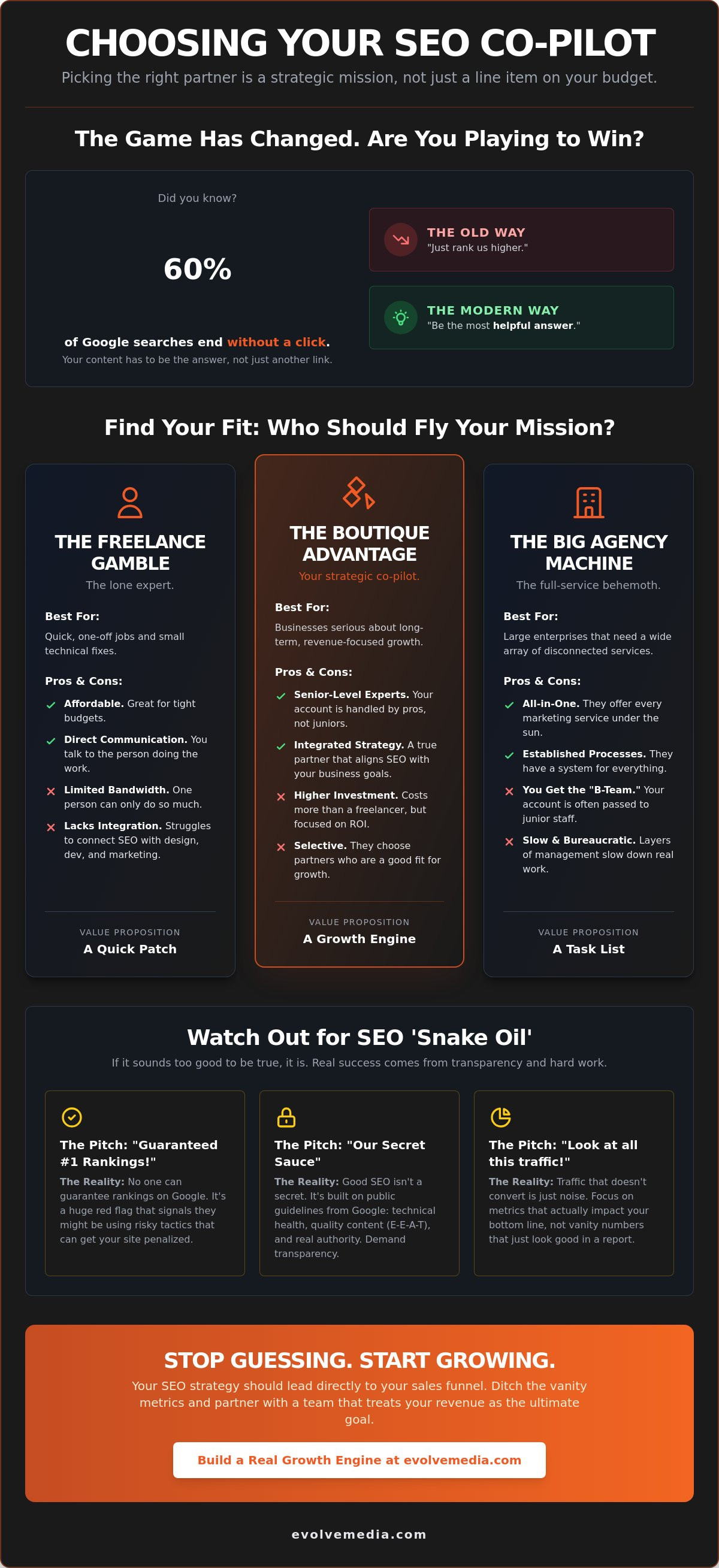
Why does hiring professional seo services often feel more like buying a lottery ticket than making a strategic business investment? With 60% of Google searches now ending without a single click, the old advice to “just rank higher” isn’t just dated; it’s potentially costing you a fortune. If you’ve ever stared at a colorful report full of ranking improvements while your sales team waits for the phone to ring, you aren’t alone.
It’s exhausting to pour budget into a black box of technical jargon only to see zero impact on your actual revenue.
We agree that the industry is loud, confusing, and frequently hides behind “secret” algorithms that don’t seem to help your bank account. You deserve a partner who treats your growth as a shared mission rather than a monthly task list. This article will teach you how to cut through the marketing noise and evaluate potential partners using real-world results and sound business logic. We’ll cover the red flags that signal a waste of your budget and show you exactly which metrics prove an agency is actually growing your bottom line.
Key Takeaways
- Stop looking for a “secret sauce” and start focusing on being the most helpful answer on the web. Modern SEO is about technical health and building real authority.
- Don’t let price be your only guide when picking professional seo services. A low-cost freelancer might save you money today, but a strategic partner builds the foundation for long-term revenue.
- Spot “snake oil” by watching out for guaranteed rankings or hidden tactics. Google’s guidelines are public; real success comes from hard work and transparency, not mysterious tricks.
- Measure what matters by ditching vanity metrics like total traffic in favor of conversions. Your SEO strategy should lead directly to your contact page and sales funnel to grow your bottom line.
What Do Professional SEO Services Actually Look Like in 2026?
Forget the idea of a “secret sauce” hidden in a dark room. In 2026, the best professional seo services focus on one thing: being the most helpful answer on the internet for your specific customers. It’s not about tricking a computer program; it’s about proving to both users and algorithms that you’re the most reliable resource in your field. When you hire professional seo services, you’re paying for a team to translate your business value into a language that search engines can verify and trust.
Professional SEO is a long-term growth engine that builds momentum over time, not a one-time fix you can set and forget. While the basics of Search engine optimization (SEO) have been around for decades, simply checking boxes on a generic list won’t help you beat competitors who are actually investing in their brand’s digital health. You need a strategy that evolves as fast as the search engines do.
To see how to spot the difference between a real strategy and a basic checklist, watch this quick audit guide:
The Technical Foundation: More Than Just Code
Your site’s technical foundation is your ticket to the game. If your pages take forever to load or look broken on a smartphone, users will bounce before they even read your first sentence. Following the March 2026 Core Update, Google now uses a holistic scoring system for Core Web Vitals like LCP, INP, and CLS. This means your web design and development must be built with performance in mind from day one. Technical health includes:
- Mobile-first logic: Ensuring the experience is perfect for the 92.3% of users on phones.
- Site speed: Reducing friction so users stay engaged.
- Structured data: Using schema so AI-driven search engines can easily quote your content.
Content That Converts: Beyond Keyword Stuffing
Writing for humans is the fastest way to rank for robots. Google’s current standards prioritize E-E-A-T, which stands for Experience, Expertise, Authoritativeness, and Trustworthiness. They want to see that a real person with actual knowledge wrote the content. A clear, 500-word “How-to” guide that solves a specific customer problem will always outperform a 2,000-word fluff piece that says nothing. In 2026, clarity is your best sales tool. If your content doesn’t answer the user’s question immediately, they’ll find someone who does.
Choosing Your Path: Freelancers vs. Big Agencies vs. Boutique Partners
Picking a partner isn’t like buying a commodity. It’s more like choosing a co-pilot for your business. When you start looking at professional seo services, the price tag is often the first thing you see. But the cheapest option can be the most expensive mistake you’ll ever make. You need to weigh the value of a “gig” against the power of a strategic partnership. According to experts at Forbes, choosing the right SEO agency requires looking beyond the sales pitch to see how they actually think about your business logic.
The gig economy approach works if you just need a few boxes checked. But if you want to grow your bottom line, you need a model that fits your revenue goals and long-term vision. Not every provider is equipped to handle the complexity of a growing brand.
The Freelance Gamble
Freelancers are often the go-to for small, one-off technical fixes. They’re affordable and you talk directly to the person doing the work. However, they usually have limited bandwidth. If your site needs an integrated strategy involving design, development, and marketing, a single person might struggle to keep up. It’s a gamble if you’re looking for consistent, scalable growth. They’re great for a quick patch, but they aren’t built to be your long-term advisory team.
The Boutique Agency Advantage
This is the sweet spot for businesses that want the expertise of a large firm without feeling like just another number in a spreadsheet. A boutique partner cares about your branding as much as your search rankings. They bring institutional knowledge to the table; some of these teams have been navigating the digital world since 1996. They’ve seen every algorithm update and know which trends are worth your time.
By offering integrated services like hosting and development, they prevent your site from breaking when new updates roll out. It’s about having a team that is deeply curious about your specific goals. If you’re tired of generic reports and want a partner who actually listens, it might be time to reach out for a more personal conversation. This model provides the calm confidence you need to focus on running your business while experts handle the technical heavy lifting.
Red Flags: How to Spot SEO ‘Snake Oil’ Before You Sign
Ever met an SEO “guru” who claims to have a direct line to Google’s headquarters? If an agency promises you the top spot by next Tuesday, they aren’t offering professional seo services; they’re selling a fantasy. Google’s algorithm changes thousands of times every year. No one outside of their campus has a magic key. Most “secret sauces” are just basic Search engine optimization (SEO) tactics wrapped in expensive words to justify a high monthly fee.
Watch out for agencies that lean heavily on fancy buzzwords to describe their work without showing you a clear workflow. Often, terms like “bespoke” or “seamless” are used to hide a lack of real process. If they can’t explain their steps in plain English, they probably don’t have a plan. You should also be wary of “proprietary reporting tools.” Many of these are designed to cherry-pick data and hide the metrics that actually matter to your bank account.
The ‘Guaranteed Rankings’ Trap
Ranking first for a keyword nobody searches for is easy. Ranking for terms that drive sales is hard work. If a partner guarantees a specific rank, they might be using “black hat” tricks that could get your site penalized or even banned. Instead of asking for a traffic report, ask for a Lead Quality report. You want to see how many people actually filled out a form or clicked your phone number. You need to know how many random bots visited your homepage versus how many real humans converted.
Communication Blackouts
You should never have to wait 30 days to hear from your team. A true partner doesn’t just say “we’re working on it.” They show you the specific A/B tests they ran this week or the headlines they tweaked to improve your click-through rate. In a real-world scenario, a reliable partner calls you the moment they see a sudden dip in your traffic. They don’t wait three weeks for a monthly meeting to tell you there was a problem. If you’re tired of the mystery and want a transparent partner, let’s talk about your specific goals. Transparency is the only way to build a strategy that actually grows your bottom line.
Making the Decision: Metrics That Actually Build Revenue
Traffic is a vanity metric. Conversions are a sanity metric. If your professional seo services provider bragged about a 50% increase in visitors last month, but your phone didn’t ring once, you’ve bought a very expensive paperweight. It’s easy to attract “window shoppers” who are just looking for free info. It’s much harder to attract 100 high-intent visitors who are ready to pull out a credit card. Quality always beats quantity in the search game.
Success starts by aligning your SEO goals with your contact page. Every piece of content should guide a user through your sales funnel with purpose. This is where your about us page becomes a secret weapon for building trust. In 2026, users check your background before they trust your advice. If that page looks like a generic template, you’re losing sales before the customer even sees your offer.
Lead Quality vs. Raw Traffic
You can’t pay your mortgage with clicks. To improve lead quality, tweak your headlines to speak directly to buyer pains rather than broad, generic topics. If you sell specialized software, don’t just target “software”; target “software for small business inventory management.” You should also track “Assisted Conversions” in your analytics. This shows how SEO introduced a customer to your brand, even if they finally bought through an email or a direct link later.
- Audit your top pages: Run a 3-day audit of your top-performing content to see if the traffic is actually relevant.
- Check the bounce rate: Are people leaving because the page is slow or because the content is irrelevant to their search?
- Verify the CTA: Ensure there is a clear, punchy next step on every single page.
The Integration Factor
SEO fails if your ecommerce development is clunky or confusing. You can get someone to the finish line, but if the checkout process is a nightmare, they’ll leave. Your website should be a digital asset that works as a 24/7 salesperson. This is why professional seo services must be integrated with your design and hosting. When your site is fast, secure, and easy to navigate, the search engines will reward you with better visibility.
Choose a partner who is as curious about your business as you are. They should ask about your profit margins, your best-selling products, and your biggest headaches. If they only talk about “backlinks” and “rankings,” they aren’t looking at your bottom line. Look for a team that treats your growth as their own success story.
Build a Strategy That Values Your Bottom Line
Finding a partner shouldn’t feel like a guessing game. By now, you’ve learned that real growth happens when you trade vanity metrics like raw traffic for sanity metrics like lead quality and sales. You know how to spot the red flags of “snake oil” promises and why a boutique approach often beats the impersonal nature of a massive agency. It’s about finding a team that cares as much about your brand identity as they do about your search rankings.
Since our founding in 1996, we’ve focused on a blend of web design, branding, and professional seo services that prioritize business logic over empty numbers. We don’t hide behind jargon or technical fluff. Instead, we focus on the results that actually show up in your bank account. You deserve a partner who acts as a propellant for your success rather than just another background vendor.
Ready to grow? Let’s chat about your strategy.
Your business has a unique story to tell. We’re here to make sure the right people find it and believe in it.
Common Questions About Growing Your Revenue with SEO
Is it worth paying for professional SEO services in 2026?
Yes, because organic search still drives 53.3% of all website traffic. In 2026, professional seo services are about more than just keywords; they make your brand “quotable” for AI-powered search results. Since 52% of sources cited in Google’s AI Overviews rank in the top 10 organic results, you can’t afford to be invisible. It’s the difference between being a cited authority and being left out of the conversation entirely.
How much should a small business spend on SEO monthly?
Industry data from early 2026 suggests local SEO typically ranges from $500 to $2,000 monthly, while national campaigns for growing businesses often fall between $2,500 and $10,000. Be careful with anyone charging under $500. At that price, an agency can only afford a few hours of work, which usually means they’re relying on low-value, automated tactics. Think of it as an investment in your digital storefront’s long-term visibility.
Can I do my own SEO with AI tools like ChatGPT?
You can use AI for brainstorming, but relying on it to run your entire strategy is a major risk. Google’s March 2026 Spam Update specifically targets scaled AI-generated content abuse. While tools help with research, they lack the real-world experience and expertise that search engines demand for high rankings. Use AI to speed up your workflow, but keep a human expert in the driver’s seat to ensure your brand stays authentic.
What happens if I stop paying for SEO services?
Your rankings won’t vanish overnight, but your growth will stall while your competitors keep moving forward. SEO is like maintaining a garden; if you stop watering, the weeds eventually take over. Technical issues like broken links or outdated schema will pile up, and you’ll miss out on new algorithm shifts. Without active professional seo services, your site slowly loses its authority and its eligibility for AI-driven answer engines.
How do I measure the ROI of my SEO partner?
Look past total traffic and focus on assisted conversions and lead quality. A good partner should show you how many people filled out a form or made a purchase after finding you through search. Since 60% of searches are now “zero-click,” you should also track brand mentions and citations in AI Overviews. If your revenue isn’t growing alongside your rankings, your strategy needs a serious pivot.
What is the difference between SEO and SEM?
Think of SEO as owning your home and SEM as renting a room. SEO focuses on organic growth through technical health and content, which typically takes 6 to 12 months to show a full return. SEM includes paid strategies like Google Ads to get immediate visibility. While SEM stops the moment you stop paying for ads, SEO builds a lasting digital asset that continues to bring in leads long after the initial work is done.