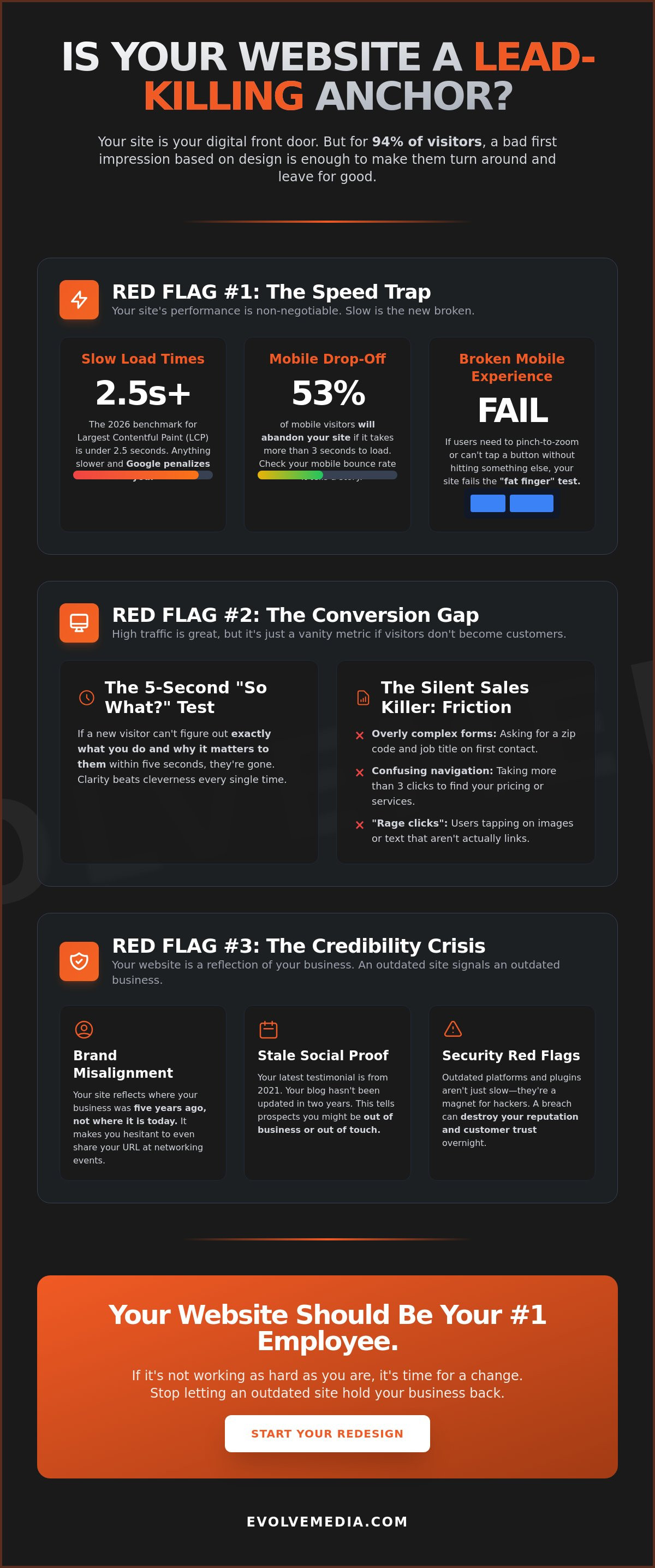
Did you know that 94% of a customer’s first impression is based entirely on your web design? If you find yourself cringing every time you send a prospect to your URL, you’re already noticing the signs it’s time for a website redesign. It’s a heavy feeling when you realize your digital home might be acting as a lead-killing anchor rather than a growth engine. We’ve seen many businesses lose ground simply because their site feels like a relic from a different era.
You deserve a platform that works as hard as you do. We’ve put together a no-nonsense checklist to help you decide if it’s time to move on from your current setup. We will walk through technical red flags, like failing the 2026 Core Web Vitals, and explain the specific ROI of professional web design. By the end, you’ll have a clear yes or no framework for your next move.
Key Takeaways
- Learn why failing the 2026 Core Web Vitals standards means Google is penalizing your site and frustrating your mobile visitors.
- Use the 5-second “So What?” test to identify the signs it’s time for a website redesign before you lose another lead to a faster competitor.
- Stop feeling hesitant at networking events by ensuring your site reflects your current professional growth rather than where you were five years ago.
- Learn how to reclaim your time by moving away from a CMS that feels like a puzzle and requires a pro just to fix a typo.
- Spot the security red flags that make outdated platforms a magnet for hackers and put your business reputation at risk.
Technical Performance: Is Your Site a Speed Trap?
Speed isn’t a luxury anymore; it is a survival requirement. In 2026, if your site takes longer than two seconds to load, you’re essentially handing your customers to the competition. It’s one of the most glaring signs it’s time for a website redesign. Most users won’t sit through a loading spinner. They’ll just hit the back button and find someone else who respects their time. These technical hiccups often stem from a lack of adherence to foundational Web design principles, which prioritize the user’s attention over flashy, heavy elements.
Google is just as impatient as your customers. They use Core Web Vitals to judge your site’s health and determine where you land in search results. If your content jumps around while loading or takes forever to respond to a simple click, your rankings will tank. You might be paying for ads only to send people to a page that frustrates them. That is a “slow tax” your business doesn’t need to pay.
To better understand how these technical factors impact your business, watch this helpful video:
The 2026 Speed Benchmark
Run your site through PageSpeed Insights right now. If your Largest Contentful Paint (LCP) is over 2.5 seconds, you are losing money. Back in 2023, a three-second load was considered “okay,” but the bar has moved. According to industry data, 53% of mobile visitors leave a page that takes longer than three seconds to load. Check your GA4 data for high bounce rates on mobile. If the numbers are climbing, your site speed is likely the culprit. Every extra second of lag can reduce your conversions by about 7%.
Mobile Accessibility and Responsiveness
Mobile-first design is the standard, but many sites still fail the “fat finger” test. Open your site on a three-year-old smartphone instead of the latest flagship model. If you have to pinch and zoom to read a sentence or struggle to tap a button because it’s too close to a link, your site is effectively broken. We see this often with older sites that weren’t built for modern mobile behavior. If a user can’t navigate your menu with one hand while walking, you’ve already lost the lead. This friction is one of the biggest signs it’s time for a website redesign to keep your funnel flowing.
The Conversion Gap: Why Traffic Isn’t Turning into Revenue
If your Google Analytics shows plenty of visitors but your inbox is as quiet as a library, you are looking at one of the biggest signs it’s time for a website redesign. Traffic is just a vanity metric if it doesn’t turn into revenue. Often, the problem is the “So What?” Test. If a stranger lands on your homepage and can’t tell exactly what you do within five seconds, they’re gone. They don’t have time to solve a riddle; they want a solution that makes their life easier.
Friction is the silent killer of sales. Think about that 12-field contact form you’re currently using. Asking for a prospect’s zip code, job title, and how they heard about you before they’ve even spoken to you is a massive hurdle. It’s too much work. Similarly, if it takes more than three clicks to find a price or a specific service, your navigation is a nightmare. Clear pathways are a huge part of following Web accessibility guidelines, making sure everyone can find what they need without a map.
Diagnosing the User Journey
To fix the gap, you need to see where people get stuck. We often use heat-mapping tools to spot “rage clicks” where users tap a non-linked image out of frustration. Look for your “leaky bucket” page. If 80% of your visitors vanish after hitting your services page, that’s where the friction lives. Identifying these signs it’s time for a website redesign helps you move from guessing to growing. Investing in professional web design can help smooth out these bumps and guide users toward the checkout or contact page.
Messaging and Brand Authority
Many sites fall into the “Resume Trap.” They spend three paragraphs on company history and zero on the client’s current pain. Your headlines should be clear, not just clever. If you want to see a change, try a quick test: tweak your primary headline today to focus on a specific result you provide. Also, check your social proof. If your latest testimonial is from 2021, prospects might think you’ve closed your doors. If you’re tired of watching leads slip through the cracks, it might be time to start a conversation about how to plug those leaks.
Brand Misalignment: When Your Website Feels Like a Throwback
Imagine you’re at a high-end networking event. You meet a perfect prospect, but when they ask for your website, you hesitate. You might even say, “Don’t look too closely, it’s a bit old.” That hesitation is one of the loudest signs it’s time for a website redesign. Statistics show that 94% of first impressions of a website are design-driven. If you feel a wave of cringe when handing out your URL, you are already telling prospects that you’re behind the times.
Visual fatigue is a trust killer. Savvy buyers in 2026 can spot a generic stock photo of a headset-wearing customer service rep from a mile away. It feels fake. It erodes the authority you’ve built through years of hard work. Your website should reflect what you sell now, not what you were doing in 2020. If your LinkedIn profile looks like a modern professional while your site looks like a digital fossil, your identity is split. This inconsistency makes people wonder which version of your business is the real one.
The Credibility Test
Pull up your site alongside your three biggest competitors. Be honest. If you were the customer, would you trust the business with the 2018-era layout? A dated design suggests a dated approach to your actual work. You can consult a guide to website redesign to see how the best in the business are currently updating their look. To see how a modern team presents itself, look at how we balance personality with professional authority on our own page.
Scaling for New Business Goals
Maybe you started as a local shop but now you’re chasing national contracts. If your site still has that “small town” feel, it is holding you back. Your digital presence needs to match your ambition. Utilizing custom web development allows you to build specific service lines that didn’t exist when you first launched. Take a moment to audit your service pages. If they don’t highlight your highest-margin offerings, you’re leaving money on the table.
If your brand and your website are speaking different languages, it’s time to get them back in sync. Let’s talk about aligning your digital presence with your actual expertise.
Operational Efficiency: When Your Site Is a Chore to Manage
Your website should be a high-performing asset, not a source of daily frustration. If you have to call a developer just to fix a typo or swap out a team photo, you are trapped in a developer bottleneck. This friction slows down your marketing and keeps your brand stuck in the past. It is one of the clearest signs it’s time for a website redesign that prioritizes your actual workflow over outdated code.
Integration failures are another silent productivity killer. If your leads are sitting in a website database instead of flowing directly into your CRM or email tools, you’re wasting hours on manual data entry. Hosting headaches like “Error 500” messages or frequent downtime are even worse. They don’t just annoy you; they kill your credibility instantly. A site that won’t “talk” to your other business tools is a site that is actively working against your growth.
The Content Management Struggle
Try this simple test: time how long it takes to publish a new blog post. If the process takes over 20 minutes, your CMS is broken. Many businesses are still using bloated builders that load dozens of unnecessary plugins. Research shows that hand-coded sites have a 61% pass rate for Core Web Vitals, while sites built with generic automated tools drop to 29%. Modern online applications can automate lead entry and simplify your life. You shouldn’t need to be a coder to update your own digital storefront.
Security and Long-term Stability
Security isn’t just about hackers; it’s about business continuity. If you are running on an outdated CMS version or an old PHP version, you are a sitting duck. Check your SSL certificate today. An “unsecure” warning in a browser is the fastest way to lose a prospect’s trust forever. Managed hosting acts as an insurance policy for your digital presence, ensuring you stay online and updated without the manual stress.
Recognizing these technical signs it’s time for a website redesign can save you from a catastrophic data breach or a total site collapse. Your platform should be the engine of your business, not a chore that keeps you from your real work. If you’re tired of fighting your own website, let’s talk about a better way to build a site that actually supports your goals.
Turning Your Digital Anchor Into a Growth Engine
A website that was “good enough” a few years ago is likely a liability today. Between the strict 2026 Core Web Vitals standards and the high expectations of modern buyers, your site needs to be more than just a digital brochure. We’ve explored how technical lag, conversion friction, and brand misalignment are the primary signs it’s time for a website redesign. Ignoring these red flags doesn’t just hurt your pride; it actively drains your marketing budget and stalls your momentum.
At Evolve Media, we’ve been navigating the digital world since 1996. We don’t just slap a pretty template over a broken system. Instead, we focus on custom business logic that solves your specific operational headaches and streamlines your lead flow. Combined with our managed hosting that ensures 99.9% uptime and proactive security, we provide the stability your business needs to scale without fear. It’s about building a partnership that lasts as long as your ambition does.
Ready to stop losing leads? Let’s build a site that actually works. Your future customers are waiting for a platform that respects their time and solves their problems. Let’s make sure they find it on your URL.
Frequently Asked Questions
How much does a website redesign actually cost in 2026?
The total investment depends on your specific page count, the complexity of your business logic, and any custom integrations you need. A site for a local service business will have different requirements than a massive e-commerce platform with thousands of SKUs. It’s best to define your business goals first so you can get a quote that reflects the actual work required to hit your targets.
How long does a full website redesign take from start to finish?
A professional project typically spans 8 to 16 weeks depending on the scope. This timeline includes the initial strategy sessions, the design phase, and the technical development required to ensure everything works on every device. Moving at a purposeful cadence ensures that we don’t miss critical bugs or skip the testing phases that protect your brand’s reputation.
Can I just update my website’s theme instead of doing a full redesign?
You can change a theme, but it’s often like putting a fresh coat of paint on a house with a cracked foundation. Themes don’t fix the underlying technical debt or messy code that slows down your site. If you’re seeing the signs it’s time for a website redesign, a surface-level fix won’t help you pass the latest speed and accessibility standards.
Will a redesign hurt my existing SEO rankings?
A redesign won’t hurt your rankings if you follow a strict migration plan, including 301 redirects for every old URL. In fact, improving your site speed and mobile experience usually leads to a ranking boost. Google rewards sites that provide a better user experience, so fixing technical failures is a long-term win for your search visibility.
How do I know if I need a new CMS or just a new design?
If you can’t update a simple headline or add a blog post without calling a pro, your CMS is the bottleneck. A new design might look better, but it won’t fix a clunky editing experience or security risks from an outdated platform. Spotting these signs it’s time for a website redesign often means realizing your current system is a chore to manage.
What is the most important feature of a modern website redesign?
Technical speed is the most critical feature in 2026. Specifically, your Largest Contentful Paint (LCP) must be under 2.5 seconds to keep visitors from bouncing. Research shows that 53% of mobile visitors will leave a page that takes longer than three seconds to load. A modern site must be fast, accessible, and designed to turn that speed into actual revenue.