
What if the most expensive mistake you make this year is applying a 2024 pricing model to a 2026 digital ecosystem? Since we began partnering with brands as a trusted advisor in 1996, we have seen how technical debt can erode a marketing budget when stakeholders lack a clear, forward looking roadmap. Learning how to budget for a new website 2026 requires more than just comparing line items; it demands a strategic shift toward investing in new chip agility while maintaining blue chip stability.
It’s exhausting to review agency quotes that vary by as much as 300 percent while trying to account for hidden maintenance fees that often surface six months after launch. We agree that you shouldn’t have to fear your technology becoming obsolete by 2027. This guide provides a professional framework to master these complexities, ensuring you balance technical innovation with long term business growth. We will break down the specific ROI of custom development versus templates and provide a clear roadmap for your digital stability.
Key Takeaways
- Understand why the shift from static brochures to integrated AI applications requires a more sophisticated approach to your 2026 digital investment strategy.
- Learn how to budget for a new website 2026 by mastering a breakdown of essential infrastructure, from high-performance hosting to advanced security protocols.
- Evaluate the long-term value of professional agency partnerships against the potential technical debt found in AI builders and freelance networks to ensure a “blue chip” standard of reliability.
- Follow a strategic five-step framework to audit your existing digital assets and align functional requirements with your core business growth objectives.
- Discover why your budget must include “Evolve Fuel”—the essential marketing and managed services that transform a successful launch into a scalable, long-term asset.
Defining Your Digital Investment: Why 2026 Web Budgeting is Different
Since we opened our doors in 1996, the digital world has undergone several radical transformations. In 2026, we’ve moved far beyond the era of “static brochures” that simply sat on a server. Your website is now an integrated business application that serves as the primary engine for your operations. Successful leaders no longer view these projects as a one-time expense; they see them as a strategic investment in a revenue-driver platform. When you look at how to budget for a new website 2026, you’re really budgeting for a digital partner that automates workflows and captures market share.
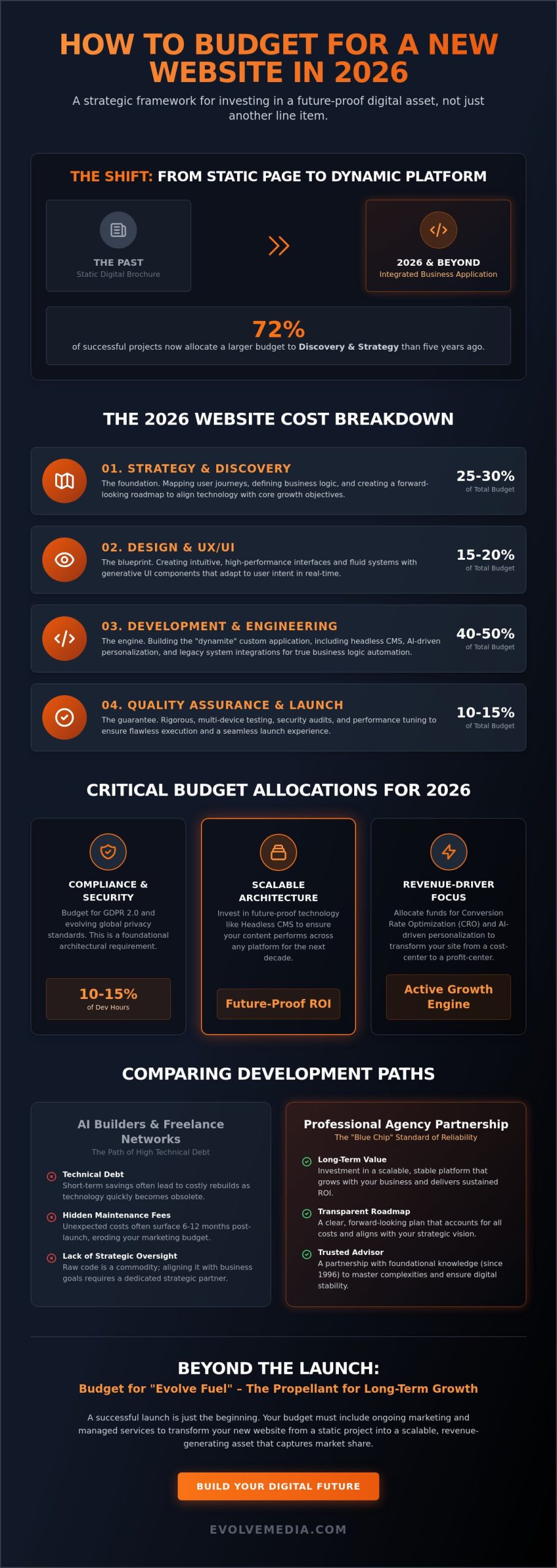
The difference between a mediocre site and a “dynamite” platform lies in the “hearts and souls” of the development team. Raw code has become a commodity, but the strategic thinking required to align that code with your specific business goals is rare. We find that 72% of successful projects now allocate a larger portion of the budget to discovery and strategy than they did five years ago. By grounding the project in the web design process, we ensure that every design choice serves a functional purpose, moving your site from a cost-center to a high-performing asset.
The 2026 Tech Landscape: AI, Privacy, and Speed
Budgeting for the current year requires accounting for the complexities of GDPR 2.0 and evolving global privacy standards. Compliance is no longer a checkbox; it’s a foundational architecture requirement that can take up 15% of your development hours. Additionally, generative UI components are changing the way we build. Instead of static templates, we’re creating fluid systems that adapt to user intent in real-time. This shift toward “headless” architectures allows your content to live independently of the display layer, providing the speed and cross-platform performance that 2026 users demand.
Blue Chip vs. New Chip Budgeting
We often categorize our partners into “blue chip” or “new chip” categories to better align their budget with their goals. Blue chip organizations typically prioritize enterprise-grade stability and long-term scalability, often requiring deep integration with legacy ERP systems. New chip startups, however, need extreme agility and the ability to pivot their business logic overnight. Whether you need the steady hand of a trusted advisor or the rapid execution of a tech-forward team, your budget must reflect these priorities. We use our foundational knowledge from 1996 to build custom online applications that don’t just look good but actually streamline your business logic and drive growth.
- Revenue-Driver Focus: Allocating funds for conversion rate optimization (CRO) and AI-driven personalization.
- Compliance Reserves: Setting aside 10-15% of the budget for ongoing data privacy and security audits.
- Scalable Architecture: Investing in headless CMS solutions to future-proof your content for the next decade.
Understanding how to budget for a new website 2026 means recognizing that your digital presence is a living organism. It requires a team that is as invested in your success as you are, providing the propellant for your growth through every stage of development.
If you’re looking for a partner to help realize this vision, you can find out more about professional web design and development services.
The 2026 Website Cost Breakdown: From Infrastructure to Interface
Building a high-performing digital presence in 2026 requires more than a sleek surface; it demands a structural integrity that supports both “blue chip” enterprises and “new chip” startups. As you determine how to budget for a new website 2026, you’re investing in a multi-layered ecosystem where strategy, design, and development must move in perfect lockstep. Since 1996, our team has seen technology cycles come and go, but the fundamental need for a solid, scalable foundation remains the most critical factor in long-term ROI.
- Strategy and Discovery: Mapping user journeys and business logic before a single pixel is moved.
- Design and UX: Creating intuitive interfaces that reflect your brand’s heart and soul.
- Development: Building the “dynamite” engine that powers your site’s functionality.
- Quality Assurance: Rigorous testing to ensure flawless execution across every possible device.
Beyond the visible interface, your budget must account for hidden layers that ensure reliability and speed. High-performance hosting and advanced security protocols are no longer optional extras. In 2026, standard security isn’t enough; you’ll need automated threat detection and edge computing capabilities, which often consume 15% to 20% of the initial infrastructure spend. Understanding how to set a budget also requires looking at third-party integrations. Connecting your CRM, ERP, and custom APIs is essential for a unified data flow that serves your customers better. We call our strategic insights “Evolve Fuel” because content and SEO are the propellants of growth; budgeting for these from day one ensures your site doesn’t just exist but actually performs.
Professional Design and User Experience (UX)
Custom branding offers a distinct competitive edge over generic template customization. While a template might seem cost-effective initially, the lack of a “unique” identity often hinders conversion rates. In 2026, accessibility is a non-negotiable budget item. The W3C’s WCAG 3.0 guidelines are the industry standard, and ensuring compliance avoids legal risks while expanding your global reach. Investing in interactive prototypes early reduces expensive development rework by allowing you to test user flows before the final build begins.
Development and Custom Logic
The allocation between frontend and backend resources depends heavily on your specific business rules. A standard corporate site might focus 60% of its development budget on the frontend, but a multi-channel ecommerce platform requires heavy backend logic to manage inventory and global shipping. Testing and QA ensure that your site’s “dynamite execution” remains consistent across the 20+ device types and browsers your customers use. If you’re feeling overwhelmed by these technical requirements, our team at Evolve Media is ready to serve as your trusted advisor to help you navigate how to budget for a new website 2026 with total confidence.
Comparing Development Paths: AI Builders vs. Professional Agencies
Choosing the right development path is the most significant variable when you determine how to budget for a new website 2026. While AI-driven DIY builders promise a functional site for a small monthly subscription, these platforms often create high technical debt that surfaces within the first year. For “new chip” startups and “blue chip” enterprises alike, the initial savings of a template-based builder are frequently offset by the limited scalability and rigid design constraints that stifle brand growth.
Freelance networks offer a middle ground, yet they often lack the cohesive strategy required for a long-term partnership. You might find a talented individual, but the absence of a multidisciplinary team means your SEO, security, and user experience (UX) may not be synchronized. A full-service agency acts as a Wise Architect; we use our institutional knowledge to build foundations that last. By integrating advanced AI tools to accelerate the heavy lifting of coding and data analysis, we provide a hybrid model that delivers professional precision at a pace that matches modern market demands.
The True Cost of “Free” or Low-Budget Builders
Low-budget builders often hide their true expense behind poor performance metrics. A one-second delay in page load speed can result in a 7% reduction in conversions; this is a heavy price for a “cheap” site. As you look to calculate your startup costs for the coming year, remember that a digital presence is an appreciating asset, not a line-item drain. Many businesses that choose the DIY route find themselves paying a “rebuild tax,” where the original site must be entirely replaced within 18 months because it can’t support new features or handle increased traffic. Additionally, unmanaged platforms are prime targets for data breaches, which can cost small businesses an average of $25,000 in recovery and lost trust.
Why a Trusted Advisor is a Budget Safeguard
Engaging a partner with a history dating back to 1996 ensures your project benefits from decades of cross-industry insights. This experience is a primary safeguard against feature creep, a common issue where unnecessary bells and whistles inflate your costs without adding value. We focus our fundamental interest on your specific ROI, prioritizing high-impact features that drive immediate lead generation. When considering how to budget for a new website 2026, a trusted advisor helps you allocate funds toward strategic UX and SEO rather than fixing avoidable technical errors. We pour our hearts and souls into ensuring your budget is spent on “Evolve Fuel,” the high-performance elements that propel your business forward rather than just keeping it afloat.
A 5-Step Framework for Building Your Website Budget
Since our founding in 1996, we’ve observed that the most resilient digital platforms are born from a balance of technical precision and strategic foresight. Understanding how to budget for a new website 2026 requires moving beyond simple price quotes to embrace a comprehensive financial framework. This structure ensures your investment supports both immediate needs and future growth.
- Step 1: Define core business goals and “must-have” functionality. Start by identifying the primary drivers of value, whether that’s lead generation, e-commerce throughput, or brand authority. We call this aligning with your business logic.
- Step 2: Audit existing digital assets and technical requirements. Review your current CMS, database structures, and third-party integrations to determine what can be migrated and what requires a total overhaul.
- Step 3: Allocate a 15-20% contingency fund for “New Chip” innovations. In a landscape where AI and spatial computing shift rapidly, this reserve allows you to integrate emerging tools without breaking your original agreement.
- Step 4: Evaluate “Buy vs. Build” for specific online applications. Determine if a custom-coded solution provides a competitive advantage or if a proven “Blue Chip” SaaS integration is more cost-effective for standard functions.
- Step 5: Project the 3-year Total Cost of Ownership (TCO). A website is a living entity. Your budget must include recurring costs for security patches, content updates, and performance tuning over a 36-month horizon.
Phase 1: Discovery and Strategic Alignment
Success begins with a “Fundamental Interest” phase where we map your operational workflows to digital features. During this stage, we establish measurable KPIs, such as a 25% increase in mobile conversion rates or a 40% reduction in page load times, to track budget effectiveness. This is also the time to decide if legacy systems, some perhaps dating back a decade, should be integrated via API or replaced entirely to prevent technical debt from draining your future resources.
Phase 2: Execution and Resource Allocation
When you move into execution, the split between internal and external resources becomes critical for managing burn rates. We recommend budgeting for “Blue Chip” hosting environments that offer 99.99% uptime and enterprise-grade security protocols to protect your reputation. To manage cash flow, consider a phased rollout. Launching a high-performing Minimum Viable Product (MVP) allows you to test results and gather user data before committing the final 30% of your budget to secondary features.
Ready to build a digital strategy that stands the test of time? Partner with Evolve Media to turn your 2026 vision into a high-performance reality.
Beyond the Launch: Budgeting for Scalability and Strategic Growth
Launching your digital platform is merely the first chapter in a long-term narrative. To ensure your investment doesn’t stagnate, your strategy for how to budget for a new website 2026 must include what we call “Evolve Fuel.” This isn’t just a maintenance line item; it’s the propellant that drives organic growth through sophisticated SEO and strategic content. Since 1996, we’ve observed that “blue chip” enterprises and “new chip” startups alike succeed only when they treat their website as a living organism rather than a static brochure. You’re not just building a site; you’re building a growth engine that requires consistent high-quality input to maintain its momentum.
Managed Hosting and Security
Choosing “commodity” hosting for a mission-critical platform is a risk that rarely pays off. Professional managed services act as essential insurance for your digital asset. You should allocate funds for monthly security audits and immediate software updates to prevent vulnerabilities before they’re exploited. For ecommerce platforms, maintaining 99.99% uptime is vital. Industry data shows that even a few minutes of downtime can result in significant revenue loss and damage to brand trust. High-performance hosting ensures your site remains fast and secure as your traffic scales, providing a stable foundation for your global reach.
Digital Marketing and Continuous Evolution
A successful 2026 budget requires an allocation for iterative development based on real user data. Instead of waiting three years for a total redesign, use analytics to inform monthly refinements that improve the user experience. This agile approach allows you to pivot quickly based on how visitors actually interact with your interface. By dedicating spend to SEO and content that resonates with your audience, you ensure your platform remains visible in a crowded marketplace. This continuous evolution keeps your brand relevant and your conversion rates climbing as you adapt to changing market demands.
The true ROI of your project comes from partnering with a “dynamite team” that remains invested in your success long after the initial launch. Having a trusted advisor who understands your fundamental business interests means you aren’t just buying code; you’re securing a long-term strategic partnership. When you consider how to budget for a new website 2026, remember that the most successful projects are those that plan for growth from day one. Ready to build a strategic budget for your 2026 project? Partner with Evolve Media today.
Building Your Future-Proof Digital Foundation
Navigating the complexities of how to budget for a new website 2026 requires a shift from viewing web development as a static expense to treating it as a high-performance investment. You’ve seen that success in the coming year hinges on balancing AI-driven agility with the “Blue Chip” stability that large-scale enterprises demand. By following our 5-step framework, you’re not just buying a site; you’re engineering a scalable asset that integrates custom development with robust managed hosting. Since 1996, we’ve helped partners transition through every major technological shift, and we know that institutional knowledge is the best defense against unpredictable market changes. Whether you’re a “New Chip” startup or an established global brand, your 2026 roadmap needs both technical precision and a dedicated team’s heart and soul. It’s time to turn these strategic insights into a functional reality that drives measurable growth.
Let our Wise Architects help you plan your 2026 digital strategy; Contact Evolve Media
We’re excited to help you architect a digital presence that stands the test of time.
Frequently Asked Questions
What is the average cost of a professional custom website in 2026?
A professional custom website in 2026 typically requires a strategic investment ranging from $15,000 for specialized small business sites to over $150,000 for complex enterprise platforms. While “new chip” startups might find entry points at the lower end of this scale, “blue chip” organizations often invest more to ensure robust security and deep API integrations. Since 1996, we’ve observed that these figures reflect the increasing necessity of high performance and custom user journeys in a crowded digital marketplace.
Can I use AI to reduce my website development budget?
You can leverage AI tools to reduce specific development line items by approximately 20% to 30% through automated code generation and initial content drafting. While these efficiencies are significant, they require expert oversight from a trusted advisor to ensure the output aligns with your sophisticated brand identity. Our team uses these tools to handle repetitive tasks, which allows us to pour more “heart and soul” into the high level strategy and custom architecture that AI cannot replicate.
How much should I budget for annual website maintenance?
You should allocate between 10% and 20% of your initial build cost for annual maintenance, security updates, and performance optimization. For a project with a $50,000 initial investment, this means setting aside $5,000 to $10,000 each year to cover hosting, plugin licenses, and proactive technical support. Regular upkeep is a critical component of how to budget for a new website 2026, as it prevents the 40% increase in emergency repair costs often seen with neglected systems.
Why do custom websites cost more than template-based sites?
What are the hidden costs of building a new website?
Hidden costs often include premium font licenses, third party API subscriptions, and professional copywriting, which can add 15% to your total project spend. Many organizations also overlook the $500 to $5,000 annual cost for specialized security certificates or advanced analytics tools. When you’re learning how to budget for a new website 2026, it’s vital to account for these ongoing operational expenses to ensure your digital presence remains functional and secure after the initial launch.
How long does the budgeting and discovery phase usually take?
The discovery and budgeting phase generally spans 3 to 6 weeks to ensure every technical requirement and strategic goal is meticulously documented. This period allows our team to function as a “Wise Architect,” uncovering the 15% of project requirements that are frequently missed in rushed, surface level estimates. A thorough discovery process is a proven way to reduce the likelihood of “scope creep” by 40% during the later development and execution stages.
Should I budget for SEO during the development phase or after launch?
You must integrate SEO budgeting directly into the development phase because 70% of search engine success depends on the site’s underlying technical architecture. Retrofitting a site for search visibility after it has launched can cost 2.5 times more than building it correctly from the start. Prioritizing SEO during the build ensures your venture gains immediate traction in a competitive 2026 market, establishing a foundation for long term organic growth and global reach.
How do I justify a larger website budget to my company’s board?
Justify a larger budget by framing the website as a primary revenue generator that is projected to increase lead conversion by 20% or more. Present data showing that 88% of users won’t return to a site after a poor experience, making the “dynamite” execution of a professional partner a necessity for protecting your market share. When you explain the strategic value of a sophisticated digital presence, the board will see the investment as a propellant for the company’s ongoing success.