



What if I told you that every dollar you put into your user experience could return 100 dollars to your bottom line? It sounds like a bold claim from a slick sales pitch, but it’s the reality of calculating web design ROI in 2026. We’ve seen it happen when companies stop treating their site like a digital brochure and start treating it like a high-performing salesperson.
We know how it feels to sit in a boardroom trying to explain the value of a redesign to a skeptical CFO who only sees an expensive “pretty” project. You’ve likely dealt with vague agency promises that focus on aesthetics while ignoring the actual math of your business. It’s exhausting to defend a budget when you can’t point to a clear profit margin.
In this guide, we’re going to move past the fluff and show you how to turn your website into a measurable profit center rather than a line-item cost.
We’ll break down the specific formula for success and the hard metrics that matter, from conversion velocity to lowering your acquisition costs, so you can prove that high-end design isn’t just a luxury; it’s a strategic necessity for growth.
Key Takeaways
- Stop wondering if your site actually works. We’ll show you how to use a simple math formula to calculate your web design ROI and prove your site’s worth to any skeptical stakeholder.
- Forget vanity metrics like total page views. Focus on the “king” of data points, your conversion rate; we’ll show you how to track exactly what each click is worth to your bottom line.
- Discover how a tiny shift in your conversion numbers can lead to a $50,000 revenue jump. This breakdown shows the difference between a site that just looks nice and one that truly performs.
- Learn why you need to audit your current data before you ever talk to a designer. We’ll help you set goals that focus on hard results, like reducing bounce rates, rather than just picking a new color palette.
Stop Guessing: What Web Design ROI Actually Means in 2026
Let’s get the math out of the way first. Calculating your web design ROI isn’t a dark art; it’s a simple equation. You take the total gain from your site, subtract what you spent on it, and divide that by the cost. If you aren’t seeing a positive number, your site isn’t an asset. It’s a liability. In 2026, “looking professional” is just the entry fee. It’s the baseline. If your site looks like it was built during the pandemic, you’ve already lost the trust of your visitors before they even read your headline.
But looking good isn’t a strategy. A real strategy involves turning those visitors into dollars. Think of your website as a 24/7 salesperson who never sleeps, never takes a lunch break, and never complains about the coffee. Whether you’re pulling in direct revenue through ecommerce development or generating assisted revenue for a service business, your site exists to move the needle. It should be the hardest working member of your team.
To better understand how these numbers play out in a real-world setting, watch this helpful video:
The Cost of Doing Nothing
Why Your CFO Hates Vague Metrics
Your CFO doesn’t care about “brand awareness” or “vibes.” Those words make them reach for their red pen. They want to hear about conversion velocity. They want to know how fast a lead moves from a click to a closed deal. When you say “it looks better,” they hear “we spent money on paint.” When you show them how a new layout reduces friction and increases lead value, they see a profit center. If you’re tired of defending a “pretty” site and want to talk about actual growth, you can reach out to us here to start a real conversation about your numbers.
The 3 Metrics That Actually Move the Needle
Numbers don’t lie, but they can be incredibly distracting. If you’re still obsessing over page views or “time on site,” you’re likely missing the forest for the trees. To see the true web design ROI, you have to focus on the levers that actually change your bank balance. We’re talking about conversion rates, lead value, and the hidden costs of your own time.
Conversion Rate: The Force Multiplier
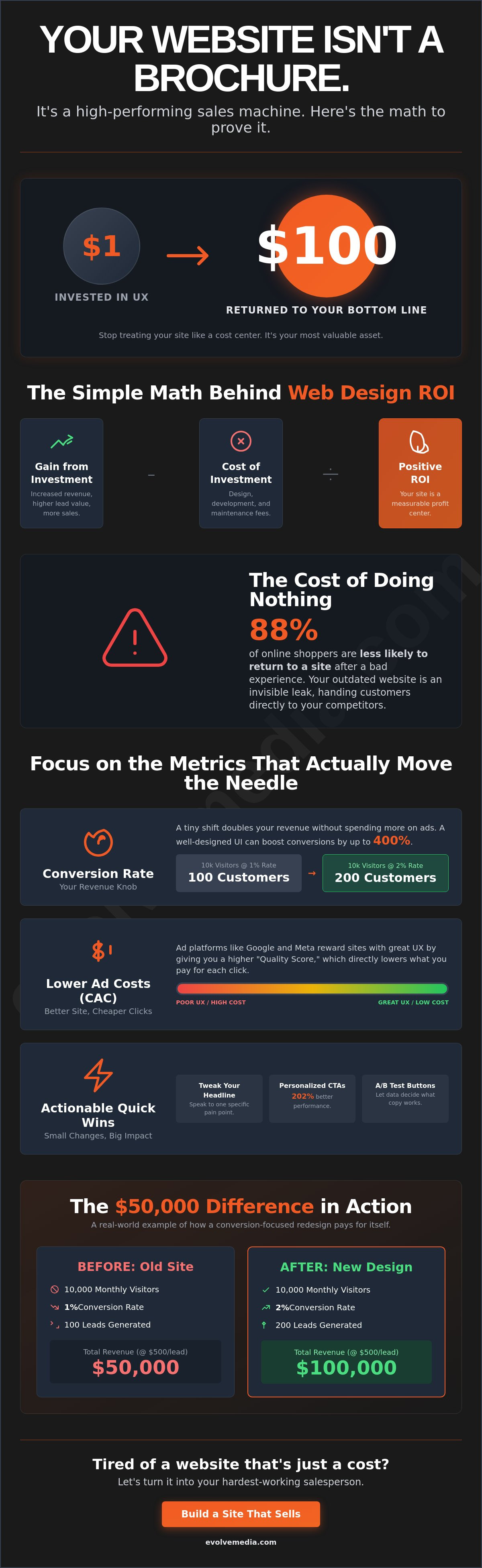
Think of your conversion rate as a volume knob for your revenue. If you have 10,000 monthly visitors and a 1% conversion rate, you have 100 customers. If you bump that rate to 2% through professional web design, you’ve doubled your revenue without spending an extra cent on ads. It’s the most efficient way to grow.
Small changes often yield the biggest wins. A well-designed user interface can increase conversion rates by up to 400 percent, according to industry research. You don’t always need a total overhaul to see results. Sometimes it’s as simple as these steps:
- Tweak your headline to speak directly to a specific customer pain point.
- Use personalized CTAs, which have been shown to perform 202 percent better than generic ones.
- Run a 3-day A/B test on your primary “Buy” or “Contact” button to see which copy resonates.
Lowering CAC Through Better UX
Ad platforms like Google and Meta aren’t just looking at your budget; they’re looking at your “quality score.” If your site is slow or confusing, they’ll charge you more for every single click. A site built with high-end UX lowers your Customer Acquisition Cost (CAC) because the algorithms reward you for being helpful. Plus, a clear brand identity builds trust faster, which naturally shortens your sales cycle. People buy from people they trust, and they trust sites that don’t look like they were built in the 90s.
Automating the Boring Stuff
This is the part most agencies ignore. Your website shouldn’t just be a marketing tool; it should be an operational engine. By using custom online applications, you can stop paying your staff to manually move data from a form into a spreadsheet. Automation is the quiet hero of web design ROI.
Imagine saving just 10 hours of admin time per week through a better intake system. Over a year, that’s 520 hours. At a modest 30 dollars per hour, you’ve just clawed back 15,600 dollars in lost productivity. We’ve been building these types of systems since our early days in the industry, and the math always holds up. When you combine that with reliable hosting and maintenance to avoid “emergency repair” fees, the site pays for itself before you even count the new sales. If you want to see where your own process is leaking cash, we can help you audit your digital workflow.
The $50k Difference: A Deep Dive into a Conversion Overhaul
Let’s talk about the actual cash sitting on the table. It’s one thing to talk about percentages; it’s another to see the impact on your bank account. To understand the true power of web design ROI, we need to look at a scenario we see all the time. Picture a business with 10,000 monthly visitors. Right now, they convert at a measly 0.5 percent. That’s 50 leads. If each lead is worth 1,000 dollars, they’re pulling in 50,000 dollars a month.
Now, we step in. We don’t just “make it pretty.” We fix the friction. We optimize for mobile traffic, which now accounts for 63 percent of all web traffic. By improving site speed and clarifying the user journey, we push that conversion rate to a modest 1.5 percent. The traffic hasn’t changed, but the results have. Now, that same business is generating 150 leads. At that same 1,000 dollar value, the monthly revenue jumps to 150,000 dollars.
The ROI Calculation in Action
The difference is a staggering 100,000 dollars in additional revenue every single month. When you subtract the one-time investment of a professional redesign, the site pays for itself in a matter of months. This isn’t a temporary spike. It’s a permanent shift in your ability to capture value. This growth is scalable. It compounds. As you drive more traffic through your digital marketing efforts, that 1.5 percent conversion rate makes every future ad dollar three times more effective than it was before.
Why Custom Beats Templates Every Time
You might be tempted to grab a cheap template and call it a day. The problem is that templates are built for “everyone.” In the world of business, that usually means they’re optimized for “no one.” A template doesn’t know your specific customer’s fears or motivations. It doesn’t understand that your ecommerce development needs a very specific pathway to guide a user from “just looking” to “entering credit card details.”
A strategy-led build focuses on the psychology of your specific buyer. We look at where they click, where they get confused, and where they drop off. Unlike rigid templates that limit your ability to scale, investing in custom web development ensures your site is built around your specific revenue goals rather than a generic framework that works for no one in particular. If you’re ready to stop leaving money on the table and want to see the math for your own business, you can request a custom audit here to see where your current site is leaking cash.
Planning Your Redesign for Maximum Financial Impact
Planning a redesign without data is like building a house without a blueprint. You’ll end up with a lot of wasted space and a front door that nobody can find. To maximize your web design ROI, you have to stop thinking about what looks cool and start thinking about what actually works. Your current website is a goldmine of information; you just have to know where to dig.
Start with a Data Audit
Before you even look at a color palette, look at your numbers. Check your heatmaps to see where people are clicking. You might discover they’re ignoring your primary call-to-action because it’s buried below a giant, useless image. Identify your “exit pages” where you’re losing potential revenue. If 70 percent of your users leave on the pricing page, you have a clarity problem, not a traffic problem.
Don’t forget to interview your sales team. They answer the same questions every single day. If your site doesn’t answer those questions upfront, it’s failing as a salesperson. Use those insights to build a site that solves problems before they reach a human. This turns your digital presence into a tool that qualifies leads while you sleep.
Set Goals That Actually Matter
Stop asking for a “modern look” or a “clean feel.” Those aren’t goals; they’re opinions. Instead, set SMART goals that your CFO can get behind. Aim for specific outcomes like these:
- Reduce bounce rate by 20 percent on your top three landing pages.
- Increase lead form completions by 15 percent through better placement and clearer copy.
- Cut page load time to under two seconds to keep mobile users from abandoning their carts.
Treat your site as an evolving asset rather than a one-time project. Industry data shows the average lifespan of a website design is now only 2 to 3 years. If you aren’t constantly tweaking your headlines or running A/B tests, you’re falling behind. You also need to keep an eye on shifting regulations. For instance, the U.S. Department of Justice has set a compliance deadline of April 26, 2027, for larger public entities to meet specific ADA standards. Staying ahead of these shifts prevents “emergency” legal costs later.
Choose a Partner, Not a Vendor
You need an agency that treats your business like their own. Look for a team that asks about your revenue goals and your average lead value before they ask about your favorite fonts. Experience matters in this game. Our about us page highlights our long history in the industry, proving we’ve seen every trend come and go. We focus on what stays: results. Ready to see the math for your own site? Let’s talk ROI.
Turning Your Digital Presence into a Profit Engine
Your website is no longer just a digital brochure; it’s the core of your business operations. By shifting your focus from “pretty” designs to the hard metrics we’ve discussed, you can finally prove your web design ROI to every stakeholder in the room. We’ve seen how a few small tweaks can transform your revenue without adding a single cent to your advertising budget.
It’s time to stop treating your site as a cost and start treating it as your most effective salesperson. Stop guessing and start growing. Contact Evolve Media for a strategy-first redesign. We’re ready to help you build something that actually pays for itself.
Frequently Asked Questions
How long does it take to see a positive ROI on a new website?
You can typically expect to see a return on your investment within three to nine months. This timeline depends heavily on your current traffic levels and how aggressively you promote the new site. If the redesign fixes a major bottleneck, like a confusing checkout process or a hidden contact form, you might see a spike in conversions within the first few weeks.
Can a small business really afford a custom web design?
Small businesses often find that they can’t afford to stick with a generic template. While a template is cheaper on day one, it often lacks the specific pathways needed to turn a visitor into a customer. A custom build focuses only on the features that drive your specific revenue goals. It’s better to invest in a site that works than to waste a smaller amount on a site that just sits there.
Is it possible to track ROI for a non-ecommerce website?
Yes, you simply need to assign a dollar value to your leads. If your sales team closes 10 percent of their leads and your average contract is worth 5,000 dollars, then every lead is worth 500 dollars. Tracking your web design ROI then becomes a simple math problem of counting how many more leads the new site generates compared to your old one.
How often should I redesign my website to maintain a high ROI?
The current standard for a redesign is every two to three years. Technology moves fast, and user expectations move even faster. A site that felt modern three years ago might feel slow or clunky to a customer today. Keeping your site fresh ensures your conversion rates don’t dip as your competitors launch newer, faster digital experiences.
Does SEO impact the ROI of my web design?
SEO and design work together like an engine and its fuel. SEO brings the traffic to your site, but the design is what converts that traffic into actual money. A high-ranking site that is hard to use will have a poor web design ROI because people will leave before they buy anything. You need both to maximize your profit.
What is the most important metric to track after a site launch?
The conversion rate is the king of all metrics. It is the most direct way to see if your new site is actually doing its job. While page views and bounce rates give you more context, they don’t directly reflect your bank balance. If your conversion rate is higher than it was before the launch, your redesign is a success.



Comment (01)
Custom Web Development: Building Digital Tools That Actually Work for You
May 22, 2026[…] points to build your “Must-Have” list. Before you add a complex, flashy feature, look at the web design ROI to see if it actually pays for itself. Tweak your project list to prioritize tools that directly […]