
That “affordable” senior designer you’re looking to hire might actually be the most expensive mistake your budget makes this year. While the idea of having a dedicated expert under your own roof feels like the ultimate safety net, the reality often involves a messy web of hidden employment taxes and recruitment fatigue that drains your momentum. When evaluating in-house vs agency web design costs, many leaders find that a single salary is merely the tip of a very deep iceberg. It’s a common frustration, especially when you realize one person can’t possibly master every technical nuance of the 2026 digital market.
We’ve spent decades guiding partners through these exact crossroads, and we’re here to help you stop the guesswork. This article provides a cold, hard look at the real Total Cost of Ownership (TCO) behind hiring a solo designer versus partnering with a multidisciplinary team. You’ll gain a clear understanding of the 2026 talent market and the confidence to build a hiring roadmap that actually protects your bottom line. We’ll compare the “management tax” of internal teams against the agility of an agency engine to see which one truly fuels your growth.
Key Takeaways
- By looking past the base salary, you’ll see how recruitment fees and employment taxes can quietly inflate your costs by 25% before work even begins.
- We’ll show you how to trade recruitment fatigue for budget certainty by using project-based fees that protect your bottom line.
- Evaluate in-house vs agency web design costs through the lens of “Time to Value” to see how much a three-month hiring delay actually costs your business in lost revenue.
- Identify whether your project volume justifies a permanent hire or if a high-performance agency engine is the smarter, more flexible choice for your 2026 roadmap.
- Discover if you have the internal “eye” to lead a designer or if a self-managed agency team is the better strategic partner for your vision.
The Hidden Ecosystem of In-House Design Costs
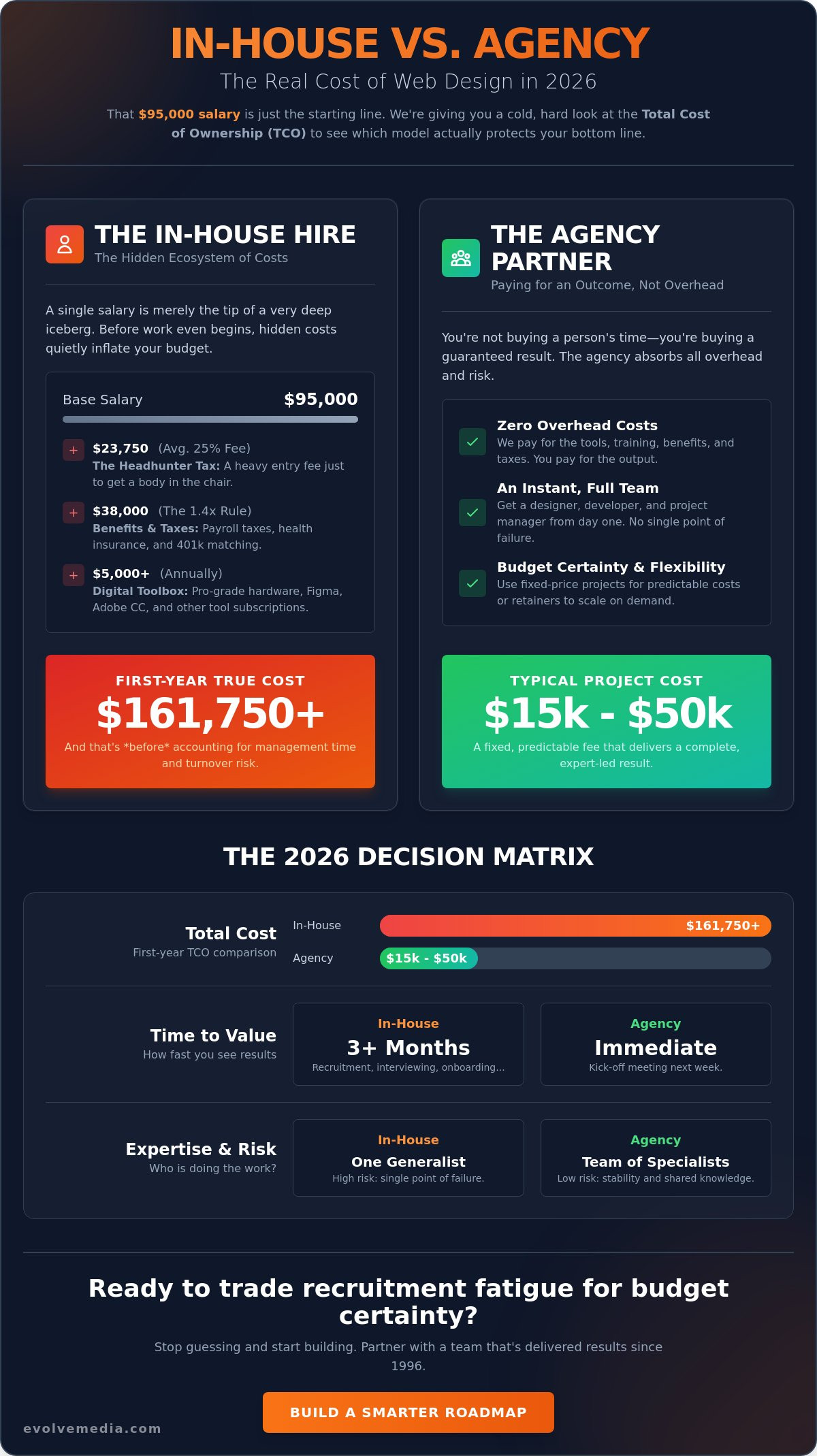
If you’re eyeing a senior designer with a $95,000 price tag, you aren’t just buying their talent; you’re buying their entire life support system. Most budgets fail because they treat salary as a destination when it’s actually just the starting line. Before your new hire even opens their laptop, recruitment fees have likely snatched away 15% to 25% of that first-year salary. That’s a $15,000 to $23,000 check written to a headhunter just to get a body in the chair. It’s a heavy entry fee that makes the debate over in-house vs agency web design costs much more lopsided than it looks on a spreadsheet.
To better understand how these costs compare to a professional partnership, watch this helpful video:
Then there’s the “digital toolbox.” A professional designer can’t work on a budget laptop from a big-box store. You’re looking at high-end MacBooks and dual color-accurate monitors that are non-negotiable for performance. Toss in annual subscriptions for Figma, Adobe Creative Cloud, and project management tools, and you’ve added several thousand dollars to your annual overhead. Understanding the web design process helps clarify why these tools are vital, but it doesn’t make the bill any easier to swallow.
The 1.4x Rule: Taxes and Benefits
Standard accounting uses the 1.4x multiplier to find the true cost of an employee. This means that $95,000 salary actually costs your business roughly $133,000. Where does the extra $38,000 go? It’s swallowed by payroll taxes, health insurance premiums, and 401k matching. If you’re providing a physical office or even a remote work stipend, that number climbs even higher. The 1.4x multiplier is the industry standard for calculating the true financial weight of an internal hire.
The Training and Retention Tax
Designers in 2026 don’t stay stagnant; they expect professional development budgets to keep their skills sharp. If they feel their growth is stalling, they’ll leave. Losing a designer mid-build is a catastrophe that can set your project back three months while you restart the recruitment cycle. At Evolve Media, we’ve provided consistent stability since 1996, ensuring your project doesn’t vanish if a single person decides to move on. We absorb the training costs and the turnover risks so you don’t have to. Partnering with us means you aren’t just hiring a person, you’re securing a legacy of reliability.
Agency Pricing Models: Paying for a Team, Not Just a Person
Switching from an internal hire to an agency partnership feels like moving from a fixed mortgage to a flexible lease. When you partner with an agency, you’re offloading that entire “ecosystem of overhead” we explored earlier. We pay for the Figma seats, the high-end hardware, and the ongoing training. This shift is a major factor when weighing in-house vs agency web design costs. You’re no longer paying for someone’s downtime; you’re paying for their direct output.
You also gain a specialized trio of experts. Instead of one designer trying to wear three hats, you get a designer, a developer, and a project manager. This collective expertise ensures your site doesn’t just look pretty but actually functions under pressure. It’s about buying an outcome rather than just a person’s time.
Fixed-Price vs. Hourly Retainers
Budget certainty is the holy grail of financial planning. Project-based fees keep your costs predictable, which is especially helpful for a custom ecommerce development build. If a feature takes longer to polish than expected, that’s the agency’s problem to solve, not your budget’s. Retainers offer a different kind of value. They allow you to scale your design needs up for a summer launch and down during a quiet winter. For example, a $15,000 flat project fee provides a clear finish line, while a $5,000 monthly retainer supports iterative growth and long-term branding.
The Specialized Skill Advantage
Finding a “unicorn” who masters UX, SEO, and clean code is nearly impossible in the 2026 talent market. Agencies provide a bench of specialists who jump in exactly when needed. An SEO marketing agency perspective ensures your new site actually ranks on Google from day one. When you consider long-term cost efficiency, this multi-disciplinary approach prevents the expensive rework that often follows a solo hire’s blind spots. You get the right brain for the right task at the right time.
If you’re tired of managing a revolving door of freelancers, we can help you find a more stable way forward.
Velocity and the Opportunity Cost of Hiring
Speed is often the most underrated variable in the in-house vs agency web design costs equation. While you’re waiting for the “perfect” candidate to clear their notice period, your competitors are already capturing your market share. Agencies can typically kick off a project within days; hiring a senior developer can take four to six months in the current market. This “Time to Value” gap is a silent budget killer that most leadership teams overlook until it’s too late.
Think about the lost sales from a site launch that’s delayed by half a year. If your website generates $10,000 in monthly revenue, a six-month hiring lag costs you $60,000 before a single line of code is even written. Beyond the money, a solo designer represents a single point of failure. If they burn out or get a better offer, your entire digital presence grinds to a halt. Agencies provide a redundant, high-performance engine that doesn’t stop just because one person takes a vacation.
Ramp-Up Time vs. Immediate Execution
Even after the ink is dry on a contract, a new hire needs about 90 days to learn your brand and hit full speed. They’re figuring out where the files are and who to ask for approval. Agencies use battle-tested processes to skip the fluff and start building immediately. For small business SEO services, being first to market is everything. You don’t have three months to waste on onboarding when your rankings are at stake.
The Management Burden
Who is actually going to lead your new designer? If you aren’t a creative director, you’ll likely spend at least 10 hours a week “babysitting” the process, providing feedback, and managing technical roadblocks. This is a massive hidden cost for founders and managers whose time is better spent on high-level strategy. When you look at The Cost of an In-House Team, you have to account for this management tax. Agencies come with built-in project management, allowing you to simply review the results and keep your focus where it belongs.
Ready to skip the recruitment headache and get your project moving today? Let’s talk about your timeline.
The 2026 Decision Matrix: Which Model Wins?
Choosing between a new hire and a professional partner shouldn’t feel like a coin flip. When you’re staring down the numbers for in-house vs agency web design costs, the right path usually reveals itself through three specific filters: your volume, your expertise, and your deadline. If you’re a founder who can’t tell a good user interface from a bad one, hiring an internal designer is essentially buying a car without knowing how to drive. You’ll spend more time trying to figure out the controls than actually reaching your destination.
- Project Volume: Is this a one-time high-impact build or a 40-hour-a-week permanent need?
- Internal Leadership: Do you have a Creative Director on staff who can mentor and lead a solo hire?
- The Timeline: Do you need a site by Q3 or “whenever we find the right person”?
Running the hard numbers makes the choice even clearer. A senior designer with a $100,000 salary actually costs your business roughly $140,000 once you factor in the 1.4x rule for taxes, benefits, and software. Compare that to a $60,000 annual agency retainer. That $80,000 difference is capital you could reallocate to actual growth. It’s the difference between funding a single salary and funding an entire marketing engine. It’s a math problem, not a personality test.
When to Go In-House
There are moments when an internal hire is the superior move. If your product is the website, such as a complex SaaS platform, you likely need a dedicated person for daily micro-tweaks and real-time troubleshooting. This model works best when you have a multi-year backlog of tasks that never ends and an existing Creative Director who can provide mentorship. Without that leadership, a solo designer often hits a creative wall within six months.
When an Agency is the Smart Play
Partnering with an agency is the strategic choice when you need a high-impact launch or a total brand refresh that requires more than just one brain. You get a combined force of digital marketing experts and technical developers for the price of a single senior hire. If your budget sits between $50,000 and $150,000, you’ll get significantly more “bang for your buck” by accessing a team’s collective wisdom rather than one person’s limited perspective. Ready to skip the HR headache and start building? Let’s talk about your project.
Own Your Digital Roadmap for 2026
Deciding on in-house vs agency web design costs isn’t just about balancing a spreadsheet; it’s about deciding how fast you want to grow. We’ve seen that the true cost of an employee often hits 1.4x their salary, while the months spent recruiting can stall your revenue. You don’t need the stress of managing hardware or the risk of a single point of failure when you’re trying to scale your brand.
At Evolve Media, we’ve been helping partners navigate these shifts since 1996. We’ve watched tech trends flicker and fade while staying focused on what actually works. When you work with us, you get a full house of designers, developers, and SEO experts without the HR overhead. We don’t do corporate fluff or empty promises; we just provide the direct results your brand deserves.
Your vision shouldn’t be held back by a slow hiring cycle or a limited skill set. Skip the hiring headache and build something great with Evolve Media. We’re ready to help you turn these numbers into actual growth. Let’s get started on your next chapter today.
Frequently Asked Questions
Is it cheaper to hire a freelancer or a web design agency?
Freelancers often have lower hourly rates, but they usually lack the specialized team depth that an agency provides. When you hire a freelancer, you’re essentially becoming their project manager and quality assurance lead. Agencies might have a higher upfront cost, but they eliminate the “management tax” by handling the coordination and technical oversight themselves.
What are the hidden costs of hiring an in-house web designer in 2026?
The biggest hidden drain is the “1.4x multiplier” which covers payroll taxes, health insurance, and 401k matching. You also have to factor in recruitment fees that can eat up to 25% of the first-year salary before the designer even starts. Don’t forget the annual cost of high-end hardware and software subscriptions like Figma and Adobe Creative Cloud.
How much does a professional web design agency charge per hour?
Hourly rates fluctuate significantly based on the agency’s location and their level of technical expertise. Teams based in the US or UK typically command higher rates for senior development work compared to offshore options in APAC or Latin America. Full-service digital agencies like jWeb Media justify these professional rates by providing the project management and testing infrastructure that a solo hire simply can’t offer.
Can I use a hybrid model with both in-house and agency teams?
Yes, many successful companies use a hybrid approach to balance daily maintenance with high-level strategy. You might keep a junior designer for micro-tweaks and social media assets while partnering with an agency for major ecommerce builds or brand refreshes. This allows your internal team to stay focused on the small stuff while experts handle the heavy lifting.
What happens to my website if my in-house designer quits?
Your digital momentum usually grinds to a halt for three to six months while you struggle to find a replacement. This creates a “single point of failure” risk that can be catastrophic mid-project. Agencies offer institutional stability because your project knowledge lives within a team of specialists rather than one person’s head.
Retainers are almost always more cost-effective because you only pay for the expertise you actually use. When you compare in-house vs agency web design costs, a retainer gives you access to developers, designers, and SEO experts for a fraction of a single senior salary. For UK-based SMEs, Dorweb provides this type of scalable expertise through dedicated lead generation systems. It’s a model that lets you ramp up for big launches without the permanent overhead of a full-time hire.
Retainers are almost always more cost-effective because you only pay for the expertise you actually use. When you compare in-house vs agency web design costs, a retainer gives you access to developers, designers, and SEO experts for a fraction of a single senior salary. It’s a scalable model that lets you ramp up for big launches without the permanent overhead of a full-time hire.