
How many hours did your team spend today tricking your software into doing its actual job? It’s a common frustration. You’re likely paying for “per-user” seats for features you never touch, while your actual staff wastes time on manual workarounds because your tools don’t talk to each other. We’ve seen this cycle repeat since our early days in the industry. It’s exactly why custom web application development has shifted from a luxury for tech giants to a tactical necessity for growing brands.
You deserve a platform that feels natural and moves at your pace. Data from Digital Applied shows that web-based software platforms can reduce operating costs by an average of 47 percent. That’s not just a dry statistic. It’s the reality of what happens when you stop fighting your tools and start owning them. We’re here to help you bridge that gap.
This article breaks down the path to software independence. We’ll show you how to build an application that actually fits your business workflows. You’ll walk away knowing how to claim full ownership of your digital tools and create a platform that scales with your ambitions.
Key Takeaways
- Identify the “Software Tax” that’s draining your team’s energy. We’ll show you why those “almost-right” tools are actually costing you thousands in lost time.
- Discover how custom web application development turns your digital tools into a competitive advantage. It’s about creating a platform that fits your workflow perfectly.
- Use our “Workaround Audit” to spot the gaps in your current stack. If your team spends hours on manual fixes, it’s time to consider a custom solution.
- See how prototyping saves you from expensive mistakes. You’ll learn why testing your app’s logic before writing final code is the smartest way to build.
The Hidden Cost of “Almost-Right” Software
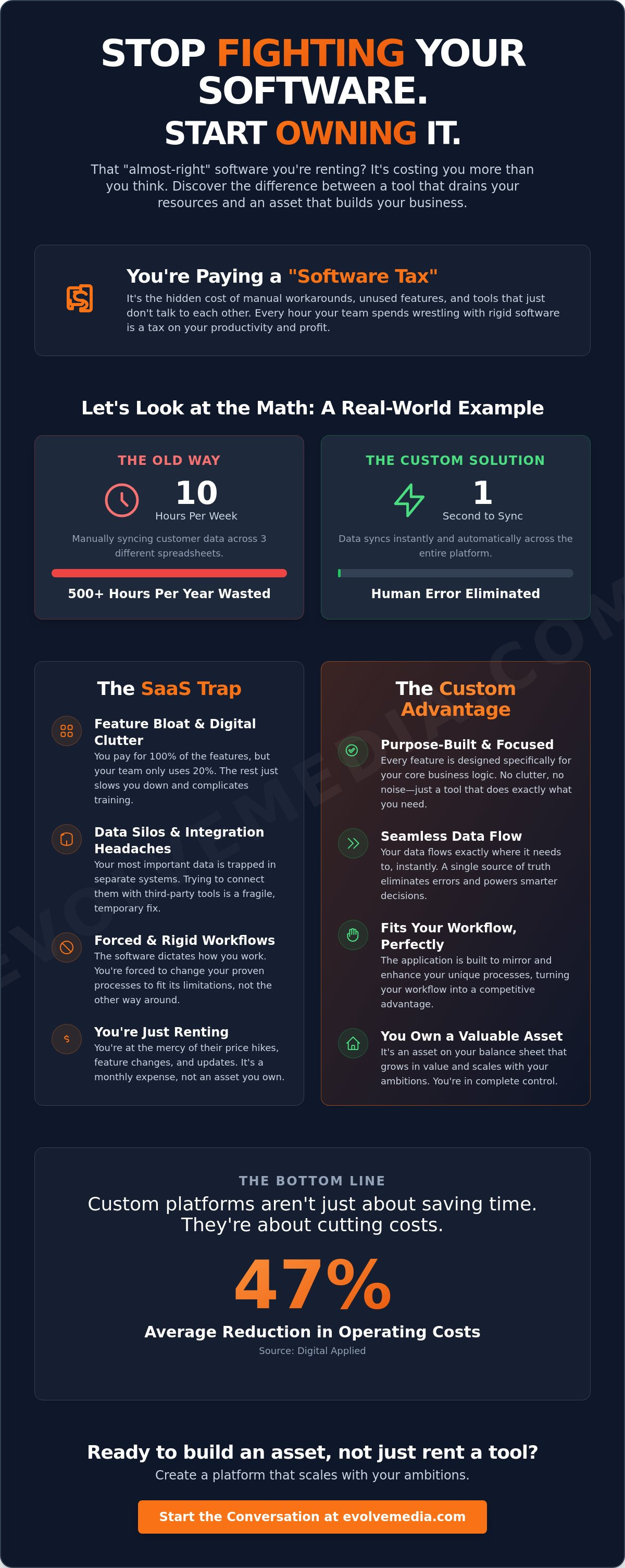
That $99 monthly SaaS subscription feels like a steal until you look at your payroll. If your team spends half their morning jumping between tabs or manually fixing data errors, you aren’t saving money. You’re paying a “Software Tax.” This hidden drain on your resources happens every time a tool forces you to change your workflow to fit its rigid rules. A standard web application is often built for the average user, but your business isn’t average. It’s unique.
To better understand how to move past these limitations, watch this helpful video on building production-ready tools:
Think about the difference between renting and owning. When you rent software, you’re paying for someone else’s asset. You’re also stuck with their updates and price hikes. Investing in custom web application development is like building your own headquarters. It’s an asset that sits on your balance sheet, grows in value, and functions exactly how you need it to. No more “Frankenstein” integrations that break the moment one app updates its API.
Let’s look at the math. We recently saw a company spending 10 hours every week just syncing customer data across three different spreadsheets. That is over 500 hours a year. By switching to a custom build, that 10-hour headache became a 1-second automated sync. They didn’t just save time; they eliminated the human error that was costing them thousands in missed follow-ups.
The Trap of the Feature-Heavy SaaS
Most off-the-shelf tools brag about having hundreds of features. Here is the reality: you probably only use 20 percent of them. The other 80 percent is just digital clutter that slows your team down. When you need a simple change, you’re often met with a “we can’t do that” from support. Choosing custom web application development means you strip away the noise. You focus entirely on the core logic that actually drives your revenue.
Data Silos and the Integration Headache
Data silos are the silent killers of productivity. You have your sales data in one place, your inventory in another, and neither side is talking. Trying to “Zapier” your way out of this works for a while, but eventually, those connections hit a breaking point. A custom integration acts as a bridge between your specific business goals and your data. It ensures your information flows where it needs to go without a middleman. If you’re tired of fighting your tools, it might be time to start a conversation about a better way to work.
What Custom Web Application Development Actually Looks Like in 2026
Think of your current website as a digital brochure. It’s nice to look at, but it doesn’t actually do anything. A web app is different. It’s a digital employee that works 24/7 to handle logic, process data, and solve problems. In 2026, custom web application development is no longer just about writing code. It’s about building a tool that slots into your business like a missing puzzle piece.
We focus on what we call “Agile Agility.” Most businesses make the mistake of trying to build for their five-year goals on day one. That usually leads to over-engineered software that’s obsolete before it launches. Instead, we build the “bones” for tomorrow while focusing on what you need to move the needle today. With the global software market projected to grow 11.8 percent annually through 2034, your platform needs to be ready for constant evolution.
Scalability is the other side of that coin. It isn’t just a buzzword for tech startups. For a growing business, scalability means your app doesn’t crash when you double your order volume or add fifty new employees. It means your database remains fast even when it’s holding years of records. We build with a Zero Trust security model, which is the 2026 standard. This protects your data at every layer without making the login process a nightmare for your team.
Internal Business Tools vs. Customer Portals
Most of our work falls into two categories. First, there are the internal tools: HR dashboards, inventory trackers, and proprietary calculators that replace messy spreadsheets. Then, there are customer portals. A generic login page feels cold and distant. A custom portal gives your clients a branded, high-touch experience that makes them feel like they’re your only priority. We’ve found that custom web development is often the secret sauce for brands in specialized niches who need to scale without adding massive headcount.
The Tech Stack Without the Jargon
You don’t need to know the difference between Python and PHP to run a successful business. However, you should care that your app is built on stable, modern foundations. JavaScript remains the king of the mountain, used by 65.6 percent of developers, with React holding a massive 40.6 percent market share. We use these tools because they are “Integration-Ready.” This means your app can easily talk to your existing accounting software or marketing tools. We also prioritize a mobile-first approach. Even if your team mostly uses desktops, your software should be just as snappy on a phone during a site visit or a commute. If you’re curious about how this could work for your specific workflow, you can reach out to our team for a chat.
The Build vs. Buy Decision: A 4-Point Framework
Deciding between a monthly subscription and custom web application development shouldn’t feel like a coin toss. Most founders get stuck in the “buy” trap because the entry price looks low. However, that low entry fee often hides a mountain of inefficiency. Use this four-point framework to decide if you should stick with your current stack or build something better.
- Step 1: The “Workaround” Audit. Track your team’s most annoying digital tasks for three days. If your staff spends more than five hours a week fixing data errors or manually moving info between apps, your software is failing you.
- Step 2: Competitive Advantage. Ask yourself if your software helps you do something your competitors can’t. If you’re using the exact same tools as the guy down the street, you’re competing on their terms, not yours.
- Step 3: Long-term ROI. Compare three years of per-user subscription fees against the cost of a one-time build. Don’t forget to factor in the 47 percent reduction in operating costs that custom platforms often provide.
- Step 4: The Scalability Wall. Will your current setup survive a 50 percent growth spurt next month? If your “Frankenstein” system of plugins and spreadsheets would break under that pressure, you’re already behind.
When to Stick with Off-the-Shelf
Sometimes, a standard tool is actually good enough. If you just need a basic email marketing platform or a simple way to track receipts, don’t over-engineer it. Building a custom solution for a problem that a $20 app solves perfectly is a waste of your capital. Focus your development budget where it actually generates revenue. Actionable step: Run that 3-day audit before you commit to any new platform.
When Custom is the Only Path Forward
Custom is the right choice when you have unique regulatory requirements or complex business logic that a generic SaaS simply can’t handle. It is also the only way to effectively connect legacy systems that modern tools tend to ignore. We see ourselves as a partner in this process, not just a vendor. You can see how we approach professional web design and development by looking at our collaborative history. If you’re ready to stop fighting your tools, you can get a custom audit of your workflow from our team today.
Navigating the Development Journey Without the Headache
Starting a software project can feel like walking into a dark room. We get it. The fear of budget overruns is a valid concern for any business owner. Verified data shows that over 50 percent of software projects exceed their budget by an average of 89 percent. That is a terrifying statistic. It usually happens because teams rush into coding before they truly understand the problem they’re trying to solve.
Our discovery phase focuses more on “Why?” than “How?” We want to know what success actually looks like for your bottom line. Is it saving 10 hours of admin work every week? Is it reducing customer churn by 15 percent? Once we know the goal, the technical path becomes much clearer. We don’t believe in the “black box” approach where you send money into a void and hope for a miracle. Custom web application development is a collaboration; you’re the expert on your business, and we’re the experts on the technology.
You shouldn’t have to wait six months to see if your app actually works. We use prototyping to show you the logic and flow before a single line of final code is written. It is like walking through a house before the foundation is poured. This saves time and prevents expensive pivots later. We also prioritize managed hosting because the launch is just the beginning. Ongoing costs for security and hosting can often double the initial build cost over a three-year period. We stay by your side to ensure your platform remains an asset, not a liability.
Finding a Partner, Not a Vendor
We’ve been doing this since 1996. That is a lifetime in the tech world. We avoid fancy, over-used labels like “bespoke” because they sound more expensive than they are useful. We prefer “tailored.” It means your software is built to be used every day, not just looked at. You can check out the Evolve Media team to see the seasoned experts who will be working on your project.
Your First Step Toward a Custom App
Don’t worry about writing a 50-page technical document. You don’t need to be an architect to talk to us. Just bring us your biggest bottleneck. Tell us about the one task that makes your team want to quit. That is usually the best place to start. During an initial consultation, we’ll listen more than we talk. If you’re ready to ditch the messy spreadsheets and “Frankenstein” apps, you can contact our team today to start the conversation.
Stop Patching the Gaps and Start Building
You’ve spent enough time trying to force generic tools to understand your unique business. From identifying the hidden “Software Tax” to auditing your daily workarounds, it’s clear that settling for “good enough” is a recipe for stagnation. Real growth happens when your technology is an asset you own, not a subscription you’re trapped in. You deserve a platform that reflects the way you actually work.
Our team has been crafting digital solutions since 1996, bringing a deep well of experience to every project we touch. We’ve helped both high-growth startups and established enterprises navigate the complexities of modern software with a seasoned team of US-based developers. We don’t just deliver a product; we act as a long-term strategic partner to ensure your tools stay sharp as your business evolves. We’re here to help you bridge the gap between where you are and where you want to be.
Investing in custom web application development is about more than just new features. It’s about gaining the freedom to scale without hitting a technical wall. You’re ready to move past the manual syncs and data silos to embrace a workflow that feels natural and efficient. It’s time to build something that lasts.
Let’s build a tool that actually works for you. Contact Evolve Media.
Frequently Asked Questions
How much does custom web application development cost in 2026?
Pricing for custom web application development varies based on the complexity of your logic and the number of integrations required. Instead of looking at it as a monthly expense, think of it as a capital investment in your efficiency. You are trading recurring “per-user” fees for a proprietary asset. Many businesses find the initial build pays for itself through the 47 percent reduction in operating costs we mentioned earlier.
How long does it take to build a custom web app from scratch?
A typical project moves from the initial discovery phase to a live launch in about three to six months. This timeframe allows us to prototype the interface, build the logic, and perform rigorous security testing. Smaller tools might be ready sooner. However, complex platforms with multiple user roles require a more deliberate pace. We prioritize a steady rhythm to ensure your team is trained and ready for the switch.
Do I own the code once the project is finished?
Ownership is one of the biggest reasons to choose custom over off-the-shelf. Once the project is complete and paid for, you own the source code and the intellectual property. This means you aren’t at the mercy of a SaaS provider’s price hikes or sudden feature changes. Your software becomes a valuable business asset that stays with you as you scale, giving you total control over your digital future.
Can a custom web app integrate with my existing tools like QuickBooks or Salesforce?
Absolutely. We build with an API-first mindset. This means your new application can easily talk to QuickBooks, Salesforce, or any other modern business tool. This connectivity is what kills those annoying data silos. Instead of your team wasting hours manually syncing spreadsheets, your data flows automatically between systems. It makes your entire tech stack work as one single, cohesive unit.
What happens if I need to add new features later?
We build for today with the bones for tomorrow. Because we use modular architectures, adding new features later is a straightforward process. You don’t have to wait for a software vendor to put your request on their roadmap. If your business pivots or expands into a new market, your app can be updated to handle those new requirements without needing to start from scratch.
Is custom software more secure than off-the-shelf SaaS?
Custom software is often more secure because it doesn’t share the same massive “attack surface” as popular SaaS platforms. We implement Zero Trust models and AI-powered threat detection specifically for your data architecture. This allows us to lock down sensitive information at every layer. You get the highest level of protection without the clunky security hurdles that often make off-the-shelf tools a pain to use daily.