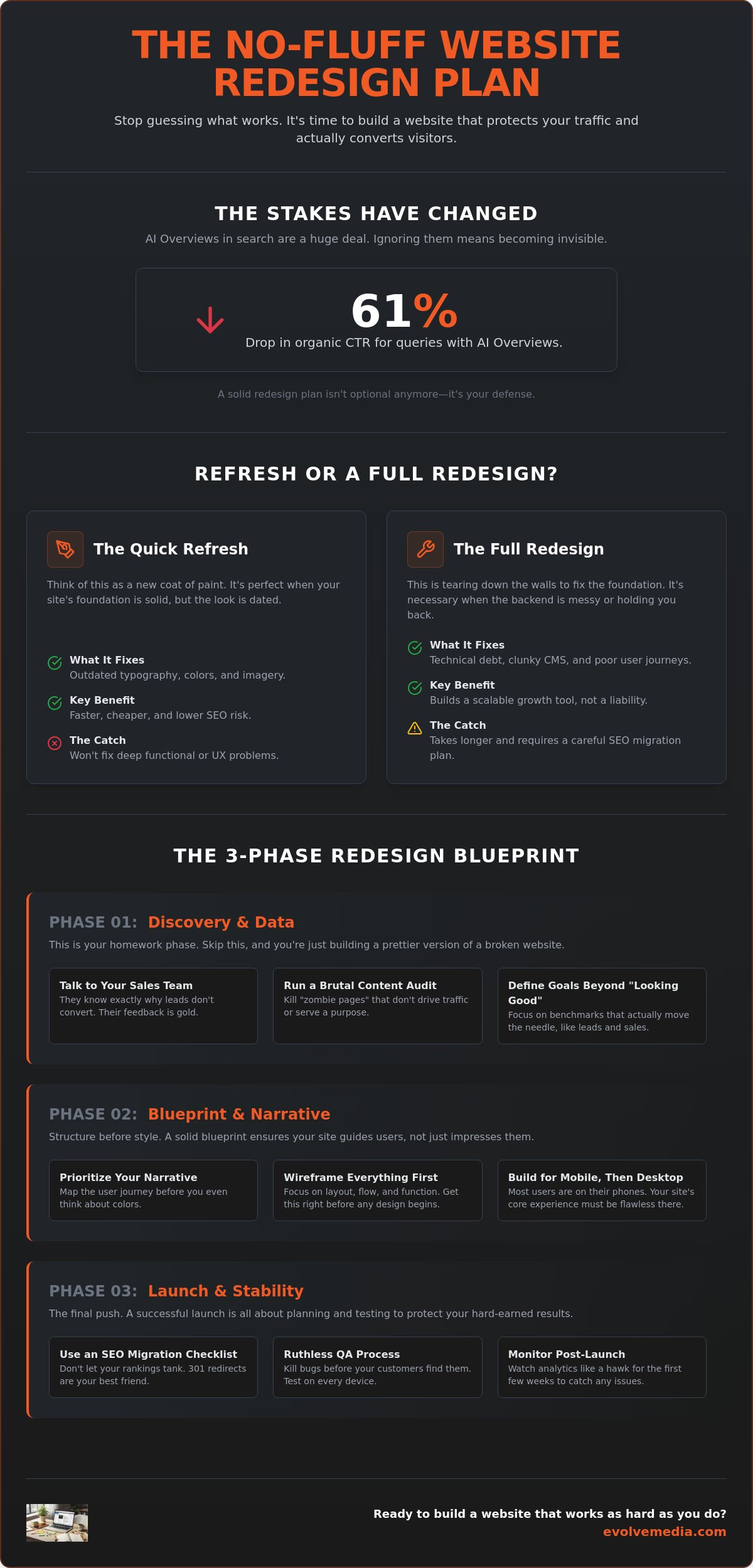
In 2025, AI Overviews started appearing in nearly a quarter of all search results, causing organic click-through rates to drop by 61% for those queries. This is why a solid website redesign project plan is no longer just a nice-to-have document. It’s your only defense against disappearing from the internet entirely. Most teams dread the overhaul conversation because they’ve seen projects drag on for years or watched their hard-earned rankings vanish in a single afternoon.
It’s exhausting to feel like you’re choosing between a site that looks pretty and one that actually functions. You need a clear, human-first blueprint that skips the corporate jargon and focuses on your actual business goals. We’ve spent years helping brands turn their digital presence from a source of anxiety into a reliable growth engine that stays ahead of the latest search trends. We don’t believe in overcomplicating things just to sound smart.
This guide breaks down the exact steps to manage a redesign without the usual headaches. We’ll show you how to protect your SEO rankings, build a site that converts visitors, and establish a timeline that your team can actually stick to. It’s time to build a website that works as hard as you do.
Key Takeaways
- Stop overbuilding. Learn how to tell if you need a total overhaul or just a quick polish to fix that “embarrassing” homepage.
- Stop guessing about what works. We’ll show you how to run a brutal content audit and set benchmarks that focus on actual conversions instead of vanity metrics.
- Use our website redesign project plan to prioritize your narrative and wireframes before you ever touch a single pixel of design.
- Protect your traffic from tanking. Get the checklist for a successful SEO migration and a QA process that kills bugs before your customers find them.
Deciding Your Direction: Is it a Website Refresh or a Total Redesign?
Stop and look at your bounce rate before you hire a designer. If people are leaving your site within three seconds, you have a problem that a new logo won’t fix. Before you commit to a massive website redesign project plan, you have to be honest about why you’re doing this. Is your site actually broken, or are you just tired of looking at the same hero image? We see it all the time. A CEO gets a gut feeling that the site is dated, and suddenly everyone is in a panic.
The “silent killers” of conversion often hide in the foundation. If your mobile load speed is crawling or your checkout process has six unnecessary steps, a new color palette is just a distraction. You need to look at your technical debt. If your current CMS makes your marketing team want to pull their hair out every time they need to post a blog, you need more than a facelift. A full overhaul is a big commitment. It’s like deciding whether to repaint your living room or tear down the walls to fix the foundation.
The Quick Refresh: When a Coat of Paint is Enough
A refresh is your best bet if your site has solid custom web development underneath but just looks dated. This involves updating typography, colors, and imagery to match your branding. It’s faster and carries much less risk for your SEO. However, it won’t fix deep UX issues. Check out lessons from unsolicited redesigns to see how changing too much can backfire with core users.
The Full Redesign: Rebuilding for Performance and Scale
Sometimes the messy backend is too far gone. A total rebuild is necessary when you need complex business logic or a move to a professional hosting environment. A full redesign lets you purge technical debt and restructure navigation for 2026 browsing habits. This path takes longer, but it ensures your site is a growth tool, not a liability.
- Audit your CMS: Is it actually holding back your content team from publishing?
- Check your speed: Are technical bottlenecks killing your conversions before the page even loads?
- Evaluate the ROI: Will a visual update actually move the needle on sales or just look pretty?
Phase 1: Discovery, Data, and Doing Your Homework
Discovery isn’t just about staring at Google Analytics and nodding at charts; it’s about finding where the friction lives. Before you sketch a single line in your website redesign project plan, you need to talk to your sales team. They’re the ones on the front lines hearing why customers didn’t click “buy” or why they couldn’t find your pricing page. This raw feedback is worth more than a dozen generic industry reports. You’re building for people, not just for search bots.
We’ve seen projects fail because they focused on vanity traffic instead of conversion rates. If you have 10,000 visitors but only two leads, your site is a leaky bucket. You need to set benchmarks that actually move the needle for your business in 2026. This means mapping out the user journey to ensure your new structure moves people through the funnel without making them hunt for a contact form.
Auditing Your Current Digital Assets
Run a brutal content audit. Most sites are weighed down by “zombie pages” that haven’t been touched since 2021. If a page doesn’t serve a purpose or drive organic traffic, kill it. Use heatmaps to see where users are getting stuck or frustrated on your current layout. If you’re looking at ecommerce development data, pay close attention to where people drop off in the checkout flow. Protecting your high-performing pages is non-negotiable; you don’t want to accidentally delete the blog post that brings in 40% of your leads.
Defining Goals Beyond “Looking Better”
Your redesign should be a propellant for growth, not just a cosmetic update. Start by listing the functional requirements for any online applications your customers use daily. Align these goals with your 2026 digital marketing strategy to ensure your site is ready for the shift toward AI-driven search. Even large institutions use a phased approach, as seen in the university web redesign process, which prioritizes strategy long before the pixels are placed. Build a timeline that includes “flex time” for the unexpected hitches that always happen during development.
- Interview Stakeholders: Ask your customer support team for the top three things people can’t find on the current site.
- Map the Funnel: Define exactly what path you want a first-time visitor to take to become a customer.
- Set Hard Metrics: Aim for a specific percentage increase in form completions, not just “more traffic.”
If you’re feeling overwhelmed by the data, it helps to chat with a partner who has navigated these audits before.
Phase 2: Building the Blueprint and Nailing the Narrative
Once you have your data, it’s tempting to jump straight into picking out fonts and high-res photos. Resist that urge. Your website redesign project plan needs a skeleton before it gets a skin. We call this the wireframing stage. It’s where you decide where the buttons go and how the pages connect without getting distracted by pretty colors. If the structure doesn’t make sense in black and white, a million-dollar color palette won’t save it.
The Messaging Framework: Talking to Humans
Ditch the corporate speak. If your grandmother wouldn’t understand what you do after reading your homepage, you’ve failed. Use the specific words your customers use when they’re complaining or asking questions. Every single page needs one clear call to action. Don’t give people ten options; give them one. Before you commit to a final version, run a 3-day A/B test on your main headlines to see which one actually gets clicks.
UX Design and Information Architecture
Keep your navigation menu lean. If you have twenty items in your header, people will get overwhelmed and leave. Build a sitemap that is logical and easy to follow. Mobile-first design is the standard now, not an extra feature you add at the end. You also need to bake in accessibility from the start. In 2026, aiming for WCAG 2.1 Level AA compliance isn’t just about being nice; it’s a legal benchmark that protects you from the 30% annual increase in ADA-related lawsuits.
- Wireframe first: Map out the user flow in grayscale to ensure the logic holds up.
- Copy leads: Finalize your messaging before the design team starts their work.
- Accessibility is core: Use high-contrast colors and screen-reader-friendly layouts from day one.
Ready to turn these blueprints into a reality? Let’s talk about your next project.
Phase 3: The Handoff, The Launch, and Staying Stable
Hitting the “publish” button feels like crossing a finish line, but in a successful website redesign project plan, it’s actually just the start of a new phase. You’ve spent months planning and designing. Now, you need to ensure the technical handoff doesn’t break everything you’ve built. We recommend a soft launch first. Let a small group of trusted users break things in a live environment before you announce it to the world. It’s much better to find a broken contact form when ten people are looking than when ten thousand are.
One of the biggest fears we hear from clients is the dreaded SEO tank. If you don’t manage your 301 redirects perfectly, Google will treat your new site like a stranger. Every old URL must point to its new home. You also need to train your team. There is nothing worse than a beautiful new site that nobody knows how to update. Spend a few hours walking through the CMS so your marketing team can swap out images and edit text without calling a developer every five minutes.
Technical Execution and SEO Migration
Rigorous QA is your best friend here. Check every link, button, and form twice. If you’re running an ecommerce site, do a real test purchase with a real credit card. You should also consider a managed hosting plan that can handle the 2026 performance demands of a modern site. Verify that your seo marketing agency has done a final sweep of the site structure to confirm that all metadata and schema tags are in place.
Post-Launch: The Project Isn’t Over Yet
Set up a 30-day monitoring period. Watch your site speed and uptime like a hawk. Even the best plans can have hiccups once they hit real-world traffic levels. Collect user feedback immediately through a simple on-site survey or by watching session recordings. This data will tell you exactly what to tweak in your next round of updates. If you want a second pair of eyes on your strategy, you can always reach out for a professional audit of your website redesign project plan to make sure you haven’t missed a beat.
- Redirects: Map every single old URL to a new one to protect your rankings.
- QA: Test your site on multiple browsers and devices to catch layout bugs.
- Training: Record your CMS training sessions so new hires can watch them later.
Turn Your Digital Blueprint Into a Growth Engine
A successful website redesign project plan isn’t about chasing the latest design trend; it’s about building a reliable tool that solves your customers’ problems. We’ve seen that prioritizing business logic over pretty pixels and protecting your SEO rankings are the only ways to keep your traffic from tanking. Your site is a living asset. It requires a team that understands the nuances of complex business logic and custom applications to keep it running at peak performance.
We’ve been helping brands navigate these technical waters since 1996. Our team provides comprehensive support that stretches from initial branding to secure hosting, ensuring your site remains stable long after the launch party is over. You don’t have to handle the technical heavy lifting alone. We’ve spent decades perfecting this process so you can focus on running your business.
Ready to build a site that actually works? Let’s talk about your project plan.
You’ve got the roadmap in your hands. Now it’s time to take the first step toward a site that your team loves and your customers trust. We’re ready when you are.
Common Questions About Redesigning Your Site
How long does a typical website redesign project take?
A typical redesign takes between three and six months from the first discovery meeting to the final launch. A simple brochure site might wrap up in eight weeks, while a custom ecommerce platform can easily stretch past six months. Your timeline depends on how fast you can approve designs and provide content. We always suggest building in a few extra weeks for unexpected testing.
Will a website redesign hurt my SEO rankings?
A redesign shouldn’t kill your traffic if you follow a strict website redesign project plan. The danger comes from changing URLs without setting up 301 redirects. If you map your old pages to the new ones and keep your high-performing content, you might actually see a boost. Search engines reward sites that load fast, work well on mobile, and provide a great user experience.
What is the average cost of a professional website redesign?
Pricing varies based on your site’s scale and the complexity of the features you need. A small business site with five pages is a different investment than a custom application with complex user logic. Instead of looking for a flat fee, focus on the specific technical requirements and the value the new site brings. Most professionals will provide a range once they’ve audited your current setup; you can also explore Projektbasierte Honorare für Webentwicklung und Webdesign to see how specialized freelancers like ImPressWeb structure their rates.
How often should a business redesign its website?
Most businesses look at a major overhaul every three to five years. Technology moves fast, and what looked modern a few years ago might feel like a relic today. You don’t always need a full rebuild, though. Regular updates to your copy and small design tweaks can keep your site relevant. If your conversion rate starts dropping, it’s a clear signal for a change.
Do I really need a project plan for a small website?
Yes, because even a tiny site can go off the rails without a clear website redesign project plan. Without a roadmap, you’ll find yourself arguing over button colors or adding features until you’ve missed your deadline by a month. A simple plan keeps everyone on the same page and ensures you hit your business goals. It’s about efficiency, not making things complicated.
What should be included in a website redesign RFP?
Your RFP should focus on your business goals and technical must-haves rather than just a list of pages. Include your target launch date, any specific integrations like a CRM or payment gateway, and your primary audience. Be clear about what isn’t working on your current site. This helps partners give you a realistic proposal that actually addresses your specific pain points.