
The cheapest quote you receive for your website might actually be the most expensive mistake your business makes this year. It’s a common frustration. You get three proposals with wildly different numbers that leave you wondering if anyone is looking at the same requirements. We’ve seen this cycle since our founding era in the early days of the web, and frankly, the rise of automation has only made web design pricing feel more like a black box than ever before.
You probably suspect that those hidden fees are waiting to pounce once the project starts.
You’re right to be cautious. It’s stressful to worry that your new digital home will look pretty but fail to actually drive revenue or scale as your company grows. We’ve guided everyone from local legends to global giants through these waters, and we’re here to settle those nerves with a checklist of mistakes to avoid so you don’t overpay.
This guide will reveal the real factors that drive costs in the age of AI. While AI coding assistants have reduced median build times by up to 34% according to 2026 benchmarks from WebFX, that efficiency hasn’t always translated to lower bills. We’ll break down how to compare agency quotes and build a framework for a site that serves as a propellant for your growth. It’s time to move past the guesswork.
Key Takeaways
- Stop buying a simple “look” and start investing in a high-performance business tool that actually drives revenue.
- Avoid the budget-killing cycle of rework by using our 7-point checklist to get your project right on the first try.
- Learn to read between the lines of web design pricing proposals to spot missing essentials like SEO and hosting before you sign.
- Discover why a partner who has navigated every tech shift since 1996 is your best bet for a site that scales with your growth.
Decoding Web Design Pricing: What Are You Actually Paying For?
The wide range of quotes you see for a new project can feel like a riddle. You might get one estimate for $5,000 and another for $50,000 for what seems like the same set of pages. The truth is that web design pricing reflects more than just the visual layout. You are paying for a combination of strategy, technical execution, and the long-term support that keeps your site from breaking three months after launch.
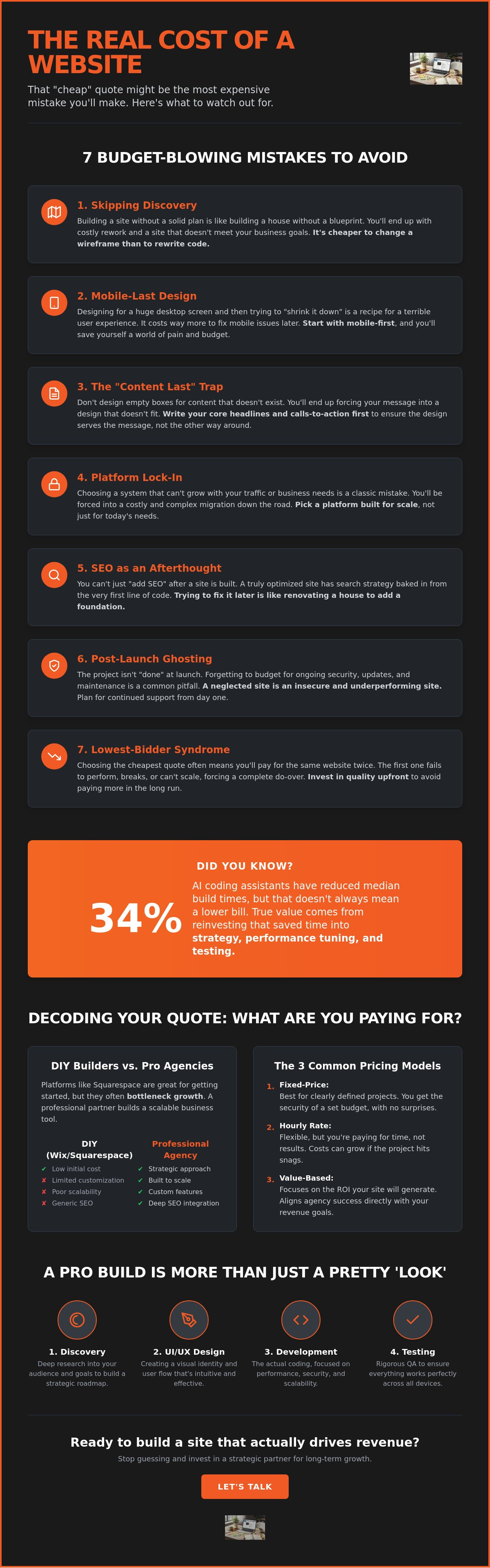
A professional build typically breaks down into four core phases:
- Discovery: Researching your audience and competitors to build a roadmap.
- UI/UX Design: Creating the visual identity and ensuring users can find what they need.
- Development: The actual coding, often sped up by AI assistants, which allows more time for performance tuning.
- Testing: Verifying that everything works across all devices and meets Core Web Vitals standards.
DIY Builders vs. Professional Agencies
Platforms like Squarespace or Wix are tempting because they’re cheap. They are a smart move if you’re just starting out and have more time than money. However, DIY approaches often bottleneck your growth. You’ll eventually hit a wall where a template can’t handle your specific business logic or high-traffic needs. For businesses ready to scale, custom web development offers the performance and flexibility that a $200-a-year subscription simply can’t match.
The Three Main Pricing Models
Most agencies use one of three ways to bill for their work. Fixed-price projects are the most common and work best when your scope is clearly defined from day one. It gives you the security of a set budget. Hourly rates are more flexible, but you’re essentially paying for time rather than results. If a project hits a snag, your bill grows. Finally, value-based pricing focuses on the ROI the site will generate. While often the most expensive upfront, it aligns the agency’s success directly with your revenue goals.
The Redesign Checklist: 7 Mistakes That Blow Your Budget
Most business owners think the quote on the proposal is the final number. It rarely is. The real budget killer isn’t the agency fee; it’s the rework. We’ve seen projects stall and costs double simply because the foundation was shaky. As your curious friend who has spent decades in the trenches, we want to help you avoid the expensive “do-overs” that plague most builds. Think of this as your manual for staying on budget.
Here are the 7 most common pitfalls that inflate web design pricing:
- Skipping Discovery: Building without a blueprint.
- Mobile-Last Design: Fixing responsive issues after the site is live.
- The “Content Last” Trap: Designing boxes for text that doesn’t exist yet.
- Platform Lock-in: Choosing a system that can’t grow with your traffic.
- SEO as an Afterthought: Trying to “add SEO” once the code is finished.
- Post-Launch Ghosting: Forgetting to budget for security and updates.
- Lowest-Bidder Syndrome: Paying for a cheap site twice because the first one failed.
Skipping the Discovery Phase
Building a site without a plan is like building a house without a blueprint. You’ll end up moving walls mid-construction, and that’s when costs spiral. Demand a discovery session before you sign a full development contract. True professional web design requires deep curiosity about your business goals, not just a list of features. It’s cheaper to change a wireframe than to rewrite a database.
Ignoring Mobile-First UX and Content Strategy
Designing for a massive desktop monitor and then “shrinking it down” is a recipe for high bounce rates. It costs far more to fix mobile issues later than to build them right from the start. Also, don’t design boxes before you know what goes in them. Tweak your approach: write your core headlines and calls-to-action before the first wireframe is drawn. This ensures the design supports your message, not the other way around.
Choosing the Wrong Platform for Scaling
Beware the trap of “cheap” proprietary platforms. They might look easy today, but they often require expensive custom coding for basic features as you grow. For high-stakes projects like ecommerce development, your choice of platform is everything. Open-source flexibility usually beats the long-term costs of being locked into a system you don’t own. If you’re feeling stuck on which tech stack to pick, feel free to ask us for a second opinion on your project scope.
How to Evaluate a Web Design Quote Without Getting Burned
Reading a proposal is often like looking at a restaurant menu where the prices are clear but the ingredients are a mystery. You have to look for what is not on the page. If a quote is suspiciously low, it is usually because essential pieces like SEO or secure hosting have been stripped out to make the number look better. This is why web design pricing can feel so deceptive. You think you are buying a finished house, but you are actually just paying for the frame.
Don’t get blinded by a flashy sales deck. Look for visual anchors in the proposal, such as detailed timelines and specific milestones. If an agency cannot tell you exactly what they will deliver by week four, they do not have a process; they have a hope. You want to see a clear map of how they get from a blank screen to a live, revenue-driving site.
We always suggest a simple 3-day A/B test of communication. Send a follow-up question to two different agencies on a Tuesday afternoon. How fast do they respond? Is the answer clear and human, or does it feel like a canned response? If an agency is slow or vague during the honeymoon phase of a pitch, imagine how they will treat you when your site has a bug six months from now. Reliability is a feature you cannot afford to skip.
Upfront Costs vs. Total Cost of Ownership (TCO)
Think of your website as an iceberg. The initial build is just the tip that sits above the water. The bulk of your investment is the Total Cost of Ownership, which includes recurring needs like security updates, managed hosting, and content refreshes. A cheap build often leads to a high TCO because the code is messy or the platform is hard to update. Always ask about post-launch support packages early in the conversation so you aren’t surprised by a massive maintenance bill later.
Portfolio Substance vs. Sales Pitch Fluff
Pretty pictures are easy to create, especially in the age of AI. Results are much harder. When you look at an agency’s portfolio, ask: “Did this site actually solve a business problem?” Look for substance over style. You want to see specific metrics, like a site that helped a client increase conversions by 20% or reduced load times by 3 seconds. If you want to see how we’ve handled these challenges for other brands, you can request a walkthrough of our recent work to see the data behind the designs.
Investing in a Strategic Partner for Long-Term Success
A great agency should feel like an energizing part of your own team, not just another vendor invoice. When you evaluate web design pricing, you are really paying for a history of reliability and the peace of mind that comes with it. We’ve been building for the web since 1996. That is a long time in digital years. It means we’ve seen every trend come and go, and we know which technologies actually stick.
Choosing a partner who understands the bigger picture is vital. A strategic build doesn’t just stop at the code. It integrates your branding and digital marketing into the very architecture of the site. This ensures that when you finally flip the switch, your site is already built to attract and convert the right people. You aren’t just buying a website; you’re buying a propellant for your growth.
The ROI of Strategic Design
Let’s look at the math. A cheap site is often the most expensive thing you can buy if it doesn’t perform. Consider this real-world scenario:
- The “Budget” Site: You spend $5,000, but it converts visitors at only 1%.
- The Strategic Site: You spend $20,000, but it converts at 5%.
The second site is four times the price, but it generates five times the revenue. It pays for itself faster and lowers your customer acquisition costs over time. Beyond just sales, custom online applications can streamline your internal business logic, saving your team hours of manual work every single week. That is where the real value lives.
Ready to Start a Conversation?
We’d love to hear about your specific goals over a coffee-style chat. Whether you need a complex ecommerce platform or a site that simply tells your brand story better, we’ve got the institutional knowledge to get you there. We value thoroughness and long-term success over quick, transactional wins. If you want a partner who is as invested in your results as you are, we’re ready to talk.
Contact Evolve Media for a transparent quote.
Ready to Build Your Revenue Engine?
Your website is more than just a digital brochure; it is the heartbeat of your business growth. We’ve talked about why the cheapest quote often hides missing essentials and how focusing on the total cost of ownership protects your bottom line. By avoiding the common budget-killers we’ve discussed, you’re already ahead of most of your competition. You’re no longer just buying a “look.” You’re investing in a tool that works.
Navigating web design pricing shouldn’t feel like a riddle. It’s about finding that sweet spot where technical authority meets a genuine interest in your goals. We’ve been strategic partners for high-growth brands since 1996. That means we offer zero corporate fluff and a deep focus on results that actually move the needle for your company.
If you’re tired of opaque structures and hidden fees, it’s time for a different approach. We’re here to help you move from guesswork to a clear, actionable plan that fits your vision.
Let’s chat about your project and get you a real number.
We can’t wait to help you take that next big step.
Frequently Asked Questions
How much does a basic professional website cost in 2026?
Your total investment for web design pricing depends largely on whether you choose a solo freelancer or a full-service agency. A 2026 survey from Clutch indicates that most small business buyers stay within a specific mid-range budget for their projects. The final cost is driven by the complexity of your features, such as custom integrations or ecommerce tools, rather than just the number of pages you need.
Why is custom web design more expensive than a template?
What are the hidden costs of a website redesign?
Content creation is the most frequent hidden cost that surprises business owners during a redesign. If you don’t have professional photography or high-quality copy ready, you’ll need to add those to your budget. Other common extras include technical SEO migrations to save your rankings, specialized security certificates, and managed hosting fees that keep your site running fast. Budgeting for these early prevents stressful surprises right before your big launch day.
How long does a typical web design project take from start to finish?
Most professional projects take between 8 and 12 weeks to move from the initial strategy to the final launch. Even though AI-assisted tools have reduced build times by up to 34% according to 2026 benchmarks from WebFX, quality still takes time. Since our founding era in 1996, we’ve learned that a purposeful cadence is essential for discovery, design feedback, and the rigorous testing required to ensure a bug-free experience.
Should I pay for a website all at once or in installments?
Paying in installments is the industry standard because it keeps the project moving while protecting your budget. Most agencies use a milestone-based schedule where you pay a deposit to start, a portion after the designs are approved, and the final balance before the site goes live. This structure ensures that everyone stays aligned on the deliverables throughout the entire process and gives you clear checkpoints to review the work.
Does web design pricing include SEO and digital marketing?
Base web design pricing usually includes technical essentials like site maps and fast load speeds, but ongoing marketing is typically separate. Think of the build as the foundation of your house and digital marketing as the furniture that makes it livable. It’s best to discuss your long-term growth plans early so your site is built to support future SEO campaigns and branding shifts from the very first day.