
Your boss doesn’t care that the company website is ugly. It’s a harsh truth, but to a stakeholder holding the checkbook, “outdated aesthetics” usually sounds like a vanity project rather than a business priority. You know the site is clunky and leaking leads, yet you’re stuck hearing that the current setup is “fine enough” for now. Learning how to get buy-in for a new website isn’t about winning a design argument; it’s about translating technical debt and slow load times into the language of lost revenue.
We’ve helped plenty of partners navigate these boardroom hurdles and we know that a “yes” comes from data, not just gut feelings. You’re about to learn how to stop apologizing for the “ugly site” and start presenting a bulletproof business case that treats a digital overhaul as a growth engine. This guide provides a clear roadmap for your pitch, including the specific metrics you need to track and the confidence to handle budget pushback. We’ll even look at why upcoming ADA Title II compliance deadlines, hitting as early as April 2027 for many organizations, make this a legal necessity rather than a “nice to have” project.
Key Takeaways
- Swap “ugly” complaints for hard evidence by identifying specific bottlenecks, like high mobile bounce rates, that stall conversions.
- Learn how to get buy-in for a new website by presenting the project as a revenue-generating asset instead of a line-item expense.
- Explain technical debt using simple metaphors to help non-technical stakeholders see why an old site is a financial liability.
- Defuse budget concerns by proposing a phased rollout that balances initial investment with immediate business goals.
- Align with a strategic partner who brings decades of industry wisdom to the table to ensure your project’s long-term success.
Audit Your Current Digital Bottlenecks Before You Pitch
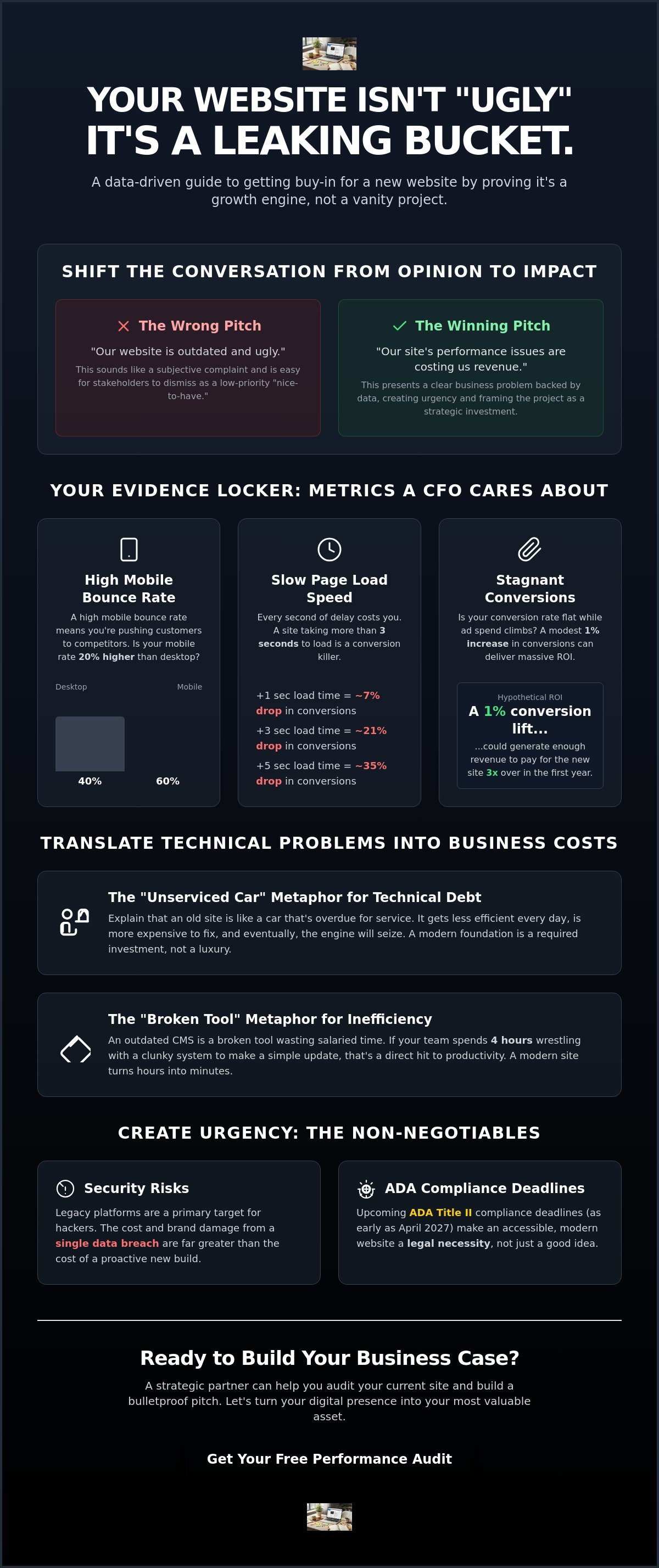
Stop telling your boss the website is ugly. Beauty is in the eye of the beholder, but a 40% bounce rate is in the eye of the accountant. If you want to know how to get buy-in for a new website, you have to stop acting like a critic and start acting like a detective. Stakeholders don’t move for “fresher colors” or “modern vibes.” They move for results. You need hard evidence that your current site is a broken tool that’s actively costing the company money.
Start by checking your mobile bounce rate. If it’s 20% higher than your desktop rate, you aren’t just missing out on clicks; you’re actively pushing mobile leads into the arms of your competitors. Follow this up with a raw speed test. If your pages take more than three seconds to load, you’re losing people before they even see your logo. Use heatmaps to find the “dead zones” where users get stuck or frustrated. When you can point to a specific spot in the sales funnel where 50% of your traffic vanishes, the conversation shifts from “do we want this?” to “how fast can we fix this?”
The Data Points That CFOs Actually Care About
Before you build your case, conduct a brief stakeholder analysis to figure out who holds the purse strings and what keeps them up at night. For most executives, that’s the bottom line. Pull conversion rate data from the last 12 months. If that line is flat or dipping while your ad spend goes up, you have a conversion problem, not a traffic problem. Highlight abandoned cart or form abandonment rates specifically. Contrast your site speed against your three biggest competitors. Nothing sparks action quite like seeing that the shop down the street is twice as fast as you are.
Visualizing the Opportunity Cost
Numbers don’t lie. Calculate exactly how much revenue a modest 1% increase in conversion would generate for the business over the next year. It’s often enough to pay for the new build several times over. Every second of lag costs roughly 7% in conversions; that is a massive tax on your marketing budget that no one should be willing to pay. If you need more “human” proof, gather a few support tickets or customer complaints about site frustration. Real stories of people trying to give you money and failing are incredibly persuasive. If you’re ready to see how these metrics look for your specific business, feel free to reach out to our team for a deeper look at your performance.
Translating Design Needs into Business Metrics
If you want to know how to get buy-in for a new website, you have to stop talking about “refreshing the look.” Stakeholders don’t buy “pretty.” They buy assets that grow the bottom line. You need to position the new site as a growth propellant that makes every dollar of your digital marketing work harder. Using a structured framework for securing buy-in for your ideas helps you pivot from asking for permission to presenting a strategic investment.
Start by explaining technical debt in plain English. It’s like driving a car that’s three years overdue for a major service. You can keep driving it for a while, but it’s getting less efficient every mile, and eventually, the engine is going to seize. A site built on old code is exactly the same. It’s slower, harder to update, and more expensive to maintain than starting fresh with a modern foundation.
Investing in custom web design and development isn’t about vanity. It’s about streamlining internal business processes. When your site talks directly to your CRM and automates lead routing, you’re buying back hours of time for your sales team. This connectivity ensures your site isn’t just a brochure, but a functional part of your operational machinery.
The “Broken Tool” Metaphor
An outdated site is a tool that actively hinders your team’s daily productivity. If your marketing team spends four hours wrestling with a clunky CMS just to update a single landing page, that’s a massive waste of salary. A modern CMS allows for updates in minutes, not hours. Plus, staying on a legacy platform is a massive security risk. Hackers look for unmanaged, out-of-date systems. A single data breach is far more expensive than a proactive new build.
Proving ROI Through Scalability
Modern ecommerce development allows your business to enter new markets without a total overhaul. A scalable site grows alongside the company, handling traffic spikes during high-stakes sales events because of robust hosting. If your current site crashes the moment you send a promotional email, you aren’t just losing sales; you’re damaging your brand’s reliability. If you’re tired of making excuses for a site that can’t keep up, you can start a conversation with us to see what a scalable platform looks like for your brand.
Neutralizing the “It’s Too Expensive” Objection
Money is almost always the sticking point. When you bring up the price tag, stakeholders often see a big number without a clear destination. To master how to get buy-in for a new website, you have to stop defending the price and start attacking the cost of inaction. Your website is a 24/7 salesperson that never takes a holiday, never gets sick, and never forgets to follow up on a lead. If that salesperson is currently showing up to meetings in a tattered suit and forgetting half the product features, you aren’t saving money; you’re losing market share to competitors who look sharper and move faster.
Breaking the project into phases helps. You don’t have to build the whole city at once. Start with the core infrastructure that drives the most revenue. This approach makes the initial investment feel manageable and allows you to prove ROI before scaling up. Using a structured approach like Colorado State University’s Web Governance framework can help you define clear roles and responsibilities early on, ensuring that money isn’t wasted on redundant processes or content that doesn’t convert.
The Three-Step Response to Budget Pushback
When the CFO says it’s too expensive, don’t get defensive. Validate their concern first: “You’re right, this is a significant investment for our team.” This builds trust. Immediately pivot to the risk you uncovered in your audit. For example, point out that you’re currently losing a confirmed percentage of leads every month because your mobile checkout is broken. Finally, propose a test to lower the stakes. Suggest starting with a discovery phase to map out the exact ROI before the company commits to the full build. This is a powerful strategy for how to get buy-in for a new website because it reduces the perceived risk for the decision-makers.
Finding Hidden Budget
Look for the money already being wasted. Most old sites are cluttered with legacy tools or expensive plugins that a modern build would make redundant. You can also show how a better user experience reduces the cost-per-acquisition (CPA) for your paid ads. When your site converts better, every dollar you spend on digital marketing goes further. You can even save on customer support costs by integrating online applications that allow users to help themselves. If you need help finding these hidden savings in your own tech stack, book a strategy call with us to audit your current setup.
From Approval to Execution: Choosing Your Strategic Partner
The “yes” from your board is a massive victory, but it is also where the real work begins. If you’ve followed the steps on how to get buy-in for a new website, you’ve promised a tool that drives revenue and solves technical debt. Now you have to deliver. The quickest way to lose that hard-won trust is to hire a vendor who just takes orders instead of a partner who understands your business logic. You need a team that asks about your conversion goals and customer pain points before they ever mention a font choice or a hex code.
Reliability matters in an industry where agencies often vanish overnight. Look for a team with a long-standing history, like Evolve Media, founded in 1996. That kind of tenure means they’ve seen every tech trend come and go; they know how to build for longevity. A strategic partner is someone who is as invested in your 2026 growth as you are, ensuring your new site isn’t just a temporary fix but a long-term asset that evolves with your company.
What to Look for in a Web Agency
You need a mix of creative branding and deep technical development expertise. It’s not enough for a site to look good; it has to work flawlessly under the hood. Ask potential partners for concrete examples of how they’ve solved specific business problems, like integrating a complex CRM or building a custom online application. If they can’t explain the “why” behind their technical choices, they aren’t the right fit. Ensure your plan includes managed hosting to protect your investment, so you aren’t left scrambling when a server goes down or a security patch is needed.
Setting the Project Up for Success
To keep your stakeholders happy, you need to prove you’re meeting the promises you made during the pitch. Define clear KPIs for the new site, such as a 15% reduction in bounce rate or a specific increase in mobile lead volume, so you can report back with hard data in six months. Establish a direct line of communication between your internal team and the developers to avoid the friction of “telephone” style misunderstandings. If you’re ready to move from the pitch to the build, contact Evolve Media for a strategy session to see how we can turn your approved case into a high-performing reality.
Turning Your Pitch Into a Performance Engine
Winning over stakeholders is less about the “look” and more about the “leak.” You’ve audited the bottlenecks, translated technical debt into revenue opportunities, and mapped out a phased plan to handle budget pushback. Mastering how to get buy-in for a new website means proving that your current digital presence is a liability that the business can no longer afford to ignore.
At Evolve Media, we’ve been helping brands navigate these high-stakes conversations since 1996. We don’t just build sites; we build strategic partnerships focused on custom business logic and ecommerce scalability. You’ll get direct, fluff-free communication from a team that understands your growth is the only metric that truly matters.
Let’s discuss your project goals and build your business case together.
It’s time to stop making excuses for your old site and start building something that actually works for your team. You’ve got the data; now go get that “yes.”
Frequently Asked Questions
How much does a new professional website usually cost in 2026?
The total cost depends entirely on the complexity of your business logic and whether you are building a simple lead-gen tool or a high-volume ecommerce platform. Industry reports show a wide range for small business builds, but you should focus on the total cost of ownership over three years. This includes the initial build, hosting, security updates, and ongoing maintenance, which can often double the original investment over time.
How long should it take to get a new website live from start to finish?
A standard professional project typically takes between eight and sixteen weeks from the initial discovery phase to the final launch. While some agencies quote faster turnarounds for basic MVPs, a strategic build requires a deliberate cadence to handle custom development and rigorous testing. Rushing the process usually results in broken funnels and technical debt that you’ll have to pay to fix later.
What is the most common reason stakeholders reject a new website proposal?
Most proposals fail because they focus on aesthetics instead of business outcomes. If a stakeholder hears “we need a fresh look,” they hear “unnecessary expense.” To fix this, your strategy for how to get buy-in for a new website must lead with evidence of failure, such as high bounce rates or lost mobile leads. They don’t say no to growth; they say no to vanity projects.
Do we really need a custom site, or is a template good enough for now?
Templates are fine for testing a basic concept, but they often become a “broken tool” as your business scales. Custom development allows you to build specific online applications and business logic that a rigid template cannot handle. If you plan on growing your traffic or adding complex ecommerce features, starting with a custom foundation prevents a costly total rebuild eighteen months down the line.
How do I explain technical SEO needs to a non-technical CEO?
Stop talking about crawl budgets and talk about “digital real estate” and visibility. Explain that technical SEO is like the foundation of a retail store. If the front door is locked and the lights are off, it doesn’t matter how great the products are; nobody can buy them. A site with poor technical health is essentially invisible to Google, which gives your competitors a free pass to take your market share.
What happens if we decide to delay the website redesign for another year?
Delaying a redesign usually increases your eventual costs while your current site continues to leak revenue. Beyond the lost leads, you face significant legal risks. The Department of Justice has issued clear ADA Title II compliance deadlines, with many organizations required to meet WCAG 2.1 AA standards by April 2027. Waiting another year leaves you with a dangerously small window to avoid potential legal challenges and accessibility audits.