What if the most expensive mistake your business makes this year isn’t the software you build, but the platform you choose to host it on? It’s a heavy question. We’ve seen many founders feel paralyzed by the choice between web apps and mobile apps, stuck between the fear of overspending on a product nobody downloads and the dread of complex development cycles. With iOS 26 SDK requirements now mandatory for App Store updates and cloud hosting prices climbing across the board, the stakes for your budget are high.
We understand the frustration. It’s hard to feel confident when you’re drowning in terminology like “hybrid” or “cross-platform” while worrying about a 25% annual maintenance bill. This guide is your straight-talking roadmap to choosing the right architecture for your business goals. We’ll skip the jargon and give you a clear decision framework based on the cost-to-value ratio. You’ll learn how to align your tech with your users’ actual habits; this ensures your next digital move is a smart investment rather than an expensive experiment.
Key Takeaways
- Ditch the “native vs. hybrid” confusion and learn why a high-functioning web app often beats a home-screen icon for early growth.
- Use our straight-talking framework to choose between web apps and mobile apps based on your specific budget and customer needs.
- Discover why a one-second lag can kill your sales and how to bake speed and security into your app’s foundation.
- Budget accurately for the future by understanding why maintenance typically costs 15-25% of your initial build every year.
- Secure a stable home for your project with hosting that scales automatically, so you don’t crash when your marketing takes off.
Web Apps and Mobile Apps: Breaking Down the Basics Without the Jargon
Let’s strip away the technical fluff and get to the heart of the matter. Think of a web app as a high-functioning website that lives entirely within a browser. You don’t visit an app store to find it; you simply type a URL into Chrome or Safari and get to work. On the flip side, mobile apps are the ones you actually download, authenticate with a thumbprint, and keep on your home screen for daily use. It’s the difference between a tool you use on the fly and a permanent fixture on your device.
Choosing between web apps and mobile apps often feels like a high-stakes gamble, but it usually boils down to how you want to reach your customers. Web apps are generally much faster to launch because you aren’t waiting for a third-party reviewer to approve your code. You push a change, and your users see it the next time they hit “refresh.” Native mobile apps, however, are the undisputed champions when your business model relies on hardware. If you need to use a phone’s camera, GPS, or Bluetooth constantly, native is your best bet.
To better understand how these different architectures function in the real world, watch this helpful breakdown:
For most businesses, the decision isn’t just about code. It’s about friction. Every extra step a user has to take, like visiting an app store or entering a password, is a chance for them to leave. Web apps remove that barrier, while mobile apps reward loyalty with a more integrated experience. Both have a place in a modern digital strategy.
Why the Line Between Web and Mobile is Blurring
The ‘Founding Era’ Perspective
Since we started in 1996, we’ve seen tech trends come and go like bad fashion. Our experience shows that reliability usually beats flashy, unnecessary features every single time. We prioritize building tools that actually solve problems rather than chasing the newest buzzword. Stability is the anchor for every successful web design and development project, ensuring your users stay happy while your maintenance costs stay predictable.
The Great Debate: Deciding Between Web, Native, and Hybrid Paths
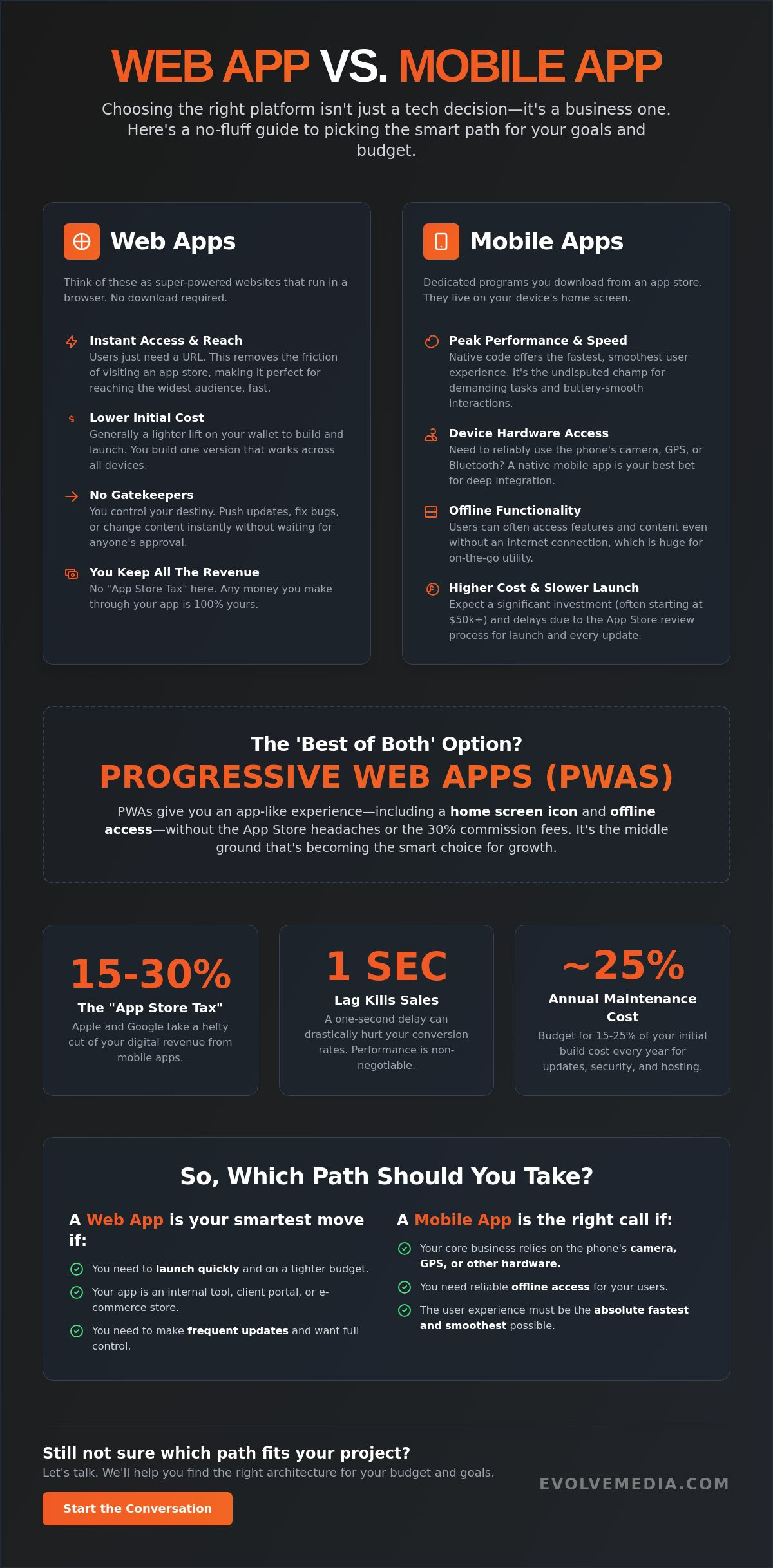
Choosing the right architecture isn’t just a technical fork in the road; it’s a major financial decision that impacts your bottom line for years. We often see businesses rush into mobile development without realizing that web apps and mobile apps serve very different masters. Web apps are generally lighter on your wallet during the initial build. While a mid-range mobile app often starts around $50,000, you can frequently get a functional web application off the ground for significantly less. It’s a matter of choosing the right tool for the job rather than the most expensive one.
Think about user friction. Asking a new customer to visit an app store, wait for a download, and grant system permissions is a massive “ask.” You’ll likely lose people before they even see your login screen. Beyond the friction, you have to account for the “App Store Tax.” Apple and Google typically take a 15% to 30% cut of your digital revenue. Plus, every time you want to tweak a headline or fix a minor bug, you’re at the mercy of their approval hurdles. If you want total control over your release schedule, the browser is your best friend.
Native apps still hold the crown for raw speed and offline use, though. If your users are in low-connectivity areas or need instant, buttery-smooth interactions, native code wins. It’s about the “feel” of the experience. If you’re unsure which path fits your current growth stage, you can start a conversation about your specific goals with us to see which architecture aligns with your budget.
When a Web App is the Smarter Move
We typically recommend web apps for internal business tools, client portals, or high-traffic stores. They act as a propellant for brands that need to scale fast across desktops, tablets, and phones simultaneously without building three separate versions. If you’re looking to sell products, our guide on ecommerce development explains how a web-first approach can keep your customer acquisition costs low by living where your SEO traffic already lands.
When a Native Mobile App is Worth the Investment
Build for mobile if your tool requires high-frequency daily interaction. If users need to check your app ten times a day, having that icon on their home screen is priceless. High-performance gaming or complex data visualization often needs the native power of the device’s processor to stay responsive. Mobile apps excel at building deep-seated loyalty through push notifications, keeping your brand at the top of their mind without relying on an algorithm.
Realistic Logistics: Security, Speed, and What Development Really Costs
Security isn’t a “nice-to-have” feature you bolt on right before launch. It is the foundation of your entire digital asset. When deciding between web apps and mobile apps, many founders ignore the boring stuff like server patches and latency until it’s too late. With supply chain vulnerabilities becoming the number one security concern for engineering teams in 2026, a single breach can wipe out years of hard-earned customer trust in an afternoon. If you don’t build with a “secure by default” mindset, you’re essentially building a house on sand.
Speed matters just as much as security. A one-second delay in load time can absolutely tank your conversion rate. Instead of looking for vague ways to “improve the experience,” look at your literal clicks. Tweak your specific user flow to remove one unnecessary form field or one extra confirmation screen. Every millisecond you save keeps a user from bouncing to a competitor. Simple, fast, and direct always wins the race.
Don’t fall into the trap of building too many features at once. We’ve seen projects stall because a team tried to launch a Swiss Army knife when the customer just needed a simple blade. Start with a solid Minimum Viable Product (MVP). As noted by the experts at Founders Workshop, distinguishing between a prototype and an MVP is crucial for focusing your resources. It’s much easier to add features to a working app than it is to fix a bloated, broken one that nobody wants to use anyway.
Protecting Your Business Data
Web apps need professional hosting to stay secure against modern threats. A “set it and forget it” DIY setup is a recipe for disaster. Managed environments are significantly safer than unmonitored servers because they receive constant updates and patches. Interestingly, a managed seo services approach often complements secure development by ensuring your site stays visible and reputable while the backend remains locked down tight.
The Real Cost of ‘Cheap’ Development
Vague advice like “find a good developer” is useless when your business is on the line. You need a partner with a long history, ideally a 30-year track record, who understands that the initial build is only half the battle. Remember to factor in annual maintenance, which typically runs between 15% and 25% of your original development cost. Stability is always cheaper in the long run than paying for constant emergency fixes. If you’re ready to build something that lasts, reach out to us today to discuss your project logistics.
Scaling for the Long Haul: Why Your App Needs a Stable Home
Pop the champagne when your code goes live, but don’t get too comfortable. Launching is just the beginning; the real work starts on day two when your first thousand users show up at once. If your server isn’t ready for that traffic spike, your hard-earned reputation vanishes in a “500 Internal Server Error.” Managed hosting ensures your app doesn’t crash when your marketing finally hits its stride. It’s about building a digital foundation that acts as a propellant for growth, not a heavy weight that slows you down.
We’ve seen too many businesses get caught off guard by the hidden costs of success. With major providers like AWS and Google Cloud Platform scheduled to increase prices in the second half of 2026, infrastructure management is becoming a significant line item. Regular performance audits keep your digital tools agile and relevant. Without them, your web apps and mobile apps will eventually feel sluggish, driving users toward the next shiny alternative. Stability is a choice you make every single day.
The Strategic Partner Advantage
We don’t just build software; we advise based on decades of market expertise. Since 1996, we’ve helped companies navigate every major shift in the digital world. A seo marketing agency perspective helps your app get discovered by the right people at the right time. We’re curious about your long-term business goals, not just your technical requirements. This relational approach ensures we’re building for your future, not just your launch date.
Ready to Build Something Real?
Stop guessing between web apps and mobile apps. Every business has a unique pulse, and your tech stack should match it perfectly. Let’s have a conversation about what your business actually needs to grow without the corporate fluff. When you’re ready to move past the concept phase, get in touch with the Evolve Media team to start your project. We’re ready to help you build something that lasts.
Build for Your Users, Not Just the App Store
Choosing between web apps and mobile apps doesn’t have to be a coin toss. You now have the framework to decide based on user friction, development costs, and the long-term reality of maintenance. Whether you need the broad reach of a web application to capture SEO traffic or the deep-seated loyalty of a native mobile experience, the focus must remain on your specific business goals. Don’t forget to account for those annual maintenance costs to keep your tools sharp, secure, and responsive.
Since 1996, we’ve helped both nimble startups and established enterprise brands build digital assets that actually solve problems. We offer full-service development, design, and hosting, which means you get a single point of contact for your entire project. Our team values deep-seated curiosity over corporate jargon, and we’re more interested in your growth than just checking off technical requirements. We’re here to ensure your technology supports your vision instead of holding it back.
Ready to turn your vision into a high-performing reality? Let’s talk about your next digital project and find the architecture that fits your budget. You’ve got the roadmap; now it’s time to start the engine. We’re ready when you are.
Common Questions About Web Apps and Mobile Apps
Is a web app cheaper than a mobile app?
Yes, a web app is typically lighter on your budget because you only build a single codebase that works across every device with a browser. You also avoid the “App Store Tax,” which saves you from paying the 15% to 30% commission that Apple and Google charge on digital sales. For many businesses, starting with a web-based tool provides a much better cost-to-value ratio during the early growth stages.
Do I need both a web app and a mobile app?
Most companies don’t need both right out of the gate. It is usually more effective to choose one platform based on how your customers actually behave; pick a web app if you want to be easily found via search engines, or a mobile app if you need to build deep loyalty through daily interactions. Spreading your budget too thin across both platforms often leads to two mediocre products instead of one great one.
Can a web app work offline like a mobile app?
Yes, modern Progressive Web Apps (PWAs) can function without a steady internet connection. They use a technology called service workers to cache important data on the user’s device. This allows your customers to browse your catalog or use specific tools even when they are in a dead zone, effectively bridging the gap between web apps and mobile apps.
What is the biggest risk when building a mobile app in 2026?
The biggest risk is building a “ghost town” app that nobody actually downloads or keeps on their home screen. Beyond user apathy, supply chain vulnerabilities have become the number one security concern for engineering teams this year. If you don’t have a partner who monitors your third-party code libraries, you are leaving your business data exposed to significant threats.
How long does it take to develop a professional web application?
A professional web application typically takes between three and six months to move from a rough concept to a live, stable launch. This timeline accounts for the essential phases of design, development, and rigorous security testing. Starting with a solid Minimum Viable Product (MVP) can often get you to market faster while you gather real-world feedback from your users.
Does building an app help with my SEO rankings?
Web apps definitely help with SEO because they live on URLs that search engines like Google can crawl and index. While web apps and mobile apps both contribute to your brand’s authority, only the web version will directly pull in new traffic from search queries. If your goal is to get found by new customers, the browser is almost always the smarter starting point.