
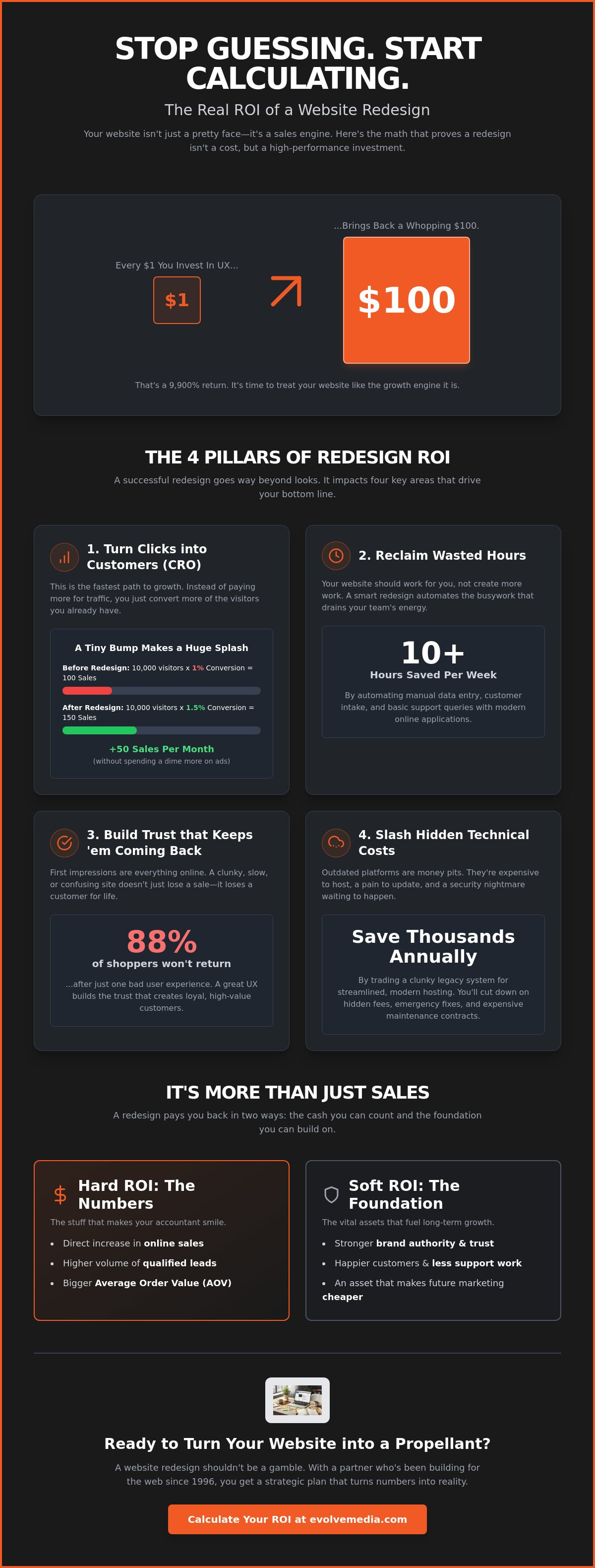
For every $1 you invest in User Experience, the average return is a staggering $100. It’s a metric that transforms a website from a “nice-to-have” gallery into a high-performance engine, making a website redesign ROI calculator the most important tool in your 2026 planning kit. Yet, when you’re staring at a proposal for a mid-range redesign that could cost anywhere from $30,000 to $80,000, those numbers can feel more like a gamble than a strategy.
We know the frustration of hearing vague agency promises that lack real math. It’s hard to justify a major spend to your stakeholders when you can’t clearly track how a new layout actually moves the needle on sales. You’re right to worry about “wasting” budget on aesthetics that don’t convert; a website shouldn’t just look pretty, it should be a propellant for your growth.
In this guide, we’ll show you how to stop guessing and start calculating exactly how much a new site will add to your bottom line. We’ve built a framework to help you value UX improvements, predict lead growth, and choose a partner who treats your budget with the respect it deserves. You’ll walk away with a clear dollar-figure estimate and the confidence to turn your digital presence into your most valuable asset.
Key Takeaways
- Stop treating your website like a digital brochure and start measuring success through the lens of actual profit gained versus project cost.
- Explore why Conversion Rate Optimization is the heaviest hitter in your ROI strategy, turning passive visitors into active buyers.
- Learn to input your baseline data into a website redesign ROI calculator to see exactly how much your current site is costing you in lost opportunities.
- Identify how better online applications reduce manual busywork. A redesign isn’t just about sales; it’s about operational sanity.
- Find out why a partner who has been building for the web since 1996 ensures your site is a propellant, not a cost.
The Real Math Behind Your 2026 Digital Face-Lift
Let’s get one thing straight: your website isn’t a digital business card or a static brochure collecting dust in a corner of the internet. It’s an engine. In the simplest terms, the Return on Investment (ROI) for a redesign is the measurable profit you gain from the new site minus the total cost of building it. If your new site doesn’t eventually pay for itself and then some, it’s a cost. If it accelerates your sales, it’s a propellant.
When we started Evolve Media back in 1996, the math was different. Back then, just “being online” was enough to win. Today, the internet is crowded and loud. Looking pretty is no longer a metric that keeps the lights on. You need to focus on user engagement and conversion rates. A website redesign ROI calculator helps you move past the “I think this looks nice” phase and into the “this is how much more we’re making” phase.
Think of your site as a strategic partner. It should be doing the heavy lifting for your sales team while they sleep. If it isn’t actively pulling in leads or closing sales, it’s essentially a high-maintenance employee that doesn’t show up for work.
Why ‘Good Enough’ Is Costing You Every Day
Technical debt is the hidden tax on your marketing budget that forces you to spend more on ads just to compensate for a leaky bucket. You might think your current site is “good enough,” but the math says otherwise. A mere 1% drop in your conversion rate because of a clunky checkout or slow mobile speed can result in thousands of dollars in lost revenue every month. Modern ecommerce development is designed specifically to fix these leaks, ensuring that every visitor has a clear path to the “buy” button.
The Difference Between Hard and Soft ROI
To build a real business case for 2026, you need to look at both sides of the coin. Hard ROI is easy to track; it’s the stuff that makes your accountant smile. Soft ROI is a bit more subtle but just as vital for long-term survival.
- Hard ROI: This includes direct increases in sales, a higher volume of qualified leads, and a bump in your average order value (AOV).
- Soft ROI: This covers brand authority, customer trust, and a reduction in customer support inquiries because your site actually answers people’s questions.
Both are essential. While hard ROI pays the bills today, soft ROI builds the foundation that makes your future marketing cheaper and more effective. Using a website redesign ROI calculator allows you to quantify these gains so you can stop guessing and start growing.
The 4 Pillars of Redesign ROI You Can’t Ignore
Most basic tools focus strictly on traffic and sales. While those numbers matter, they ignore the “Cost of Doing Nothing.” An outdated site isn’t just sitting there; it’s actively driving away 88% of online shoppers who are less likely to return after a single bad experience. To get a true reading from your website redesign ROI calculator, you have to look at the four pillars that actually support your bottom line.
- Conversion Rate Optimization (CRO): This is the shortest distance between your current revenue and your growth goals.
- Operational Efficiency: Your team shouldn’t be wasting hours on manual data entry that better online applications could handle in seconds.
- Customer Lifetime Value (LTV): A site that’s easy to use builds the kind of trust that keeps customers coming back for years.
- Hosting and Maintenance: Trading a clunky, expensive legacy system for streamlined modern hosting can save you thousands in hidden fees and emergency fixes.
Pillar 1: Turning Traffic into Revenue
The math here is refreshingly simple: (Traffic x Conversion Rate) x Average Order Value = Revenue. Most businesses obsess over getting more traffic, but that’s the most expensive way to grow. If you have 10,000 monthly visitors and a 1% conversion rate, a tiny 0.5% bump in that rate adds 50 more sales every single month without spending an extra dime on ads. For many of our clients, that specific shift pays for the entire redesign in just a few months. It’s why we focus so heavily on the data found in programs like the Digital Analytics Program to identify exactly where people are dropping off.
Pillar 2: The Efficiency Dividend
We often see teams losing 10 hours a week to manual tasks because their website doesn’t talk to their internal systems. That’s not just a headache; it’s a drain on your “Staff ROI.” You can calculate this by taking (Hours Saved x Hourly Rate) to find your annual savings. If an automated form saves a $30 per hour employee 40 hours a month, you’ve just added $14,400 back to your budget every year. At Evolve Media, we build custom applications that turn these manual roadblocks into automated pathways. If you’re tired of fighting with your own tools, it might be time to start a conversation about your specific goals.
A smart website redesign ROI calculator accounts for these saved hours. When your site works harder, your team doesn’t have to. This shift from “cost center” to “efficiency engine” is what separates a successful 2026 project from a simple coat of paint.
How to Use This Calculator to Justify Your Budget
A website redesign ROI calculator shouldn’t be a mysterious black box where you plug in a wish and hope for a profit. To get a number your CFO will actually believe, you need to feed it cold, hard reality. Most tools fail because they don’t explain where the data comes from, leaving you to guess at your future success. We prefer a more transparent approach that relies on your actual performance history.
Start by pulling your baseline data from the last 12 months. You’ll need your total traffic, lead count, and sales revenue. If you aren’t sure where to find these, look at your “Conversions” report in Google Analytics. This is your “Point A.” Without a solid starting line, you can’t measure how far you’ve traveled or how much speed you’ve gained.
Next, be brutally honest about your current “bleed rate.” This includes your monthly hosting, the cost of manual developer fixes, and the price of lost opportunities. For example, research shows that a one-second delay in page load time can lead to a 7% reduction in conversions. Calculate how much money that delay is stealing from you every month. Finally, plug in a range of growth estimates. We recommend running a conservative 10% improvement alongside a more aggressive 30% goal. This gives you a clear Payback Period, which is simply the number of months it takes for the new profit to cover the initial project cost.
The eCommerce Path: Focus on AOV and Retention
For online stores, ROI is won or lost at the checkout. Instead of guessing why people leave, run a 3-day A/B test on your headline or your “Add to Cart” button color. Small tweaks can lead to a massive increase in conversion rates when the user interface is handled correctly. You also need the right people coming through the door. You can learn more about finding high-intent buyers in our guide on small business SEO services.
The Lead Gen Path: Focus on Quality and CAC
In B2B, more leads aren’t always better. If you get 100 leads but only 2 are qualified, your site is failing. A strategic redesign focuses on your Lead-to-Close ratio by filtering out the noise and building trust immediately. This naturally lowers your Customer Acquisition Cost (CAC) because you’re spending less time chasing duds. If you want to see exactly where your current funnel is broken, contact us for a deeper audit of your existing data. We’ll help you turn these calculator estimates into a functional roadmap for your 2026 growth.
Turning Numbers into Reality with a Strategic Partner
A website redesign ROI calculator is a powerful map, but a map doesn’t drive the car. It shows you the destination, but it doesn’t account for the construction zones or the sudden weather shifts of the digital market. You need a partner who has been behind the wheel long enough to know which shortcuts are worth taking and which ones lead to a dead end. Projections are just math until you have a team that can turn those digits into dollars.
A successful project requires more than just a launch date. It needs a foundation that includes:
- Managed Hosting: Keeping your site fast and secure so you don’t lose that 7% of conversions to a slow server.
- Performance Monitoring: Constantly checking the vitals to ensure your conversion rate stays in the green.
- Scalable Architecture: Building a platform that can handle your growth without needing a total rebuild in two years.
Substance Over Style
Flashy distractions might win design awards, but they rarely win customers. We prioritize functional web solutions that focus on clarity and speed. Your site needs to be a tool that solves problems for your users, not a gallery of complex animations that slow down their journey. Our team is committed to building platforms that are as reliable as they are effective. You can see our history of long-term partnerships and reliability on our About Us page.
Your Next Step: From Estimate to Execution
Moving from a theoretical estimate to actual execution shouldn’t feel like a leap of faith. The best first step is a low-friction discovery call to validate what the website redesign ROI calculator told you. We’ll look at your baseline data together and see if those projections hold water in the real world. We’ll help you identify the “quick wins” that can start paying back your investment before the project is even finished.
Don’t let another year of “good enough” drain your potential. Your website should be your hardest-working employee, not a budget leak. Reach out when you’re ready to start building.
Contact Evolve Media: Schedule your discovery call
From Projections to Profit
Your website shouldn’t be a black box that quietly eats your marketing budget while you hope for the best. It’s a high-performance engine that requires a clear roadmap to reach its full potential. We’ve walked through the math, explored the four pillars of conversion, and showed you how a website redesign ROI calculator can turn vague promises into a solid business case for your 2026 goals.
Now comes the part where you move from spreadsheets to actual sales. Evolve Media has been partnering with brands to build high-growth digital assets since 1996. For companies scaling toward major milestones, platforms like Pre-IPO Hype demonstrate how a specialized digital presence can connect high-growth ventures with institutional investors. With an A+ rating for our custom online applications and a focus on expert advisory, we ensure your redesign is a propellant for your business rather than just another line item on your expense report.
Don’t let another quarter slip by with a site that’s “good enough” while your competitors are pulling ahead. Let’s look at your baseline data and build a strategy that actually pays for itself. Ready to turn these numbers into a growth strategy? Let’s talk.
You have the data. You have the framework. Now, you just need the right driver to help you navigate the road to a better bottom line.
Frequently Asked Questions
How long does it usually take to see a positive ROI after a redesign?
Most businesses start seeing a positive return within 6 to 18 months. While a 30% increase in leads often happens within the first 90 days, the full financial impact depends on the length of your sales cycle. A website redesign ROI calculator helps you map this break-even point by comparing your initial project cost against the monthly revenue growth generated by your new, high-performance site.
Can a website redesign actually lower my marketing costs?
Yes, a redesign lowers your Customer Acquisition Cost (CAC) by making your existing traffic work harder. If your site converts twice as many visitors, you effectively cut your lead generation costs in half without spending an extra dime on Google Ads. Better UX also reduces the “bounce tax” you pay when visitors leave because they can’t find what they need.
What is a ‘good’ conversion rate for a B2B website in 2026?
For most B2B sectors in 2026, a good conversion rate sits between 2% and 5%. However, elite sites optimized for user experience often see rates climb above 10%. Keep in mind that mobile conversion rates currently average about half of desktop rates, 2.1% versus 4.3%, so closing that gap is often the fastest way to boost your total ROI.
Do I need to include my hosting costs in the ROI calculation?
You should definitely include hosting in your math because it directly affects site speed and stability. A one-second delay in load time can slash conversions by 7%, so paying for reliable hosting is an investment in your bottom line. Switching from a budget host to a professional environment reduces the technical debt that often triggers expensive emergency fixes later.
What happens if our traffic stays the same but our conversion rate goes up?
This is the “holy grail” of redesign outcomes because it represents pure profit growth. If your traffic remains at 5,000 visitors but your conversion rate moves from 1% to 2%, you’ve doubled your revenue without increasing your marketing budget. This scenario is exactly why we use a website redesign ROI calculator to prioritize conversion optimization over expensive traffic acquisition.
Is it possible for a redesign to have a negative ROI?
A redesign can fail if it prioritizes flashy aesthetics over functional user experience. If a new design makes it harder for users to navigate or breaks your SEO rankings, your conversion rate will plummet. Since 88% of shoppers won’t return after a bad experience, a pretty site that doesn’t work will quickly become a liability rather than a propellant.