A “pretty” website is often the most expensive mistake a business can make. It’s easy to get seduced by trendy fonts or sleek animations, but if those elements don’t move the needle on your bottom line, you’re just buying digital wallpaper. We know how frustrating it is to sit in a boardroom trying to explain the value of user experience to people who only care about the balance sheet. That’s why we’ve developed a logic-based website redesign ROI calculator framework to help you turn “gut feelings” into hard numbers.
We understand the fear of sinking a budget into a project that results in flat conversion rates. It’s a common worry, especially when the global average website conversion rate for 2026 is just 2.35 percent. However, a strategy-led rebuild can deliver an average ROI of 68 percent in nine months or less. This article will teach you how to measure the real financial impact of a refresh. You’ll get a clear framework to justify your budget to stakeholders and the confidence to choose a partner that prioritizes measurable growth. Let’s stop guessing and start calculating.
Key Takeaways
- Stop viewing your site as a static brochure and start treating it as a performance-driven salesperson that works around the clock.
- Use our website redesign ROI calculator logic to identify exactly where your current site is “leaking” profit through flat conversion rates.
- Learn why monthly traffic and current analytics are the only baseline numbers that matter when forecasting your future growth.
- Discover how to pitch the “payback period” to executives so they see the redesign as a self-funding asset rather than a sunk cost.
- Learn why a deep dive into business logic beats a fancy mood board every time when building high-performance digital assets.
Beyond the Price Tag: Why You Need a Website Redesign ROI Calculator
Think of your current website. Is it a passive digital brochure or a high-performing salesperson that never sleeps? Many businesses fall into the trap of viewing a site refresh as a cosmetic expense, like repainting a lobby. In reality, it is a strategic engine for growth. If your site is “leaking” visitors because of a confusing layout or slow load times, you aren’t just losing clicks; you’re losing revenue every single hour.
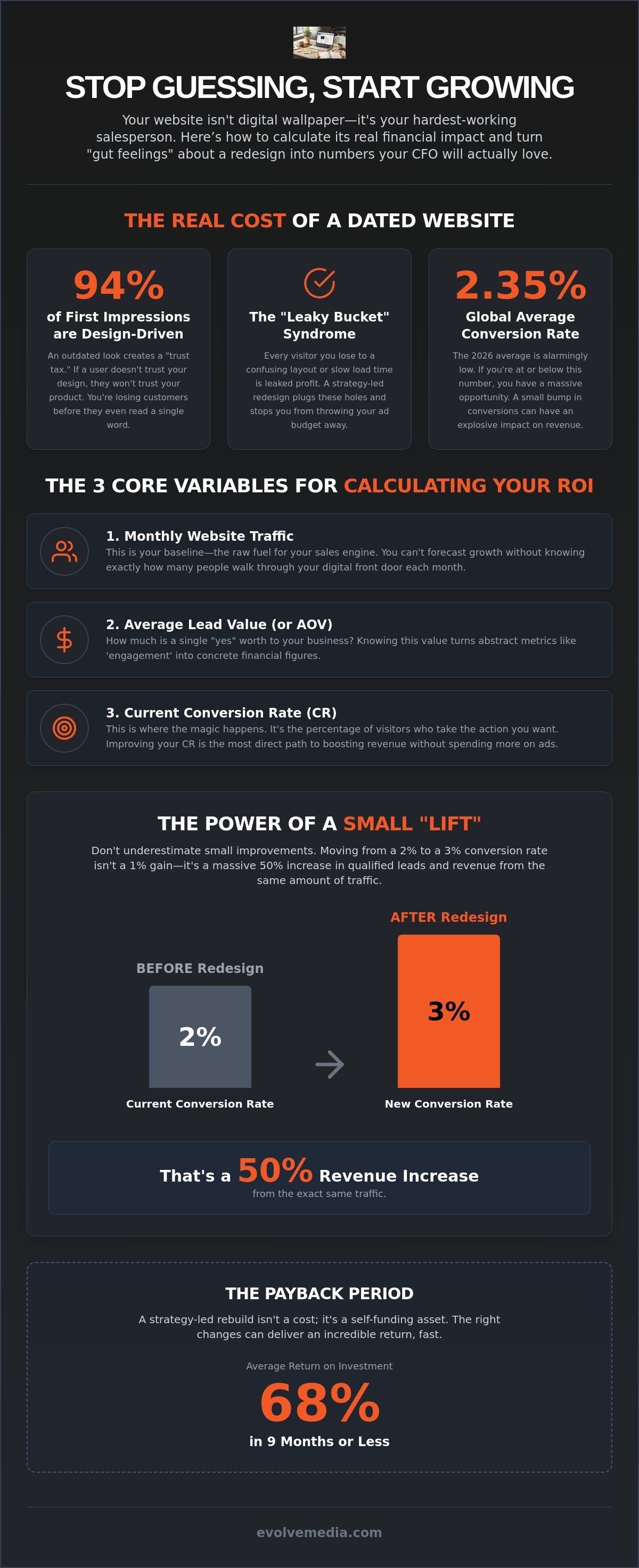
This is where the “Leaky Bucket” syndrome comes into play. If your conversion rate drops by just 1 percent, the impact on your annual profit can be devastating. Consider that the global average website conversion rate in 2026 is approximately 2.35 percent. A slight dip means you are paying the same amount for traffic but getting significantly fewer leads. To understand the true value of a fix, we look at the Return on Investment (ROI). The formula is simple: (Gain from Investment – Cost of Investment) / Cost of Investment. It serves as the definitive bridge between a creative vision and your business reality.
The Real Cost of a Dated Website
A website that looks like it belongs in 2015 does more than just hurt your pride. It creates a “trust tax” that every visitor has to pay. Research shows that 94 percent of first impressions are entirely design-driven. If a user doesn’t trust the look, they won’t trust the product. This skepticism directly inflates your Customer Acquisition Cost (CAC). You spend money on ads to bring people in, but high bounce rates mean you are essentially throwing that budget into a paper shredder. Improving your page load speed by just one second can be the difference between a bounce and a sale.
Why a Calculator Beats a Guess
Data-driven decisions remove the heated emotions from high-stakes marketing meetings. Using a website redesign ROI calculator allows you to set realistic Key Performance Indicators (KPIs) before a single pixel is moved. It shifts the conversation from subjective opinions about colors to objective discussions about lead flow.
- Eliminate guesswork by using your actual web analytics as a baseline.
- Justify the spend to stakeholders with hard numbers rather than “gut feelings.”
- Identify bottlenecks in your current user flow that are costing you money.
A website redesign ROI calculator provides the clarity needed to treat your digital presence as the long-term investment it truly is. It turns a daunting project into a predictable path for growth.
The Math of Growth: Breaking Down the ROI Variables
You can’t fix what you haven’t tracked. Before you plug numbers into a website redesign ROI calculator, you need to pull your current Web Analytics data. This isn’t just about looking at a graph that goes up and to the right; it’s about finding your baseline. Traffic is the raw fuel for your sales engine. If you have 10,000 monthly visitors, that is the foundation for every calculation we make next. Without an accurate traffic count, any ROI prediction is just a shot in the dark.
Then there is the Average Order Value (AOV) or Lead Value. How much is a single “yes” worth to your bottom line? If every new lead is worth $500 to your business, a small bump in conversions translates to a massive shift in your quarterly earnings. Conversion Rate (CR) is where the real magic happens. It’s the percentage of people who actually take action. Improving this isn’t just about making things look nice. It is about the psychology of user flow and removing the mental friction that stops a sale.
Predicting the “Conversion Lift”
Don’t just pull a 5 percent increase out of thin air. Look at reality. In 2026, the average B2B SaaS visitor-to-lead rate is between 1.4 and 1.5 percent. If you are currently at 2 percent and you move to 3 percent, you haven’t just gained one point. You have increased your revenue by 50 percent. That is the power of a strategy-led rebuild. By building better online applications and streamlining checkout processes, you remove the obstacles that kill deals. Even a project as complex as a federal government website redesign relies on user-centered design to ensure people can actually finish what they started.
Factoring in the Total Investment
ROI isn’t just the price on the initial invoice. To get an honest result from your website redesign ROI calculator, you have to look at the total picture. This includes the initial development, managed hosting, and the internal time your team spends on content audits and strategy meetings. We have been refining this math for three decades. You can see our journey and how we’ve evolved since 1996 on our about us page. If you’re ready to stop guessing and start measuring, it might be time to reach out for a chat about your specific goals.
How to Use Your ROI Data to Secure Executive Buy-In
You’ve finished the math. You have a solid figure from your website redesign ROI calculator. But walking into a boardroom with just a spreadsheet is a gamble. Numbers provide the logic, but stories provide the motivation. To get that signature, you need to wrap your data in a narrative of business growth. Executives don’t just want to see what they are spending; they want to see what they are gaining.
One of the most effective metrics you can present is the “Payback Period.” This tells the CFO exactly how many months it will take for the new site to pay for itself. If your data shows a break-even point within the first six to twelve months, the project stops looking like an expense and starts looking like a self-funding asset. It changes the energy of the room from “how much does this cost” to “how soon can we start.”
Don’t ignore the “Opportunity Cost.” What happens if the business does nothing for another year? If your current site is underperforming, every day you wait is a day you’re handing market share to a competitor. Use a simple table to show a “Before vs. After” scenario. Visual anchors help stakeholders process the potential revenue wins quickly. This makes the cost of inaction feel much higher than the cost of the project itself.
Tweak Your Presentation Strategy
Lead with the projected revenue increase, not the price tag. Show how a redesign supports other departments, like reducing customer support tickets by 15 percent through better FAQs and self-service tools. This demonstrates that the website isn’t just a marketing tool; it’s a company-wide efficiency engine. If you want to be extra thorough, run a small-scale audit to prove your conversion assumptions before you ask for the full budget.
Addressing the CFO’s Biggest Objections
Be ready for the “can’t we just do it ourselves?” question. Remind them that DIY often leads to technical debt that costs significantly more to fix in the long run. There is a massive difference between a “template site” and custom web development for long-term scaling. A professional site is an asset that appreciates as it gathers data; a broken one is a liability that actively pushes customers away.
Ready to build a business case that’s impossible to ignore? Let’s look at your numbers together and find the best path forward for your brand.
Turning Estimates into Reality with Evolve Media
We’ve been building digital assets since 1996. That is long enough to know exactly where the “leaks” hide in a sales funnel.
A website redesign ROI calculator provides a useful map, but we provide the performance engine. We don’t start with a pretty mood board; we start with your business logic. By combining our seo marketing agency experience with high-performance ecommerce development, we build sites that actually close deals. We handle the managed hosting and tech headaches so you can focus on scaling. It’s about building a conversion engine, not a digital brochure.
We’ve seen it all, from the dial-up days to the AI era, where staying informed via Canada News Media is just as critical as maintaining a modern digital infrastructure.
Real Results, No Fluff
One client saw their lead flow jump by 20 percent just by simplifying their contact path.
Our small business seo services keep your funnel full, while the site design does the heavy lifting at the bottom. We aren’t a one-and-done shop. We are your long-term strategic partner. We’ve supported brands across B2B, finance, and retail through decades of tech shifts.
We’re in this for your long-term success.
Your Next Step
Let’s grab a coffee and look at your specific numbers.
We’ll provide a custom audit that goes deeper than any online tool can. It’s a chance to see exactly where your site is falling short and how to fix it. Let’s talk about your redesign ROI today.
Turn Your Digital Presence into a Performance Asset
Moving your website from a line-item expense to a revenue driver requires a fundamental shift in perspective. We’ve explored how to identify “leaks” in your conversion funnel and why the “payback period” is the most important number in your pitch to the C-suite. By grounding your project in actual web analytics, you transform a subjective design project into a predictable business outcome. It’s about making every visitor count.
A website redesign ROI calculator is a powerful first step, but it only tells part of the story. Since 1996, we’ve acted as a strategic partner for businesses across the B2B, finance, and retail sectors, helping them navigate the complexities of digital growth. We don’t just hand you a vendor quote; we provide a roadmap for long-term success that aligns with your specific goals. Our team is invested in your results, not just your launch date.
Ready to see the real numbers? Contact Evolve Media for a custom ROI audit. We’ll help you move past the estimates and build a site that actually pays for itself. It’s time to stop worrying about the cost and start investing in your future. We can’t wait to see what we’ll build together.
Frequently Asked Questions
How accurate is a website redesign ROI calculator?
A website redesign ROI calculator is an estimation tool, not a crystal ball. Its accuracy depends entirely on the quality of the data you feed it, such as your current monthly traffic and average lead value. While it provides a logical baseline for budget discussions, it’s best used to establish a “payback period” rather than a guaranteed future balance.
Can I calculate ROI for a non-ecommerce website?
You absolutely can, and you should. For non-ecommerce sites, ROI is calculated by assigning a dollar value to every lead or inquiry generated through your online forms. If you know that one out of every ten leads turns into a $5,000 contract, then every lead is worth $500. This math makes the value of a high-performing site just as clear as an online store.
What is a “good” ROI for a website redesign project?
A strategy-led rebuild typically delivers an average ROI of 68 percent within nine months. For businesses that prioritize User Experience (UX), the returns can be even more dramatic; some industry reports suggest a return of up to $100 for every $1 invested in UX. If your project is projected to pay for itself within the first year, you’re looking at a very successful project.
How much should a professional website redesign cost in 2026?
Professional redesign costs in 2026 are influenced by several factors, including the number of pages, the complexity of your backend, and the need for modern features like AI-driven search. Enterprise projects and small business sites naturally sit at very different levels of investment. For those seeking quality on a smaller budget, Equinox Web Design provides professional solutions that bridge the gap between affordability and performance. The most important thing is to ensure your budget allows for a strategy-led approach that focuses on your specific business goals rather than just a visual update.
What happens if our traffic stays the same after a redesign?
You can still see a massive win even if your visitor count doesn’t budge. If your current site is “leaking” leads, a website redesign ROI calculator will show that a higher conversion rate makes your existing traffic much more profitable. Doubling your conversion rate from 2 percent to 4 percent has the same impact as doubling your traffic, but often at a lower long-term cost.
Is it better to do a full redesign or small incremental changes?
It depends on the state of your current foundation. If your site is built on a slow, outdated platform, small tweaks are like repainting a car with a broken engine. A full redesign is better for fixing deep structural issues and improving speed, while incremental changes are perfect for high-performing sites that just need to test new headlines or button colors.