What if the biggest risk to your digital growth isn’t a bad line of code, but the absence of a clear map? Understanding what to expect during website development is the difference between a site that just looks pretty and a high-performance asset that actually drives revenue. Most business owners walk into a project feeling like they’re handing over a blank check. It’s a stressful way to build.
We’ve seen the anxiety. You’re likely worried about jargon that sounds like a foreign language or the sinking feeling of a missed launch date. We get it. Having partnered with brands since our founding era in the early days of the web, we’ve learned that clarity is the best cure for stress.
In this guide, we’ll walk you through the 2026 development cycle, where AI-assisted coding is cutting build times by up to 34% while making expert-led architecture more critical than ever. You’ll get a clear roadmap of milestones. We’ll cover everything from navigating new data privacy laws in states like Kentucky and Rhode Island to hitting mandatory ADA accessibility targets.
We’re moving past the fluff. You deserve the confidence to know your project is on track for a real return on investment. If you are looking for a partner that specializes in high-performance web solutions, check out Marcy Design.
Key Takeaways
- Align your business goals with a structural blueprint during the discovery phase to avoid costly mid-project pivots.
- Learn exactly what to expect during website development so you can track progress and milestones with total confidence.
- Prioritize a mobile-first approach to ensure your site works perfectly for the majority of your audience scrolling on their phones.
- Prepare for a rigorous testing phase that catches bugs and broken forms before your customers ever see them.
- Protect your digital asset with managed hosting and support that keeps your site secure and fast long after launch.
The Pre-Game: What to Expect During the Discovery Phase
Before a single brick is laid for a skyscraper, there is a blueprint that accounts for every bolt and beam. In the web development process, the discovery phase is that essential blueprint. It is the moment we sit down together to map out the digital architecture of your future. We focus on the “Why” long before we touch the “How.” This ensures the final product doesn’t just sit there looking pretty; it actually moves the needle for your business.
If you’re wondering what to expect during website development, it starts with us getting a bit nosey. We’ll do a deep dive into your target audience, your current pain points, and your long-term vision. We aren’t just a vendor; we’re a strategic partner invested in your success. You can learn more about our collaborative approach and how we prioritize your specific business goals.
Defining Your Project Goals and KPIs
We need to move past the idea of just wanting a “modern site.” That is too vague. Instead, we aim for specific outcomes, like increasing your qualified leads by 20% or cutting down checkout friction. We’ll also look at your competitors. What are they doing that works? Where are they dropping the ball? Data shows that establishing a clear, documented goal at this stage can reduce revision cycles by 30%. It saves time. It saves money. Most importantly, it keeps everyone rowing in the same direction.
The Client Homework: What We Need From You
This is the part of what to expect during website development that often catches people off guard: the homework. To keep things moving, we need your brand assets, high-resolution imagery, and existing copy early in the game. Think of it as providing the raw materials for your new home. If the wood and nails aren’t on-site, the builders can’t work.
We will help you categorize features into “Must-Have” and “Nice-to-Have” lists. This isn’t about limiting your vision; it’s about managing your budget effectively. Let’s be direct: if you don’t have your content ready, the project will stall. Gathering these items now prevents the final sprint from becoming a final crawl. It’s about setting a pace that guarantees a high-performance digital asset.
The Creative Construction: What to Expect During Website Design and Development
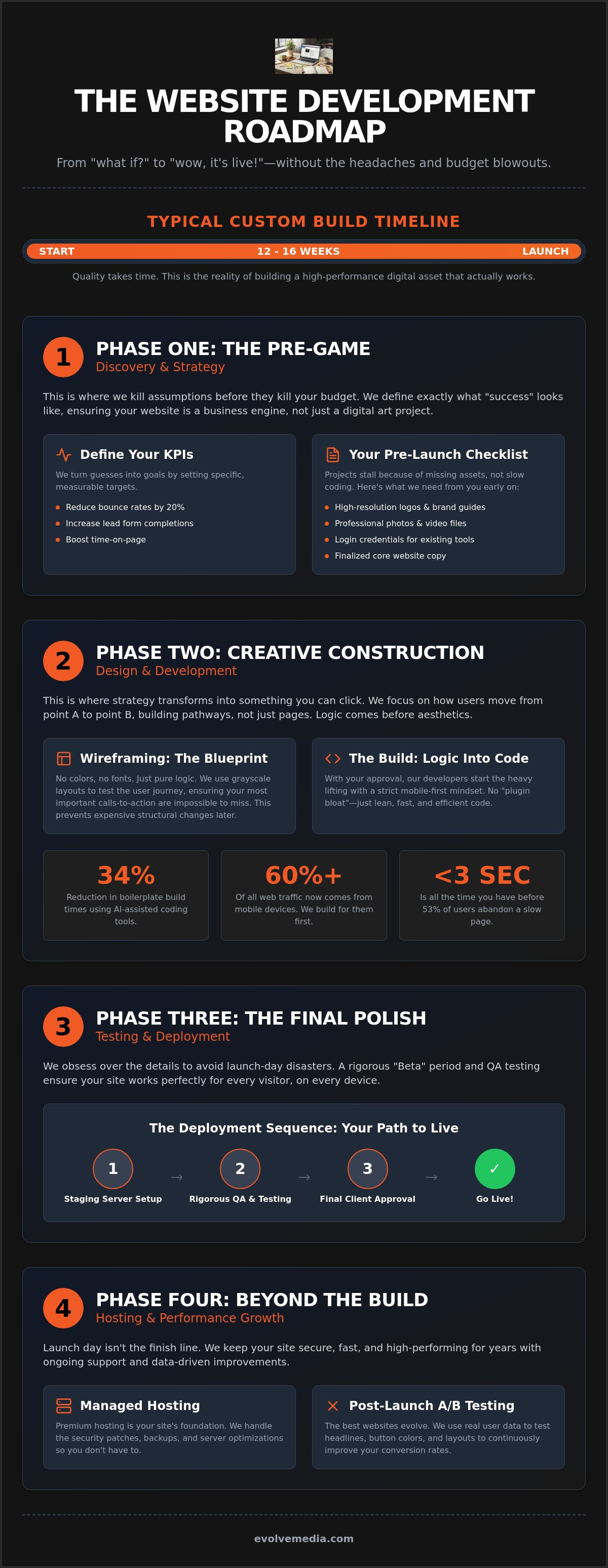
This is the stage where your strategy transforms into something you can actually touch and click. We take those goals from discovery and turn them into visual anchors and functional code. Understanding what to expect during website development means knowing that we prioritize custom solutions that actually scale rather than generic templates. If you’re building a digital storefront, you’ll want to check out our strategic guide to ecommerce development.
Expect a Mobile-First approach. It isn’t just a suggestion anymore. Since most of your users are likely scrolling on their phones while waiting for coffee, we build for the small screen first. This aligns with the U.S. Web Design System standards, which emphasize accessibility and mobile responsiveness as the baseline for modern sites. We avoid the “bespoke” corporate fluff and focus on real-world utility.
Wireframing and UI/UX Design
Think of wireframes as the “skeleton” of your site. There are no colors, fancy fonts, or high-res photos here. It’s just layout and logic. We review user flows to make sure your customers don’t get lost on their way to the checkout page. UI is how it looks; UX is how it feels. Getting this right early prevents expensive mistakes later in the what to expect during website development process. It ensures the path to conversion is obvious and easy.
The Development Build and Functional Logic
This is the heavy lifting. Our team writes the front-end and back-end code that powers your site. We often build custom online applications that automate your specific business processes, such as a custom booking engine or a complex pricing calculator. We prioritize clean code. Google loves it because it’s easy to read, and you’ll love it because it keeps the site fast.
While AI-assisted coding is now used by over 70% of developers in 2026, we don’t let the machines run the show. We use these tools to cut build times by up to 34%, but an expert always reviews the architecture. This balance ensures speed without sacrificing security or performance. If you have questions about how these technical steps fit your specific needs, feel free to reach out for a chat.
The Final Polish: What to Expect During Testing and Launching
The “Final Sprint” is where we intentionally try to break your site. We do this to ensure your visitors don’t break it later. It is a high-intensity phase where we check every button, link, and contact form for total reliability. When you understand what to expect during website development, you realize the work we do right before launch is just as critical as the initial design.
Rigorous testing ensures your site survives the real world without crashing when your customers arrive. This is why we treat the Quality Assurance (QA) process with such gravity. It isn’t just a quick check; it is the safety net that protects your brand’s reputation before the first user lands on your homepage.
Launch day is a coordinated event. We don’t just click a “Go Live” button and hope for the best. We follow a strict checklist to make sure the transition is smooth and your new asset is ready for traffic. This involves everything from configuring server settings to verifying that your analytics are tracking correctly from second one.
Cross-Browser and Device Testing
We test your site on a wide range of hardware. This includes everything from an old iPhone to a massive 4K desktop monitor. You should expect a “Bug List” during this stage. These are minor visual glitches we squash before the public sees them. Tweak your headlines one last time during this phase. Now that you see the final layout on different screens, you might find that a shorter title works better for mobile readability.
The Deployment Process
We handle the technical migration from our staging environment to your live domain. This includes managing DNS settings and ensuring your security certificates are active. Expect a 24-hour “Watch Period.” During this time, we monitor the site for post-launch hiccups like server lag or broken links. Simplicity wins here. We make the transition easy so you can stay focused on running your business. If you are ready to build a site that stands up to real-world pressure, get in touch with our team today.
Beyond the Build: What to Expect From Post-Launch Support
Most guides treat the launch as the finish line. In reality, it is the starting gun. A website is a living organism, not a static billboard; it needs regular care to remain a high-performance asset. We don’t just build and bolt. We position ourselves as your long-term strategic partner to ensure your digital presence keeps growing alongside your business.
The real work of driving ROI happens after the site goes live. Part of what to expect during website development is a plan for what happens next. Research shows the total cost of ownership over three years is often double the initial build cost, largely because professional maintenance and security are non-negotiable for success.
If you want to keep the momentum going, it helps to have the right team in your corner. You might want to check out our tips on choosing an seo marketing agency to help turn your new site into a traffic magnet.
Managed Hosting and Security
Professional hosting is about more than just keeping the lights on. It ensures 99.9% uptime and protects your sensitive data from evolving threats. We handle regular software and plugin updates to prevent performance lag and security vulnerabilities. Choosing the cheapest hosting is like buying a discount parachute; it saves you money right up until the moment you actually need it to work. We prioritize speed and stability so your customers never have to wait for a page to load.
Iterative Growth and Performance Metrics
We use real data to see how users interact with your new site. We look for friction points where people get stuck or leave. Expect to:
- Run small A/B tests on your call-to-action buttons to see which colors or phrases drive more clicks.
- Monitor page speed to ensure new content doesn’t slow down the user experience.
- Tweak headlines based on heatmaps that show where users are actually looking.
This data-driven approach is how we squeeze more conversions out of your existing traffic. It transforms your site from a simple business card into a proactive sales tool. Ready to start your project and build something that lasts? Contact our team today and let’s get to work.
Turning Your Digital Vision into a High-Performance Asset
Building a website in 2026 is about much more than writing code; it is about creating a strategic engine that fuels your growth. From the initial blueprint of the discovery phase to the rigorous testing that ensures your site survives a heavy traffic spike, knowing what to expect during website development gives you the control you need. You now have a roadmap that moves from strategy to launch and into long-term maintenance.
We’ve been a trusted partner for brands since our founding era in 1996, combining a national reach with the attentive, boutique feel your project deserves. Much like the personalized coaching and expert guidance provided by Dating Explained, we focus on clarity and human-centric strategy to help you achieve your most important goals. We specialize in custom business logic that automates your unique processes, ensuring your site does the heavy lifting while you focus on your vision. Our commitment doesn’t end at the launch button; we stay by your side as a strategic partner to monitor performance and drive iterative results.
Ready to build something great? Let’s talk about your project.
Your next digital milestone is closer than you think. Let’s build something that actually works for your business.
Frequently Asked Questions
How long does the average website development project take?
A typical project takes between 8 and 16 weeks from the initial discovery meeting to the final launch. Small marketing sites can often be completed on the shorter end of that window, while complex ecommerce platforms or custom online applications usually require the full four months. This timeline accounts for deep-dive strategy sessions, multiple design reviews, and the rigorous testing needed to ensure your site performs perfectly on day one.
What do I need to provide before the development starts?
We need your brand assets, high-resolution imagery, and finalized website copy before we can begin the build. As we discussed in the discovery phase, having these “raw materials” ready prevents the project from stalling. We will also need access to your current domain registrar and any existing analytics accounts if you want us to migrate your historical data to the new platform.
Will I be able to update the content on my website myself?
Yes, we build every site using an intuitive Content Management System (CMS) that allows you to make changes without touching code. You will be able to tweak your headlines, upload new team photos, or publish blog posts with just a few clicks. We provide a dedicated training session after the launch to make sure you and your team feel completely confident managing your new digital asset.
What happens if something breaks after the website is launched?
We provide a 24-hour watch period immediately after launch to catch any post-deployment hiccups. If a form stops submitting or a layout shifts on a specific device, our team is available to jump in and fix it. Knowing what to expect during website development means planning for stability, which is why we offer ongoing support to keep your site running smoothly as browser standards evolve.
Do I need to pay for hosting and maintenance separately?
Yes, hosting and maintenance are ongoing costs that are separate from the initial build fee. These services cover the secure server space where your site lives, along with the regular security patches and plugin updates that prevent performance lag. Think of it as a specialized insurance policy that keeps your site fast, secure, and accessible to your customers around the clock.