



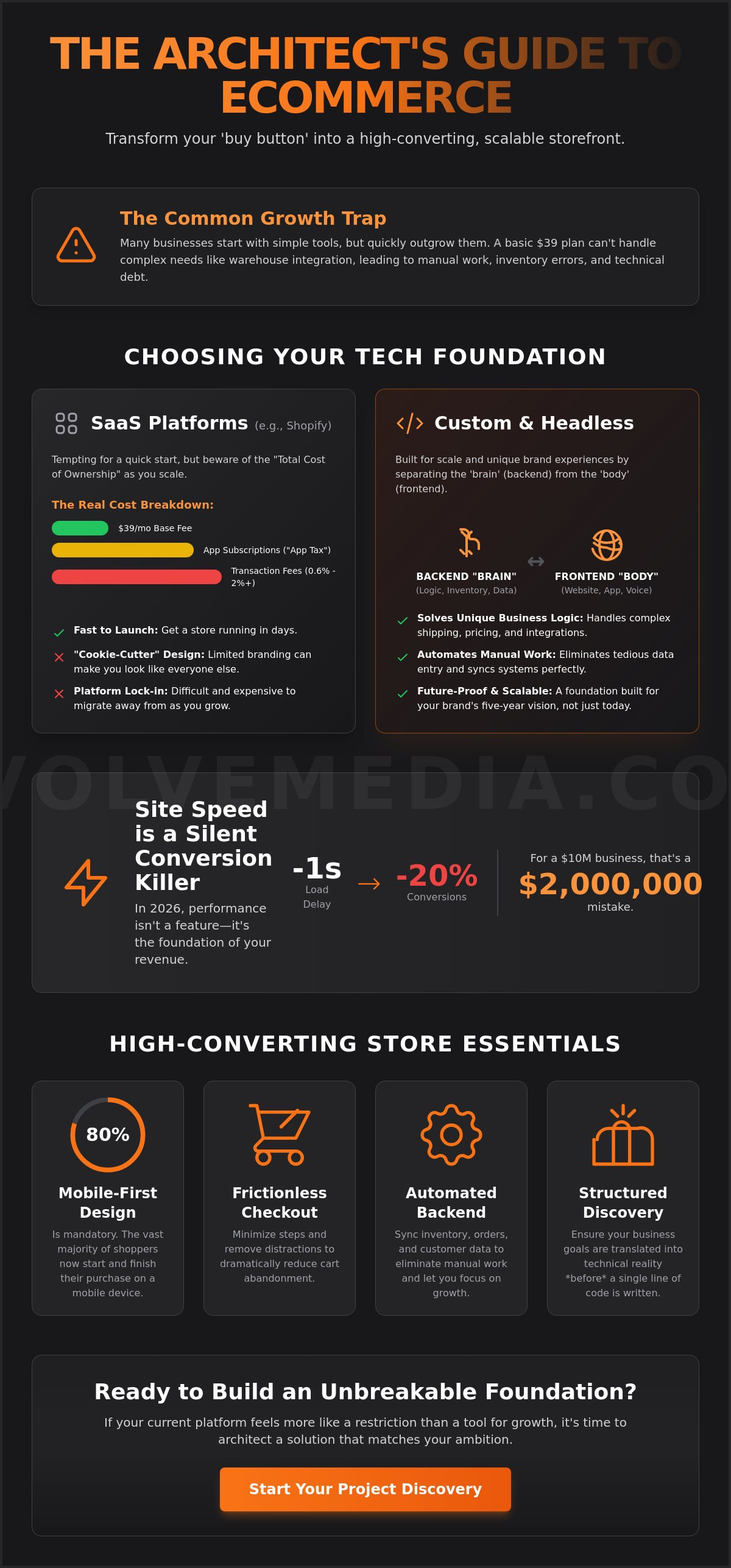
My friend Sarah spent months building her dream boutique, only to realize her $39 Shopify Basic plan couldn’t talk to her warehouse software. Every time she sold a silk scarf on Instagram, she had to manually update her site or risk sending an apology email to a frustrated customer. It’s a classic case of technical debt that hits hard when you outgrow early-stage tools. Getting ecommerce development right isn’t just about the code; it’s about making sure your tech stack actually serves your brand identity. Since 1996, we’ve helped partners handle these shifts from simple buy buttons to complex systems.
Key Takeaways
- Shift your mindset from a simple “buy button” to a strategic storefront that blends user psychology with secure, reliable code.
- Decide whether a headless “brain and body” setup or a traditional platform fits your business best to avoid expensive technical debt later.
- Prioritize a frictionless checkout and mobile-first design, which is now the mandatory baseline for 80% of all online shoppers.
- Use a structured discovery phase to ensure your ecommerce development project translates your actual business goals into technical reality.
- Build a backend that automates the tedious manual work, keeping your inventory and logic perfectly in sync while you scale.
The Digital Storefront: More Than Just a Buy Button
Thinking of a website as just a digital catalog is a bit like buying a high-end sports car and only driving it to the mailbox. True ecommerce development is much more than putting a price tag on a picture; it’s the delicate fusion of business logic, user psychology, and airtight code that keeps your business running while you sleep. When we discuss E-commerce (electronic commerce), we’re really talking about the digital engine of your entire brand. It’s the space where your vision meets the customer’s needs without any friction in between.
Think of your store as your most dedicated employee. It works 24 hours a day, never calls in sick, and talks to thousands of people at once without breaking a sweat. In 2026, the market has moved past basic transactions. Customers now expect a full experience that feels personal and lightning fast—whether they are shopping for retail goods or signing up for intentional fitness programs like Evora Training. By building a solid digital foundation today, you aren’t just selling a product. You’re creating a home for future AI tools and marketing strategies that haven’t even been invented yet. It’s about being ready for the next big shift before it happens.
Why Custom Development Beats the Cookie-Cutter Approach
Templates are tempting, but they often lead to a trap where your store looks exactly like every other shop on the internet. When you choose custom code, you’re solving real business headaches that generic layouts just can’t handle. Maybe you have complex shipping rules for fragile items or need tiered pricing for wholesale partners. These aren’t just features; they are essential parts of your daily operation. This is why strategic branding must be baked into your code from day one. It ensures your store speaks your language, not the language of a pre-set configuration.
The ROI of a High-Performance Foundation
Site speed is the silent engine of your conversion rate. It’s a simple math problem. According to 2026 industry benchmarks, a 1-second delay in page load time can result in a 20% drop in conversions. For a brand generating $10 million in annual revenue, that tiny lag is a $2 million mistake. As the Wise Architect, we don’t build for where you are today. We build for where you’ll be in five years. This forward-thinking ecommerce development ensures that when your brand goes viral, your site stays standing while the competition crumbles.
Choosing Your Tech Stack: Platforms vs. Custom Builds
Imagine your online store is a high-end restaurant. The kitchen is your “brain” where the magic happens; it’s the logic, the recipes, and the inventory. The dining room is your “body” where the customers sit and experience your brand. Headless commerce lets you remodel that dining room every week without ever touching the kitchen stoves. In the world of ecommerce development, this separation is a game changer for brands that want to stay fresh without rebuilding their entire operation from scratch. It allows you to deliver a unique look while keeping your data processing stable and secure.
Choosing between SaaS, Open Source, and custom builds is the most important decision you’ll make when developing a strong e-commerce strategy. SaaS platforms like Shopify or BigCommerce are fantastic for getting off the ground quickly. Shopify Basic starts at $39 a month, but you have to keep an eye on the “Total Cost of Ownership.” That low monthly fee can balloon quickly when you add in transaction fees, which can range from 0.6% to 2% if you don’t use their internal payment systems, plus the cost of various monthly app subscriptions. We’ve seen many partners start here and eventually feel the squeeze as they grow.
When to Go Custom: The Maturity Milestone
You’ll know it’s time to move toward a custom solution when your team spends hours every day manually syncing inventory or typing data from one screen to another. Custom ecommerce development allows you to build specific applications that automate these headaches. It eliminates the “app tax” where you pay a third party for basic features. Since 1996, we’ve helped businesses realize that if their business logic is unique, their code should be too. If you’re feeling restricted by your current setup, it might be time to chat about your specific needs.
The Hybrid Strategy: Composable Commerce
Think of this as the “best-of-all-worlds” approach. Instead of buying one giant software package, you pick the best tool for every job. You might use one service for your search bar, another for your checkout, and a third for your blog. This prevents “platform lock-in” and keeps your business agile.
- Agility: Can you swap out a single feature without breaking the whole site?
- Performance: Does your stack support the instant load times customers expect in 2026?
- Scalability: Can your system handle a 500% spike in traffic during a flash sale?
If the answer to any of these is “no,” your current stack might be holding you back.
Essential Features for High-Converting Ecommerce Stores
A frictionless checkout is often called the holy grail of ecommerce development for a very good reason. It’s the final hurdle where most sales are either won or lost. By 2026, mobile-first design has transitioned from a recommendation to a mandatory baseline, as 80% of all online shoppers now complete their journey on a handheld device. If your checkout process feels clunky or requires too many taps, you aren’t just annoying your customers; you’re effectively handing them over to a competitor with a smoother interface.
Modern shoppers are also changing how they discover what you sell. Recent data shows that 22% of consumers now use AI-powered search tools to research products and brands before they ever land on a homepage. This means your site needs to be built for intent, not just keywords. Pairing a well-built store with the right SEO marketing agency ensures your products are found by the right customers at the right moment. While the front end handles the charm, the security underneath keeps the relationship alive. Solid SSL certificates and PCI compliance are the digital equivalent of a firm handshake. They tell your customer that their data is safe, which is the only way to build long-term trust in a crowded digital world.
The Art of User Experience (UX) Design
Good UX is like a well-organized store; you find what you need without having to ask for help. Intuitive navigation reduces the cognitive load, making the shopping process feel light rather than like a chore. We focus on micro-interactions, such as a subtle button change or a smooth page transition, to make the experience feel tactile and responsive. This level of detail is a core part of our approach to digital identity, ensuring your store feels like a natural extension of your brand.
Backend Power: Integrations That Save Time
A beautiful storefront is only half the battle if your warehouse doesn’t know what’s happening in real time. Connecting your store to your ERP or CRM systems automates the tedious stuff like tax math and shipping labels. Real-time data sync is the only thing standing between you and the nightmare of selling an item that is actually sitting in someone else’s cart. If your current system feels like it’s held together with duct tape, it might be time to get a professional feature audit to see where you can automate and grow.
Your Roadmap to a Successful Ecommerce Launch
Think of your launch day like a grand opening for a brick and mortar flagship store. You wouldn’t just unlock the doors and hope the plumbing works. The process starts long before the first customer arrives, beginning with a Discovery Phase. This is where we sit down to translate your specific business goals into technical requirements. We look at how your inventory moves, how your team handles orders, and where you want to be in five years. This clarity ensures the ecommerce development process builds a tool that actually solves your problems instead of creating new ones.
Once the blueprint is set, we move into Development Sprints. We prefer a transparent approach where you see progress in real time rather than waiting for a big reveal. This constant communication keeps the project on track and ensures the final product feels like your brand’s digital home. Before anyone sees the site, we enter the QA and Stress Testing phase. We intentionally try to break things, testing how the site handles thousands of simultaneous visitors or weird edge-case shipping addresses. It’s better for us to find a bug on a Tuesday morning than for your customers to find it during a Black Friday sale.
The Importance of Managed Hosting and Performance
Professional hosting is the ultimate insurance policy for your digital asset. Cheap hosting is often the most expensive mistake a brand can make because it leads to slow load times and frequent downtime. If your site is down for even ten minutes during a peak period, the lost revenue and damaged trust far outweigh any monthly savings. We prioritize long-term stability and performance because we know that a fast, reliable site is the foundation of your growth. Since 1996, we have seen that the best stores are the ones that are always ready for business.
Continuous Evolution: Why Data is Your Fuel
The “Launch” button is the beginning of our partnership, not the end of a project. Once the site is live, we use real-world analytics to see exactly where customers are clicking and where they are getting stuck. We use A/B testing to refine your checkout and product pages, slowly turning a good store into a great one. You need to partner with a team that pours their heart and soul into your ongoing success. Ecommerce development in 2026 is about constant evolution, using data to fuel every decision you make as you scale.
Build a Store That Never Stops Growing
Success in 2026 isn’t about finding a magic buy button that solves every problem overnight. It’s about the steady work of refining your user experience and ensuring your technical foundation is strong enough to support your biggest ambitions. Throughout this guide, we have explored how a custom approach to ecommerce development removes the limitations of basic templates, allowing your business logic to drive your growth rather than hinder it. From mobile-first designs to seamless backend integrations, every choice you make today sets the stage for your brand’s future. To make sure your store gets discovered by the right audience, pairing your technical build with dedicated small business SEO services is one of the most impactful investments you can make in 2026.
Since 1996, we have acted as the trusted partner for brands looking to move beyond the basics. By specializing in custom online applications that automate heavy lifting and providing professional managed hosting that guarantees 99.9% uptime, we ensure your store remains a reliable asset. You deserve a team that pours its heart and soul into your project, creating a digital flagship that is as resilient as it is beautiful. Let’s make sure your business is ready for whatever the market throws at you next.
Let’s build a storefront that evolves with your brand. Contact the Evolve Media team today.
Answers to Your Ecommerce Questions
How much does custom ecommerce development cost in 2026?
The cost of custom work is determined by your specific business logic and the complexity of your required integrations. While a platform like Shopify Plus starts at $2,300 monthly, high-growth brands often find that custom ecommerce development saves more money over time by eliminating the “app tax” and transaction fees. We focus on the total cost of ownership over several years to ensure your investment actually drives profit instead of just adding to your overhead.
How long does it take to build a custom online store from scratch?
Building a custom store from scratch typically takes between 12 and 24 weeks from the first discovery meeting to the final launch. This timeline allows us to move through several development sprints where we build, test, and refine your site’s specific features. We take the extra time to stress-test every button and link so you don’t have to worry about a crash during your first major holiday sale or influencer promotion.
Should I choose Shopify or a custom-built website for my brand?
Choosing between Shopify and a custom build depends on whether you prefer a quick start or total control over your business processes. Shopify currently holds a 27.6% market share because it’s a great tool for many, but it can feel restrictive if you have unique shipping rules or complex inventory. If you find your team spending hours on manual data entry, you’ve likely reached the milestone where a custom solution becomes a necessity.
What is headless commerce, and do I actually need it?
Headless commerce is a setup that separates your site’s front-end design from its back-end data processing logic. You should consider it if you want the agility to change your store’s appearance quickly without risking your core customer data. This flexibility is becoming vital as 22% of shoppers now use new AI research tools to find brands, requiring your site to be more adaptable than a standard template allows.
How do I ensure my ecommerce site is secure for customer payments?
Ensuring your site is secure requires a combination of SSL certificates, PCI compliance, and strict adherence to the latest regional data laws. As of January 1, 2026, new comprehensive consumer data privacy laws are in effect in Indiana, Kentucky, and Rhode Island. We build these protections into the foundation of your site to protect your customers and keep your business compliant with these evolving legal standards across the country.
Can I migrate my existing store to a new ecommerce platform?
You can certainly migrate your store, but it requires a detailed plan to protect your SEO rankings and customer history. Having been active in this industry since 1996, we understand that migration is a standard part of growing a business; however, it must be handled with precision. We map out every product and customer record to ensure that your ecommerce development project results in a seamless transition without any lost sales.



Comments(22)
Branding in 2026: The Wise Architect’s Guide to Strategic Identity
May 4, 2026[…] strong brand identity is only as powerful as the platform it lives on, which is why pairing it with strategic ecommerce development is essential for turning brand equity into measurable […]
What Is an SEO Marketing Agency? A Friend’s Guide to Finding the Right Partner
May 8, 2026[…] a scalable asset rather than a static brochure. A true partner integrates search efforts with your ecommerce development and branding to create mental availability for your customers. This means when a shopper sees your […]
Professional Web Design: Busting the Myths of the “Easy” DIY Website
May 11, 2026[…] moment you need to grow. You might start with a simple blog, but what happens when you need complex ecommerce development or custom online applications? Professional builds are designed with global reach in mind from day […]
Online Applications for Business: A How-To Guide for Scaling Your Workflow
May 15, 2026[…] toward custom web development replaces those fragile files with a robust, centralized system. It secures your data, automates the […]
Professional SEO Services: How to Pick a Partner That Actually Grows Your Bottom Line
May 18, 2026[…] now uses a holistic scoring system for Core Web Vitals like LCP, INP, and CLS. This means your web design and development must be built with performance in mind from day one. Technical health […]
Web Design ROI: How to Calculate the Real Value of Your Digital Presence in 2026
May 20, 2026[…] doesn’t know your specific customer’s fears or motivations. It doesn’t understand that your ecommerce development needs a very specific pathway to guide a user from “just looking” to “entering credit card […]
In-House vs. Agency Web Design Costs: The Brutal Truth for 2026
May 27, 2026[…] planning. Project-based fees keep your costs predictable, which is especially helpful for a custom ecommerce development build. If a feature takes longer to polish than expected, that’s the agency’s problem to solve, […]
Custom Web Application Development: Stop Fighting Your Software and Start Scaling
May 29, 2026[…] high-touch experience that makes them feel like they’re your only priority. We’ve found that custom web development is often the secret sauce for brands in specialized niches who need to scale without adding massive […]
Online Applications (web apps) vs. Mobile Apps. What’s Best for Your Company?
June 3, 2026[…] without building three separate versions. If you’re looking to sell products, our guide on ecommerce development explains how a web-first approach can keep your customer acquisition costs low by living where your […]
Website Design Discovery Process: How to Plan for ROI in 2026
June 5, 2026[…] to eat on the couch. We prioritize high-value pages early in the plan. If you are building an ecommerce store, we need to know your product hierarchy before we sketch a single […]
Custom Web Application Development: Building Digital Tools That Scale in 2026
June 8, 2026[…] are genuinely curious about what you want to achieve. Whether you need to create a high-converting store or a complex internal database, the process should be transparent. No technical “dev-speak.” No […]
Freelance vs Agency for Web Design: Which One Actually Scales Your Business in 2026?
June 12, 2026[…] B: You’re an established brand needing an overhaul. When your current ecommerce development setup is leaking revenue through slow load times or a clunky checkout, you’ve outgrown solo help. […]
High-Converting Landing Page Design: The No-Fluff Guide for 2026
June 14, 2026[…] to act as cognitive shorthand for reliability. This level of credibility is especially vital for ecommerce development where the distance between a click and a purchase is razor-thin. If you want to see how your […]
The Ultimate UX Audit Checklist: How to Fix Your Site’s Friction in 2026
June 18, 2026[…] which is pure gold for your audit. If you’re running an online store, check out our guide on ecommerce development for specific tips on auditing your checkout flow. The best way to stop losing sales is to see your […]
The Ultimate Website Redesign Project Plan: A Human-First Guide for 2026
June 22, 2026[…] refresh is your best bet if your site has solid custom web development underneath but just looks dated. This involves updating typography, colors, and imagery to match […]
Common Website Redesign Mistakes to Avoid: A Stress-Free Checklist for 2026
June 24, 2026[…] can’t reach the main CTA with your thumb, your layout needs a tweak. For those running shops, our strategic guide to ecommerce development offers deeper insights into mobile-optimized […]
Website Pricing in the Age of AI
June 26, 2026[…] can’t handle your specific business logic or high-traffic needs. For businesses ready to scale, custom web development offers the performance and flexibility that a $200-a-year subscription simply can’t […]
How to Get Buy-In for a New Website: A No-Fluff Guide to Winning Over Stakeholders
June 29, 2026[…] ecommerce development allows your business to enter new markets without a total overhaul. A scalable site grows alongside […]
Website Redesign ROI Calculator: Is Your New Site a Cost or a Propellant?
July 1, 2026[…] or slow mobile speed can result in thousands of dollars in lost revenue every month. Modern ecommerce development is designed specifically to fix these leaks, ensuring that every visitor has a clear path to the […]
What to Expect During Website Development: A Fluff-Free Guide for 2026
July 3, 2026[…] This is the stage where your strategy transforms into something you can actually touch and click. We take those goals from discovery and turn them into visual anchors and functional code. Understanding what to expect during website development means knowing that we prioritize custom solutions that actually scale rather than generic templates. If you’re building a digital storefront, you’ll want to check out our strategic guide to ecommerce development. […]
Website Redesign ROI Calculator: Does the Math Actually Add Up?
July 6, 2026[…] redesign often fixes high bounce rates because it filters out the noise. When we focus on better ecommerce development, we want higher-intent visitors who are ready to buy. It’s better to have 1,000 visitors who are […]
Website Redesign ROI Calculator: Is Your New Site a Cost or an Investment?
July 8, 2026[…] more to fix in the long run. There is a massive difference between a “template site” and custom web development for long-term scaling. A professional site is an asset that appreciates as it gathers data; a […]