
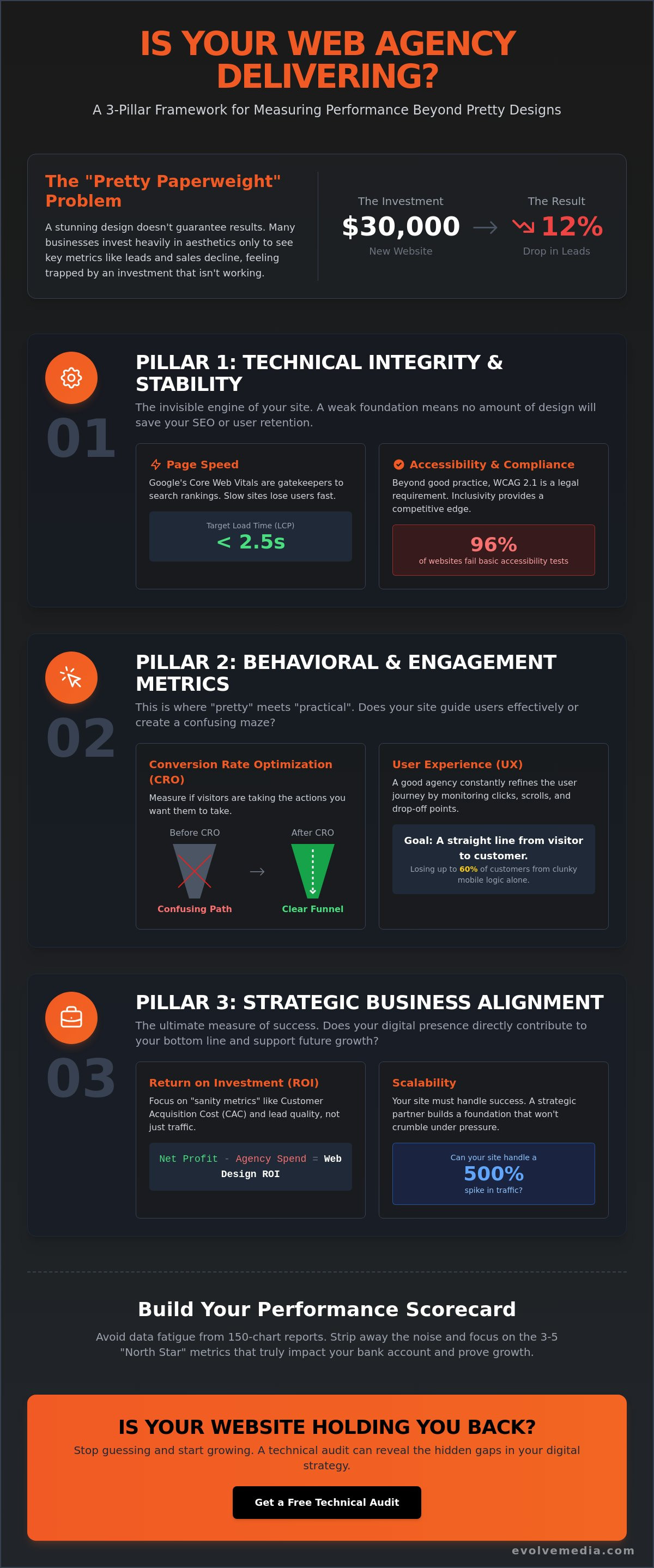
On May 12, 2026, my friend Sarah showed me her brand new $30,000 website. It featured organic shapes and soft gradients that looked incredible, but she was quietly panicking because her leads had actually dropped by 12 percent. She felt trapped in a black box, buried under technical jargon while her investment sat there like a pretty digital paperweight. It’s a common frustration when you’re measuring web design agency performance without a clear map to guide your expectations.
You likely suspect that a beautiful layout isn’t enough if it doesn’t move the needle on your bottom line. I’ll give you the exact metrics and frameworks you need to see if your agency is truly a strategic partner or just a vendor with a nice portfolio. We’ll explore how to link visual choices to revenue and why hitting the April 24, 2026, ADA compliance deadline is the ultimate test of professional accountability for any modern team.
Key Takeaways
- Stop judging your site by its cover. You’ll learn how to distinguish between a beautiful layout and a site that actually converts visitors into customers.
- We’ll break down the three pillars of agency health, ensuring your technical foundation is rock solid while your user experience keeps people moving toward the checkout.
- Discover how to build a simple scorecard for measuring web design agency performance using only three to five metrics that truly matter to your bank account.
- Learn why the speed of your agency’s response is just as important as the speed of your website when it comes to long term success.
Beyond the Aesthetics: Why Measuring Performance is Your Secret Growth Weapon
Sarah’s $30,000 website was objectively stunning. It featured the hand-drawn scribbles and soft gradients that are everywhere in May 2026. However, three months after launch, it hadn’t captured a single qualified lead. It was a digital paperweight, beautiful to look at but functionally useless for her bottom line. True performance is never just about the visual wrapper; it is the marriage of technical execution and strategic intent.
This is a common pitfall that a B2B digital marketing agency often addresses, particularly when analyzing why complex sites fail to turn visitors into qualified RFQs despite a high-end visual design.
To better understand how a structured approach leads to better results, watch this helpful video:
When you are measuring web design agency performance, you have to look past vanity metrics like social shares or raw traffic counts. In 2026, the industry has shifted toward intent-first measurement where we prioritize how effectively visitors achieve their specific goals. You need sanity metrics, like conversion rates and customer acquisition costs, to know if your investment is actually fueling your growth.
The Hidden Cost of Not Measuring
Ignoring the data creates design debt that eventually breaks your budget. If your mobile logic is clunky, you might be losing up to 60 percent of your potential customers before they even see your offer. Web design ROI is the net profit generated by digital assets minus total agency spend.
Setting the Stage for a Transparent Partnership
A Wise Architect knows that tracking begins during the discovery phase, not as an afterthought. You must establish baseline data early because you can’t prove growth if you don’t know where you started. Understanding web performance fundamentals helps you see through the technical fog and ensures your agency is actually partnering with you for the long haul.
The Three-Pillar Framework for Evaluating Your Agency
Measuring web design agency performance shouldn’t feel like you’re trying to solve a Rubik’s cube in the dark. While some agencies love to hide behind complex spreadsheets, I prefer a simple three pillar framework. It’s a way to look at the engine, the experience, and the bottom line. If these three areas aren’t balanced, your digital presence will eventually wobble and fall over. Think of it as a health check for your investment.
A great agency acts as a strategic partner, ensuring that every pixel serves a purpose. When these pillars are in alignment, you stop guessing and start growing. It turns your website from a static brochure into a high performance tool that can handle whatever your market throws at it.
Pillar 1: Technical Integrity and Stability
Technical health is the invisible engine of your site. In May 2026, Google’s Core Web Vitals are more than just suggestions; they are the gatekeepers of your search rankings. Your site needs to load in under 2.5 seconds to keep users from jumping ship. Beyond speed, accessibility is now a legal requirement. Since the April 24, 2026 deadline passed for larger entities to meet WCAG 2.1 Level AA standards, your agency must ensure your site is inclusive. If your foundation isn’t rock solid, no amount of pretty design will save your SEO.
Pillar 2: Behavioral and Engagement Metrics
User experience is where the “pretty” meets the “practical.” You want to see a straight line to your checkout or contact form, not a confusing maze. We look at Conversion Rate Optimization (CRO) to see if visitors are actually doing what you want them to do. If 96 percent of websites currently fail basic accessibility tests, having a site that is easy to navigate gives you a massive edge. A good agency monitors where people click and where they get stuck, constantly refining the path to make it smoother.
Pillar 3: Strategic Business Alignment
The final pillar is all about the results that show up in your bank account. It’s not just about getting more leads; it’s about getting better ones. Your digital presence should reflect your brand consistently across every touchpoint. Scalability is also key here. Your site should be able to handle a 500 percent spike in traffic without breaking a sweat. If you feel like your current site is holding you back, it might be time to reach out for a technical audit to see where the gaps are hiding.
How to Build Your Agency Performance Scorecard
I once sat with a founder who was staring at a 40-page monthly report like it was a foreign language textbook. He had 150 different charts and graphs, yet he couldn’t tell me if his $50,000 investment was actually working. He was drowning in data fatigue, which is exactly what happens when you don’t have a focused scorecard. To avoid this, you need to strip away the noise and focus on a few “North Star” metrics that actually impact your bank account.
Building a scorecard makes measuring web design agency performance a collaborative process rather than a confrontation. Start by picking just three to five key metrics. Then, establish a monthly reporting rhythm. You should use a shared dashboard, like a simple Google Looker Studio page, so everyone is looking at the same version of the truth. Finally, perform a gap analysis once a quarter to see where the agency is over-delivering and where they might be coasting on past successes.
Choosing the Right Metrics for Your Business Stage
Your goals change as your company matures. If you are in the early stages, focus on brand awareness and how long people stay on your site. Once you hit the growth stage, your scorecard should shift toward conversion rates and lowering your customer acquisition costs. For large scale organizations, the focus often moves to system integration and how much manual work the new site has automated. A site that saves your team 10 hours of data entry a week is just as valuable as one that brings in new leads.
The Monthly Review: Questions You Must Ask
Don’t just let your agency email you a PDF and call it a day. Sit down for twenty minutes and ask these three specific questions. First, what was the single biggest technical win this month? Second, where exactly are users getting stuck in our conversion funnel? Third, how does this month’s data change our design priorities for next month? If they can’t answer these clearly, they aren’t acting as a strategic partner.
If your current reports feel like a bunch of empty numbers, it is time to simplify your approach. You can contact our team for a performance consultation to help you identify the metrics that will actually move your business forward.
The Partnership KPI: Why Trust and Stability Are the Ultimate Metrics
You can have the fastest site on the planet, but if your agency disappears when you have a question, that speed doesn’t matter much. measuring web design agency performance eventually moves past the cold numbers on a screen and into the reality of your daily working relationship. You need to know if your partner is looking out for your future or just billing you for the past. While spreadsheets give you the “what,” your partnership health gives you the “why.”
I look for communication velocity as a primary indicator of a healthy project. If your agency takes three days to respond to a simple question about a landing page, they aren’t a partner; they’re a bottleneck. A high performing team provides solutions before you even realize there’s a problem. They should be suggesting how to integrate new AI tools into your workflow or how to optimize for the May 2026 search trends without being prompted. This proactive energy is what separates a silent vendor from a trusted advisor.
Longevity also brings a unique level of stability that you can’t find with a team that started last year. When an agency has been active since 1996, they’ve seen every major shift in digital history. They act as a Wise Architect, guiding you through technical transitions with a calm confidence that prevents expensive mistakes. This institutional knowledge ensures that your site isn’t just a trend, but a scalable asset that grows with your company.
Evaluating Agency Proactivity and Innovation
Your Next Steps for Digital Evolution
Take ten minutes today to audit your current agency’s transparency. If you feel like you’re still in the dark about where your money is going, it’s time for a change. You deserve a discovery session with a team that values clarity over jargon. Ready for a partner who prioritizes your ROI? Let’s talk about your project and see how we can move your business forward.
Take Control of Your Digital Future
You’ve got the map now. No more staring at confusing reports and wondering if your agency is just making things look pretty while your leads flatline. By focusing on technical health, user behavior, and strategic alignment, measuring web design agency performance becomes a tool for growth rather than a source of stress. You need a partner who values transparency as much as they value design.
Since 1996, we’ve focused on building custom online applications that don’t just sit there; they work. We back our builds with managed hosting that offers 99.9 percent uptime stability, ensuring your site is always ready to handle your next big win. It’s about moving from a vendor relationship to a strategic partnership where your success is the only metric that truly matters. You deserve a team that brings both technical authority and genuine collaborative warmth to the table.
Ready to see what a high-performance site can do for your bottom line? Discover how Evolve Media builds high-performance digital assets. You’ve got this, and we’re here to help you navigate the path ahead.
Frequently Asked Questions
What is the most important KPI for a web design agency?
The conversion rate is the ultimate metric for success. While traffic is nice, it doesn’t pay your bills if visitors don’t take action. A high performing site should turn at least 2 to 5 percent of visitors into qualified leads. If you are measuring web design agency performance solely on “likes” or “shares,” you are missing the bigger picture of actual business growth and revenue generation.
How often should I review my agency’s performance data?
You should review tactical data every 30 days and conduct a deep strategic dive every 90 days. Monthly reviews catch technical glitches or sudden drops in speed before they become expensive disasters. Quarterly reviews ensure your digital strategy still aligns with your company’s 2026 goals. This rhythm prevents data fatigue while keeping your agency accountable for consistent, measurable progress and long term stability.
What should I do if my agency’s design looks great but isn’t converting?
You need to perform a user path analysis to see where people are getting lost. A beautiful site that doesn’t convert is usually a “pretty maze” where the call to action is hidden or confusing. Since 96 percent of websites currently fail basic accessibility tests, your problem might be a lack of inclusive design that prevents users from completing a purchase or filling out a form easily.
Is page speed the only technical metric that matters in 2026?
Page speed is vital, but accessibility is a non negotiable standard in 2026. Under ADA Title II, public entities with over 50,000 people had to meet WCAG 2.1 Level AA by April 24, 2026. Your agency must also focus on mobile responsiveness and security. A site that loads in 1.5 seconds but is impossible for a screen reader to navigate is a major legal and financial risk.
How do I measure the ROI of a branding project versus a web development project?
Branding ROI is measured by long term sentiment and the ability to charge premium prices. Web development ROI is more immediate, focusing on the net profit generated by your digital assets minus what you spent. While branding builds the “soul” of your company over several months, measuring web design agency performance on a development project is about seeing a direct spike in lead quality within 8 to 12 weeks of launch.
Can a web design agency help with my business process automation?
Yes, especially if the agency specializes in custom online applications. We often build tools that automate data entry or client onboarding, which can save a team 15 to 20 hours of manual labor every week. A strategic partner looks at your entire business process, not just your homepage, to find ways where code can replace repetitive tasks and improve your overall efficiency and bottom line.