



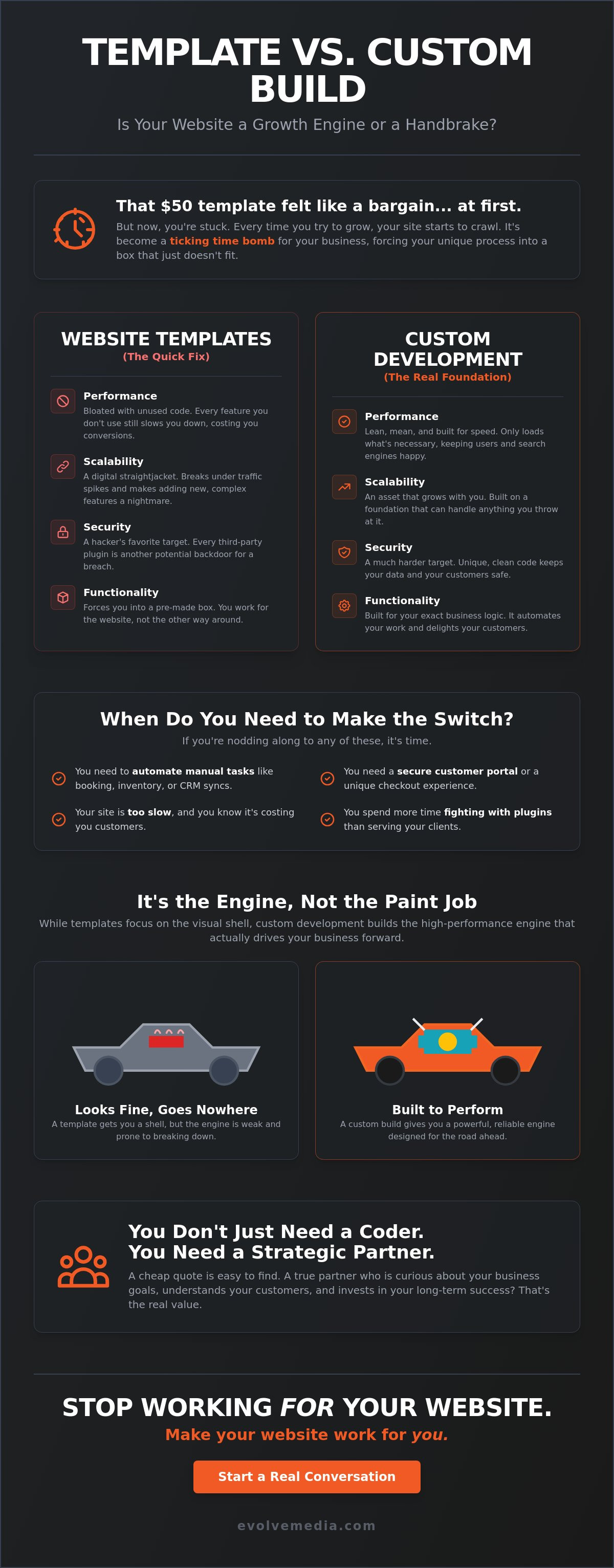
That $50 template you bought last year wasn’t actually a bargain. It was a ticking time bomb for your growth. You likely felt like you were winning when you launched in a weekend, but now, every time you try to add a simple booking feature, the whole thing starts to crawl. Choosing custom web development over a rigid theme is often the difference between a site that breaks and a site that builds your bottom line.
We’ve seen this cycle many times since our agency started back in the early days of the web. You want to focus on your customers, but instead, you’re stuck fighting with a plugin that won’t update or a page that takes five seconds to load. It’s frustrating to realize your own website is the biggest bottleneck in your business. While AI coding assistants have reduced build times by up to 34% according to recent 2026 benchmarks, the real value still lies in the strategic thinking our seasoned experts bring to your project architecture.
This article explains how custom tools solve the specific problems that templates can’t touch. We’ll show you how to automate manual tasks, boost site speed to save your conversions, and find a digital partner who is as invested in your success as you are. It’s time to stop working for your website and make your website start working for you.
Key Takeaways
- Templates often become a digital straightjacket that limits your growth. Learn how to spot the moment you’ve outgrown your theme and need a site that actually scales.
- Stop focusing on the paint job and start looking at the engine. We explain how custom web development builds the specific business logic you need to automate your daily manual work.
- A discovery phase is the secret to keeping your project on budget. Learn how starting with your biggest business problems prevents you from overpaying for flashy features that don’t convert.
- You don’t just need someone to write code; you need a strategic partner who understands your long-term goals. See why a team’s curiosity about your business is a better indicator of success than a cheap quote.
Templates vs. Custom: When to Stop Fitting Into a Pre-Made Box
Templates are the fast food of the internet. They’re quick, cheap, and they get the job done when you’re just starting out. But as your business grows, that “easy” theme often turns into a digital straightjacket. You find yourself trying to force your unique business processes into a pre-made box that just wasn’t built for them. Modern Web development has evolved far beyond simple static pages; today, it’s about creating a performant engine that drives your specific goals. While templates are a starting point, true custom web development is what separates a hobbyist site from a professional revenue driver.
To better understand the fundamentals of building from the ground up, watch this helpful video:
The hidden cost of “easy” website builders
The problem with most DIY builders isn’t that they look bad. It’s what’s happening under the hood. Templates often come with bloated code. This means they load hundreds of features you don’t actually use, which kills your site speed. This is a major red flag for your 2026 SEO efforts. If your site takes more than three seconds to load, you’re losing money.
Many owners try to fix these gaps by stacking third-party plugins. This is a security nightmare. Every plugin is a potential back door for a hack. Real professional web design focuses on lean, functional code that keeps your data safe and your pages fast. It’s about building for the long haul, not just for the launch date.
When custom is the only way forward
How do you know when you’ve hit the wall? It usually happens when you need your site to do more than just look pretty. If you need a secure customer portal, a complex database to manage inventory, or a checkout process that doesn’t look like every other store, you’ve reached the limit of off-the-shelf tools.
Choosing custom web development allows you to build exactly what you need without the technical debt of a template. It gives you total control over the user experience. Instead of fitting in with the crowd, you get a digital tool that stands out and handles high traffic spikes without breaking a sweat. It’s an investment in a foundation that scales with you, rather than a temporary fix you’ll have to replace in twelve months.
The Real Work: What Happens Inside a Custom Web Development Project
If you think custom web development is just about picking better colors or fonts, you’re only seeing the surface. It’s like buying a car based on the leather seats while ignoring the fact that there’s no engine under the hood. While templates focus on the visual shell, custom web development prioritizes the logic that makes your business run. In a custom project, the real work happens where your customers never look: in the code that actually runs your day-to-day operations.
We don’t build these tools in a vacuum. Your site needs to talk to your inventory software, your email list, and your payment processor. Custom APIs act as the translators that make these conversations happen without you having to lift a finger. This connectivity ensures that your data flows exactly where it needs to go, reducing the time you spend on manual entry.
Solving business logic problems
Think about an automated booking system that doesn’t just take a name, but checks your actual staff availability, syncs with your CRM, and sends a follow-up text. This is what we mean by business logic. These types of online applications replace the messy, error-prone spreadsheets that keep you working late on Friday nights. Backend architecture is essentially the brain of your digital operation.
Performance and security at scale
Hackers love generic templates. Why? Because one vulnerability can open the door to millions of sites at once. Custom builds are much harder targets. Since the code is unique to your business, there isn’t a public “how-to” guide for breaking in. We also write “clean code” from the very first line. This means your site isn’t weighed down by thousands of lines of junk it doesn’t need to function.
Combined with professional hosting, you get stability that scales as you grow. Performance is baked into the foundation, not added later as a patch. If you’re tired of manual work and want to see how these tools could fit your specific workflow, let’s start a conversation about your goals.
How to Plan Your Custom Build Without Losing Your Mind (or Budget)
Most people start a custom web development project by listing features they want to see. That’s a mistake. It’s like picking out curtains before you’ve poured the foundation. You should start with the problem you’re trying to solve. Is your checkout process leaking customers? Are your employees spending ten hours a week manually moving data between systems? Focus on the friction first.
The discovery phase is the most critical part of the build. It isn’t just a fancy term for a meeting. This is where we map out the logic we discussed earlier. It’s much better to spend two weeks planning than six months building the wrong thing. Be honest about the clock, too. You can launch a template in a weekend, but a custom tool takes weeks or months. Quality doesn’t happen overnight. A flexible roadmap allows us to make adjustments as we uncover new insights during the build.
Defining your “Must-Haves” vs. “Nice-to-Haves”
Try this: Spend three days tracking your team’s biggest digital headaches. What stops them from finishing their work? Use those pain points to build your “Must-Have” list. Before you add a complex, flashy feature, look at the web design ROI to see if it actually pays for itself. Tweak your project list to prioritize tools that directly drive revenue rather than just looking cool.
Avoiding the technical debt trap
Technical debt is like a credit card for code. If you take shortcuts now to save a few bucks, you’ll pay high interest later. Choosing the right tech stack today prevents your site from becoming obsolete by 2027. Proper documentation ensures that when you want to update your site in three years, you won’t have to start from scratch. If you’re ready to stop guessing and start planning, reach out to our team to begin your discovery phase.
Finding a Strategic Partner for Your 2026 Digital Growth
You don’t need a vendor to just check off a list of tasks. You need a team that is genuinely curious about your business model. Most coders will say “yes” to every request you have, even if it’s a bad idea for your long-term growth. A true partner has the guts to say, “Here is a better way to handle that database.” This is the difference between a project that just finishes and one that actually succeeds. When you invest in custom web development, you are hiring an advisor as much as a builder.
Before you sign a contract, look at the people behind the screen. Ask them about their history. Ask them what they do when things get difficult. A partner who understands the “why” behind your business logic will always produce a better product than someone just following a ticket list. We’ve found that the best results come from long-term relationships where we act as a propellant for our clients’ growth.
Why 30 years of experience matters
We’ve been in this industry since 1996. In that time, we’ve seen every flash-in-the-pan trend come and go. We know what lasts. By taking a moment to meet the human faces behind the code, you can see the depth of dedication we bring to every project. That longevity brings a sense of calm confidence to the process. You aren’t just getting custom web development; you’re getting three decades of institutional knowledge that helps you avoid common pitfalls.
Support that goes beyond the launch
A website is a living tool. It isn’t a poster you stick on a wall and forget. It needs regular care, security patches, and performance tweaks to stay competitive. Our managed hosting services ensure that your site stays fast and secure long after the initial launch excitement has faded. We don’t just hand over the keys and disappear. We stay in your corner to make sure your digital tools keep working for you as your business evolves. Let’s grab that virtual coffee and talk about your project today.
Stop Fighting Your Website and Start Winning
Your digital presence shouldn’t be a source of constant stress. If you’re tired of “making it work” with a broken template or a slow checkout, it’s time to shift your focus to a foundation that scales. Investing in custom web development isn’t just about writing code; it’s about reclaiming your time and automating the manual tasks that hold you back. You need a site that matches your ambition.
We’ve been building custom digital tools since 1996. Our team brings deep expertise across ecommerce development, online applications, and professional hosting to every project we touch. We prioritize your actual business goals over technical jargon, acting as a strategic partner rather than just another vendor. You deserve a site that is as ambitious as your growth plans for 2026 and beyond.
Ready to build something that actually works? Let’s talk.
The right tool doesn’t just sit there. It propels you forward. We can’t wait to see what you build next.
Frequently Asked Questions
How much does custom web development usually cost?
The investment depends entirely on the complexity of the logic your business requires. A simple site with a few pages costs significantly less than a complex e-commerce platform or a multi-tenant web application. You aren’t just paying for lines of code. You’re paying for the strategic planning and discovery phase that ensures the final product actually solves your specific problems without the hidden costs of technical debt.
How long does it take to build a custom website from scratch?
Most professional projects take between eight and sixteen weeks to move from the initial strategy sessions to the final launch. While a template can be slapped together in a few days, building a custom engine requires time for architecture, development, and rigorous testing. This timeline ensures your site is stable, secure, and ready to handle high traffic from the moment it goes live.
Can I update a custom-built website myself, or do I need a developer?
You can absolutely manage your own content without needing a developer for every tiny change. We build sites using intuitive content management systems that allow you to tweak headlines, swap images, or post new articles easily. You get the power of a professional build with the simplicity of a DIY tool for your daily updates. We handle the heavy lifting so you can focus on your business.
Is custom web development better for SEO than using a template?
Custom web development offers a massive advantage for SEO because it eliminates the bloated code found in most generic themes. Google prioritizes site speed and mobile performance, which are two things we bake into the foundation of every project. Since your site only contains the code it actually needs, your pages load faster and your search rankings don’t suffer from technical “junk” dragging them down.
What is the difference between a web designer and a web developer?
A web designer focuses on the visual experience and how your site feels to a user. A web developer builds the code that makes those designs function and connects them to your databases. Think of the designer as the architect who draws the blueprints and the developer as the engineer who ensures the building is structurally sound. Our team handles both roles to ensure your branding and functionality work together perfectly.
What happens if I want to add new features to my custom site later?
Adding features to a custom site is much easier than trying to “hack” a rigid template. Because the code is clean and properly documented, we can build new modules or integrate new APIs without breaking your existing functionality. This flexibility is exactly why growing businesses choose custom builds. Your site is a living tool that can grow as your business needs change, rather than a static box that limits your potential.



Comment (01)
Professional Web Design: Busting the Myths of the “Easy” DIY Website
May 22, 2026[…] rather than a recycled layout. If your current template is already holding you back, exploring custom web development solutions that are built around your specific business logic is often the most effective next […]