
Two-thirds of website redesigns fail to meet their business goals because they are treated as art projects rather than performance engines. It’s a frustrating reality for marketing leaders who know their site needs a refresh but can’t quite prove the financial payoff to a skeptical board. You’ve likely felt that nagging worry that you’ll spend thousands on a “pretty” interface that doesn’t actually convert visitors into customers.
We’ve seen this cycle before, and we believe it’s time to bring some seasoned clarity to the table. You deserve to move forward with confidence, backed by a website redesign ROI calculator framework that translates design choices into dollar figures.
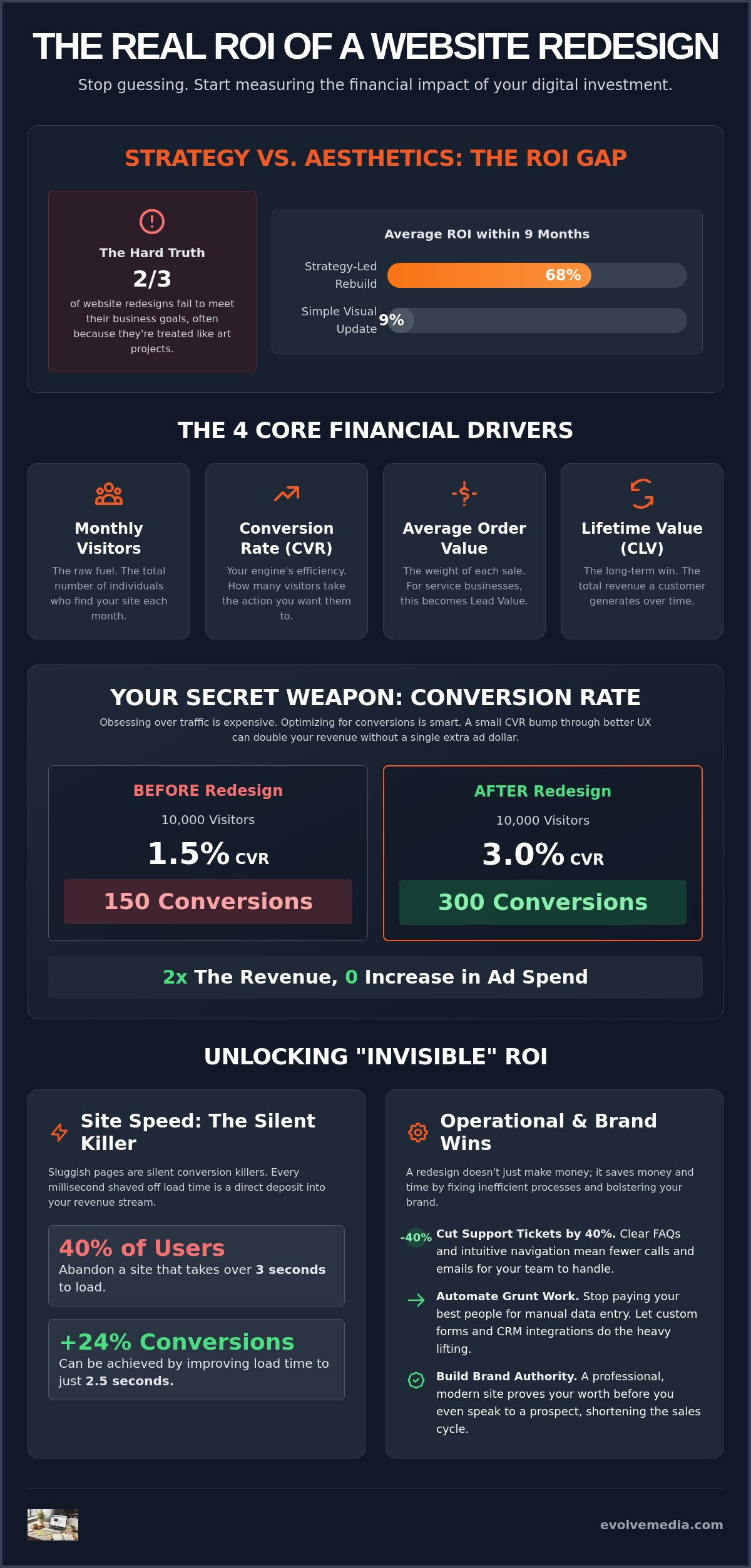
A strategy-led rebuild can deliver an average ROI of 68% within nine months. That’s a massive leap over the 9% return seen from simple visual updates. In this guide, we’ll share our transparent framework for measuring real financial impact. We’ll explore the metrics that actually drive profit, like how fixing friction points can slash support tickets by 40% and why a 2.5-second load time is your secret weapon for 24% more conversions.
Key Takeaways
- Identify the two most critical drivers, monthly unique visitors and conversion rates, that determine whether your digital investment translates into real-world profit.
- Quantify the value of operational wins, like reduced support calls and time saved through automated forms, to see the full picture of your return.
- Use your baseline data from the past year to build a reliable growth forecast with a website redesign ROI calculator framework.
- Understand why custom web development is essential for streamlining business logic and ensuring your new site isn’t just a pretty face.
The Core Variables: What Drives Your Website’s Financial Performance?
A website isn’t a static billboard; it’s a living machine with specific gears that need to mesh together. To get an accurate reading from any website redesign ROI calculator, you have to understand the math behind the curtain. Most people look at a site and see colors; we see variables. We’ve been building digital solutions since 1996, and we’ve learned that four core inputs dictate your success.
- Monthly Unique Visitors: This is the raw fuel. It’s the total number of individuals who find your site every month.
- Conversion Rate (CVR): This is the efficiency of your engine. It measures how many visitors actually take the action you want.
- Average Order Value (AOV): This is the “weight” of each sale. For service-based businesses, we swap this for Lead Value. This is the estimated dollar amount a qualified inquiry is worth to your bottom line based on historical closing rates.
- Customer Lifetime Value (CLV): This is the long-term win. It accounts for the total revenue a customer generates over their entire relationship with you.
Why Conversion Rate is Your Secret Weapon
Many people obsess over getting more traffic, but that’s often the most expensive way to grow. Imagine you have 10,000 visitors and a 1.5% CVR. If you bump that rate to 3% through better UX, you’ve just doubled your revenue without spending an extra dime on ads. Page views are just vanity metrics; goal completions are sanity metrics. Simply put, CVR is the ratio of “doers” to “lookers” on your site. This logic is the foundation for any accurate Return on Investment (ROI) projection.
Traffic Quality vs. Traffic Quantity
A redesign often fixes high bounce rates because it filters out the noise. When we focus on better ecommerce development, we want higher-intent visitors who are ready to buy. It’s better to have 1,000 visitors who are 10% likely to purchase than 10,000 visitors who are only 0.1% likely. Before using a website redesign ROI calculator, check your GA4 data. You need to know why “lookers” are leaving before you can build a site that makes them stay.
Hard Gains vs. Soft Wins: Calculating the Total Value of a Refresh
Think beyond the direct sale for a moment. While a website redesign ROI calculator usually focuses on the cash register, it often misses the money you’re currently setting on fire through inefficiency. We’ve seen teams reclaim dozens of hours every month just by moving from messy email threads to automated forms that feed directly into a CRM. That isn’t just a “nice to have” update. It’s a structural improvement that keeps your overhead low.
- Operational Efficiency: Stop paying your best people to do manual data entry. Custom development handles the grunt work.
- Customer Support Savings: A clear FAQ section and intuitive navigation can cut your support call volume significantly.
- Brand Authority: If you sell high-ticket services, a dated site is a red flag. A professional look shortens your sales cycle by proving your worth before you even meet.
- Managed Hosting: Think of this as insurance. Good hosting prevents the “negative ROI” that happens when your site goes dark during a big promotion.
The “Invisible” ROI of Site Speed
Speed is the silent killer of conversions. It’s a hard reality that 40% of users abandon a site that takes over 3 seconds to load. You can have the best product in the world, but if your pages are sluggish, you’re effectively closing your doors on nearly half your potential customers. This is why performance is a cornerstone of small business SEO services. Search engines want to send users to sites that actually work. When you follow a comprehensive guide to website redesign, you’ll see that every millisecond shaved off your load time is a direct deposit into your revenue stream.
Reducing the Cost of Customer Acquisition (CAC)
Your marketing budget is only as effective as your landing page. If you’re spending thousands on ads but sending that traffic to a confusing site, you’re paying a “frustration tax.” A high-converting site makes your paid spend go much further. Trust-building elements like clear testimonials and sharp branding reduce the friction that usually stops a click from becoming a client. It’s often cheaper to fix a “leaky” website than it is to keep buying more traffic. If you’re ready to see how your current site measures up, let’s take a look at your performance data together.
Running the Numbers: A Step-by-Step Guide to Your ROI Forecast
Calculations aren’t magic; they’re math. To get the most out of a website redesign ROI calculator, you have to feed it honest data. We’ve seen too many leaders plug in “dream numbers” only to be disappointed when reality hits. If you want a forecast that actually holds up in a boardroom, you need to start with a cold, hard look at your current performance.
Finding Your Baseline
Open your analytics dashboard and pull your data from the last 12 months. Why a full year? Because a 12-month average is the only way to account for seasonal dips and spikes, like the holiday rush or the summer slump. You need to pin down your current Conversion Rate (CVR) and Average Order Value (AOV) exactly as they are today. It’s also a great time to audit your online applications and internal tools to see where users are dropping off or where your team is losing time to manual entry.
Setting Realistic “After” Goals
Don’t fall into the trap of assuming a 500% revenue increase overnight. While a strategy-led rebuild can deliver massive gains, we prefer to aim for incremental, sustainable wins. A 1% or 2% bump in CVR might not sound flashy, but it can completely transform your profit margins. Remember that branding and digital marketing work in tandem to push these numbers higher. To see the potential, use this simple formula:
(New Annual Revenue – Old Annual Revenue) / Cost of Redesign = ROI.
We recommend running three distinct scenarios to manage expectations and plan your budget:
- Conservative: A modest 10% to 15% improvement in conversion efficiency.
- Realistic: A 20% to 50% increase, which is typical for well-executed performance projects.
- Aggressive: A total digital overhaul that fixes major friction points and slashes your Payback Period.
The Payback Period is simply the number of months it takes for your new profit to cover the total project cost. If you’re ready to see what these numbers look like for your specific business, book a strategy session with our team and we’ll help you run the math.
From Spreadsheets to Success: Making Your New Website Pay for Itself
Crunching numbers in a website redesign ROI calculator is a fantastic start, but a spreadsheet won’t build your site. The real work begins when you turn those projections into a functional business plan. We’ve seen plenty of “pretty” websites that fail to move the needle because they were built as art projects rather than strategic assets. To make your investment pay for itself, you need a site that matches your unique business logic and stays sharp long after launch.
The biggest mistake we see is the “set it and forget it” mindset. Digital markets change fast. A site that converts today might need a tweak tomorrow to stay ahead of the competition. Think of your website as a high-performance engine that needs regular tuning to keep those returns high. This is where custom web development proves its worth by allowing for the flexibility and scale that off-the-shelf templates simply can’t match.
Why Evolve Media is Your ROI Partner
We’ve been in this game since 1996. That longevity isn’t just a number; it’s a deep well of institutional knowledge that we bring to every project. Our about us story is rooted in a genuine curiosity about how our clients actually make money. We don’t just build for our portfolio; we build for your bottom line. By focusing on performance over polish, we ensure your site handles the heavy lifting of your business, from lead capture to complex ecommerce flows.
Ready to Stop Guessing?
Generic tools can only take you so far. A website redesign ROI calculator gives you an estimate, but a tailored strategy gives you a roadmap. If you’re tired of guessing which metrics matter or how to explain the value of UX to your board, it’s time for a different approach. We’re here to help you move from theory to reality with a plan built on your specific data and goals. Every major success story we’ve been part of started with a simple, honest look at the numbers.
Let’s build something that actually grows your business. The best results always start with a single, smart conversation.
Move Beyond the Spreadsheet to Real-World Growth
A website redesign isn’t just a cost to be managed; it’s an engine for revenue and operational efficiency that pays for itself when built on logic. You’ve seen how a 1% conversion bump can transform your bottom line and how fixing friction points can slash support tickets by up to 40%. While a website redesign ROI calculator is a powerful tool for setting baseline expectations, the real magic happens when you move from generic projections to a tailored business plan.
Since 1996, we’ve acted as strategic partners for businesses navigating the complexities of eCommerce, branding, and custom apps. We bring decades of institutional knowledge to the table, ensuring your digital refresh isn’t just a visual update but a performance-driven powerhouse. We’re here to help you turn those spreadsheet numbers into a reality that actually moves the needle for your team and your customers.
Let’s talk about your project and run the numbers together. You don’t have to guess about your digital future when you have a partner who is as invested in your long-term success as you are.
Common Questions About Website ROI
How do I accurately estimate my new conversion rate after a redesign?
Look at your current friction points and compare them to industry benchmarks for performance-led projects. Professional redesigns typically result in a 20% to 50% increase in conversions within the first six months. You shouldn’t just pull a number out of thin air; instead, look at how fixing specific usability issues, like a confusing checkout or a slow form, will naturally turn more “lookers” into “doers.”
What is a “good” ROI for a professional web design project?
A strategy-led rebuild should aim for an average ROI of 68% within the first nine months. While every industry has different margins, a project is generally considered successful if it pays for itself within the first year through new revenue or saved operational hours. If you only see a 9% return after twelve months, you likely opted for a simple visual refresh rather than a strategic overhaul.
How long does it typically take to see a return on investment?
Most businesses start seeing a measurable impact on their bottom line within six to nine months. Data from Bixel Design indicates that this is the sweet spot where strategy-led projects hit their stride. Early wins, like a 24% boost in conversions from faster load times, can appear much sooner, but the full financial picture usually stabilizes by the end of the first year.
Should I include hosting and maintenance costs in my ROI calculation?
Yes, you should factor these in as recurring operational expenses to get a realistic net profit figure. While they are ongoing costs, high-quality hosting acts as a safeguard against “negative ROI” caused by site crashes or security breaches. Including these numbers ensures your website redesign ROI calculator reflects the true total cost of ownership rather than just the initial launch price.
Can I calculate ROI if my website doesn’t sell products directly?
Absolutely, by assigning a specific dollar value to your leads based on your historical closing rates. If one out of every ten leads becomes a customer worth $5,000, then every lead has a value of $500. When you plug these lead values into a website redesign ROI calculator, you can see exactly how much revenue a 15% to 35% lift in inquiry rates will generate for your sales team.
Is a redesign worth the investment if my current traffic is very low?
It depends on whether your site is the reason the traffic is low. If your current site fails to meet accessibility standards or loads slowly, search engines will likely bury you in the rankings. A redesign can act as the catalyst for growth by fixing these technical hurdles, but you’ll still need a solid digital marketing plan to pour fuel on the fire and maximize your return.