
You’ve finally hit your limit with that clunky, legacy CMS that takes twenty minutes just to upload a single blog post. You know the poor user experience is dragging down your marketing campaigns, but every time you mention a redesign, the Finance team looks at you like you’re asking for a luxury vacation. Learning how to get buy-in for a new website isn’t about winning an argument over “pretty” colors; it’s about proving that your current digital platform is a bottleneck for growth.
It’s exhausting to watch organic traffic stall when you know that 40.65% of all web traffic comes from search. We’ve been helping brands manage these internal hurdles since 1996. We’ve learned that a project only moves forward when it solves a business problem rather than a design one. This guide gives you the exact framework to turn skeptical executives into project champions. We’ll cover data-backed arguments for the CFO, a strategy to align IT and Marketing, and a clear roadmap to secure your budget without the usual friction.
Key Takeaways
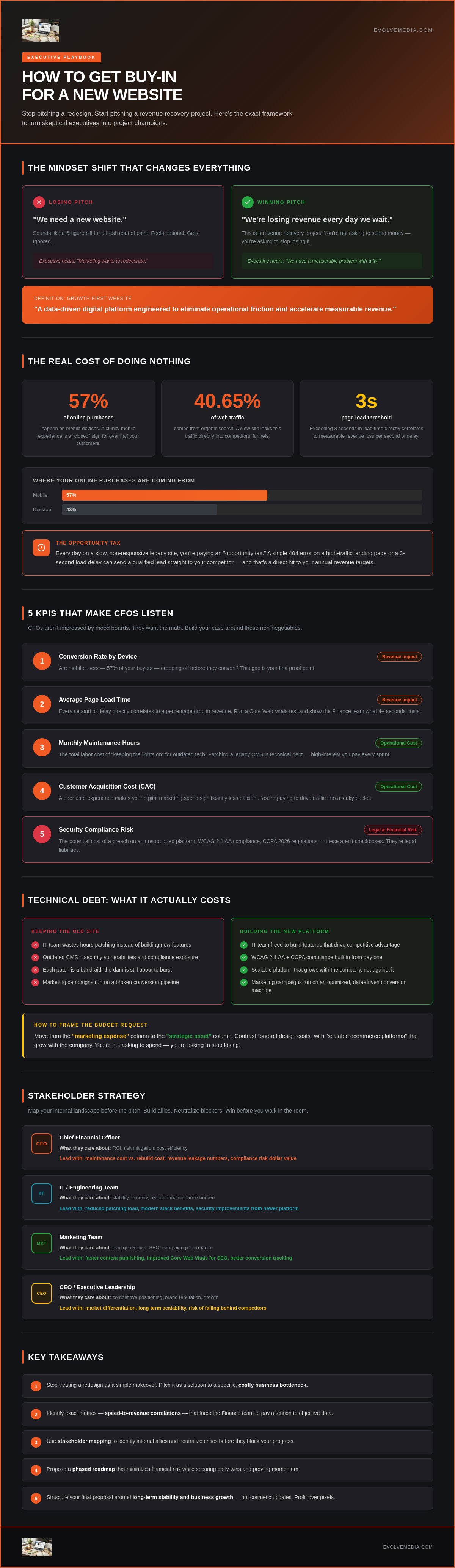
- Stop treating a redesign as a simple makeover and start pitching it as a solution to a specific, costly business bottleneck.
- Identify the exact metrics, such as speed-to-revenue correlations, that force the Finance team to pay attention to your objective data.
- Use stakeholder mapping to identify your internal allies and neutralize critics before they have a chance to block your progress.
- Discover how to get buy-in for a new website by proposing a phased roadmap that minimizes financial risk while securing early wins.
- Structure your final proposal to focus on long-term stability and business growth rather than just cosmetic updates.
Stop Asking for a Website and Start Solving a Business Problem
If you walk into a boardroom and ask for a new website, you’ve already lost the room. To an executive, the word “website” often sounds like a six-figure bill for a fresh coat of paint. It feels optional. To understand how to get buy-in for a new website, you have to stop talking about pixels and start talking about profit. Effective Stakeholder management starts with identifying the specific business friction that your current platform creates.
There is a massive difference between a cosmetic update and a functional business tool. A cosmetic update changes the font; a functional tool automates your lead routing or integrates your inventory with your sales floor. Stakeholders often ignore the “silent killers” of conversion, such as failing to meet the WCAG 2.1 Level AA accessibility standards or ignoring the 2026 CCPA data privacy regulations. These aren’t just technical checkboxes. They are significant legal and financial risks that can tank a brand’s reputation overnight.
A Growth-First Website is a data-driven digital platform engineered to eliminate operational friction and accelerate measurable revenue.
The Real Cost of Doing Nothing
Every day you spend on a slow, non-responsive legacy site, you’re paying an “opportunity tax.” It’s expensive to stay still. With mobile devices now accounting for 57% of all online purchases, a clunky mobile experience is essentially a “closed” sign for more than half of your potential customers. We’ve seen cases where a single 404 error on a high-traffic landing page or a three-second delay in load time caused a lead to bounce straight to a competitor. That isn’t just a tech glitch; it’s a direct hit to your annual revenue targets.
Shifting the Narrative from Expense to Asset
Reframe your budget request as a “revenue recovery” project. You aren’t asking to spend money; you’re asking to stop losing it. Contrast the idea of “one-off design costs” with “scalable ecommerce platforms” that grow with the company. When you position the project as a way to streamline business processes, it moves from the “marketing expense” column to the “strategic asset” column. For a deeper look at the numbers, you can explore the ROI of Quality Web Design Services to help ground your argument in financial reality.
Gathering the Evidence: Metrics That Make CFOs Listen
CFOs aren’t impressed by mood boards. They want the math. If you want to master how to get buy-in for a new website, you need a spreadsheet, not just a vision. Start by running a Core Web Vitals test. If your site takes longer than three seconds to load, you’re likely losing a huge portion of that 40.65% of traffic that comes from organic search. That’s not just a technical lag. It’s a leak in your sales funnel.
Technical debt is the high interest you pay for keeping an old system on life support. It’s the hours your IT team wastes patching a legacy CMS instead of building new features. For the Finance team, this is a ticking time bomb. Every patch is a band-aid on a dam that’s about to burst. To build a bulletproof business case, focus on these five non-negotiable KPIs:
- Conversion Rate by Device: Are mobile users, who make up 57% of online purchases, dropping off at the finish line?
- Average Page Load Time: Every second of delay directly correlates to a percentage drop in revenue.
- Monthly Maintenance Hours: The total labor cost of “keeping the lights on” for outdated tech.
- Customer Acquisition Cost (CAC): A poor user experience makes your digital marketing spend significantly less efficient.
- Security Compliance Risk: The potential legal and financial cost of a breach on an unsupported platform.
Auditing Your Current Digital Bottlenecks
Don’t just tell them the checkout is frustrating. Show them the data. Is it a lack of mobile-friendly payment options or a clunky forced registration? By combining our decades of custom development expertise with a deep understanding of ecommerce conversion patterns and a commitment to streamlining business processes, we can help you identify exactly where your site is failing. Custom online applications can often automate these manual friction points, turning a slow process into a profit center. If you’re curious about where your revenue is leaking, we can act as a strategic partner to help you map out your performance gaps.
Mapping Technical Debt to Lost Revenue
Patching an old site often costs more than building a new one. With WordPress 7.0.1 already released, staying on an outdated version is a massive security risk that no Finance team should ignore. Try running a 3-day A/B test on your main call-to-action button or headline. Even a tiny 1% lift in conversion proves that a modern platform would pay for itself in months. This data is the secret to how to get buy-in for a new website and securing buy-in from the people who hold the checkbook.
The Art of the Internal Alliance: Managing Your Stakeholders
Most website projects don’t die because of bad code. They die in meeting rooms because of misaligned expectations. Learning how to get buy-in for a new website is less about design and more about being a high-level translator. You have to map out your internal power players: the CEO, CFO, CTO, and the Sales Lead. Each of these stakeholders speaks a different language, and you need to be fluent in all of them to move the needle.
The “we can do it in-house” objection is often the biggest hurdle. It sounds like a cost-saver, but it’s usually a productivity trap. When you pull your lead engineer away from your core product to fix a CSS bug on the homepage, you’re wasting high-value talent on a task that isn’t their primary focus. We’ve been acting as the strategic partner for businesses since 1996, handling the technical heavy lifting so your internal teams can stay focused on what they do best.
Speaking the Three Languages of Buy-in
The CEO cares about brand dominance and market share. If your competitor’s site is capturing the 60% of product discovery now happening on social media while yours feels like a relic, that’s a growth problem. The CFO wants to hear about risk mitigation and ROI. They need to know that a new site prevents legal fees from WCAG accessibility non-compliance. Finally, the IT team needs to hear about security, scalability, and the stability of managed hosting. They want to know the new platform won’t be another system they have to babysit at 2 a.m.
The Co-Creation Secret: Why Big Reveals Fail
Never walk into a meeting with a “finished” design mockup as your first move. It invites stakeholders to pick apart colors and fonts instead of focusing on functionality. Instead, use “Wireframe Workshops.” Sit down with the Sales Lead and let them show you exactly where their biggest lead-gen friction happens. When you involve a critic early in the process, they stop being a blocker and start feeling like an author of the solution. This ownership is the secret to how to get buy-in for a new website without the usual friction.
Ready to turn your internal critics into project champions? We can help you map out an approval strategy that aligns your departments and secures your budget.
Follow this 5-step timeline for a smooth internal approval cycle:
- Problem Definition: Identify the specific business bottleneck.
- Evidence Gathering: Collect the metrics that prove the current site is losing money.
- Stakeholder Workshop: Use co-creation to align departmental needs.
- Phased Proposal: Present a roadmap that minimizes initial financial risk.
- Final Sign-off: Secure the budget with a clear ROI projection.
Delivering the Pitch and Choosing Your Development Partner
The final step in learning how to get buy-in for a new website is the pitch itself. This isn’t a design presentation; it’s a business case. A winning proposal doesn’t start with a homepage mockup. It starts with the revenue you’re currently leaving on the table and ends with a clear path to reclaiming it. You want to present a structure that prioritizes business logic over aesthetics, showing that you’ve thought through the technical debt and stakeholder concerns we discussed earlier.
Crafting a Lean Project Roadmap
Instead of asking for a massive budget for a year-long project, pitch a phased roadmap. This reduces the “sticker shock” for the CFO and allows you to launch a Minimum Viable Website much faster. By setting realistic milestones, you keep stakeholders engaged because they see progress in months, not years. This approach also allows for a post-launch feedback loop. You can tweak your headline or run a 3-day A/B test based on real user data rather than boardroom guesses. It’s about constant, measurable improvement rather than a single “big bang” launch that might miss the mark.
Why Longevity Matters in a Digital Partner
When evaluating who will build this platform, look beyond the price tag. A partner’s history is a predictor of your future stability. Checking an agency’s about us page for industry tenure is a simple but effective litmus test. We’ve been in this business since 1996. We’ve seen platforms come and go. This history gives us the calm confidence to handle your technical heavy lifting without the typical startup growing pains. You aren’t just looking for a vendor to write code; you’re looking for a strategic partner who understands that your website is a long-term asset.
Choosing a partner who offers managed hosting is about more than just server space. It’s about long-term peace of mind. You need to know that when the site goes live, it’s being monitored by experts who understand your specific business goals. This is how you ensure the buy-in you worked so hard to get turns into a long-term success. Ready to build your business case? Contact our team for a strategic consultation and let’s get your project off the ground.
Turn Skepticism into Strategic Success
Securing approval for a major project is about more than just a better-looking homepage. It’s about demonstrating that you’ve identified the specific business bottlenecks dragging down your revenue. By shifting the conversation from design to data, you provide the calm confidence stakeholders need to sign off on the budget. Mastering how to get buy-in for a new website requires speaking the unique languages of Finance, IT, and Sales to build a unified alliance.
Since 1996, we’ve helped companies across the country navigate these internal hurdles by building custom digital solutions that solve complex business logic. We don’t just build sites; we act as a supportive, partner-first specialist in high-performance ecommerce. Whether you’re fighting legacy tech or underperforming campaigns, the right partner makes the path to approval much smoother.
Secure your digital future with a strategic web partner.
You have the data and the framework. Now it’s time to lead the charge and transform your digital platform into the asset your business deserves.
Your Stakeholder Survival Questions Answered
How long does it typically take to get buy-in for a major website overhaul?
It usually takes between three and six months for a mid-to-large organization to move from the first “we need this” conversation to a signed contract. This timeframe depends heavily on how quickly you can gather objective performance data and map out your internal stakeholders. If you’re struggling with how to get buy-in for a new website, focusing on the pre-work phase can help you avoid long delays in the boardroom.
What is the most common reason executives reject a new website proposal?
Executives usually say “no” because the proposal feels like an elective expense rather than a business necessity. If your pitch focuses on “modernizing the look” instead of “reclaiming lost leads,” it’s easy for a CFO to dismiss. They need to see how the new platform directly impacts market share or solves a specific operational bottleneck that’s currently costing the company money every single day.
Should I get agency quotes before or after I talk to my boss?
You should gather a few high-level estimates before that first big meeting. You don’t need a final contract yet, but having a realistic price range prevents you from being blindsided by budget questions. Look for partners with a long history in the industry to ensure your estimates are grounded in reality rather than just optimistic guesswork from a startup that hasn’t seen a full project lifecycle.
How do I handle a stakeholder who insists on keeping a legacy system?
Shift the conversation from “features” to “risk.” A legacy system isn’t just old; it’s a security vulnerability and a drain on your internal IT resources. When you calculate the “interest” you’re paying on that technical debt in the form of maintenance hours and lost mobile traffic, the cost of staying still often becomes higher than the cost of a fresh start with a strategic partner.
Can I prove the ROI of a new website before we even build it?
You can project ROI by looking at your current traffic and conversion leaks. For instance, if you know that 57% of your customers are on mobile but your mobile conversion rate is half of your desktop rate, that gap represents your projected gain. Proving how to get buy-in for a new website is much easier when you can show that a tiny lift in UX performance pays for the build in months.
What happens if we get buy-in but the budget is smaller than we expected?
Don’t scrap the project; just shrink the initial scope. Launch a “Minimum Viable Website” that solves your most painful business problem first, such as a broken checkout flow or a non-responsive landing page. You can then use the revenue generated from that first phase to fund the rest of your wishlist. This phased approach keeps stakeholders happy because they see a return on investment much faster than an all-or-nothing launch.