
Did you know that 43% of cyberattacks specifically target small businesses? It’s a sobering reality that often leads to that dreaded “site down” notification just as you’re sitting down for morning coffee. You shouldn’t have to be a security expert or a coding wizard just to keep your digital doors open. Most owners feel like they’re paying for a black box, never quite sure what their provider actually does until something breaks.
It’s time to stop worrying about security gaps and start focusing on your growth. This guide will help you find a website maintenance plan for small business that actually protects your bottom line. Since 1996, we’ve helped partners navigate every major tech shift with calm confidence. We’ll show you how to ensure your site hits those critical 2026 performance metrics, such as a sub-200 millisecond Interaction to Next Paint (INP) score.
We’ll break down the essential components of a modern plan, from proactive security to clear reporting that proves its worth. You’ll learn how to spot a true strategic partner who keeps your site running while you scale.
Key Takeaways
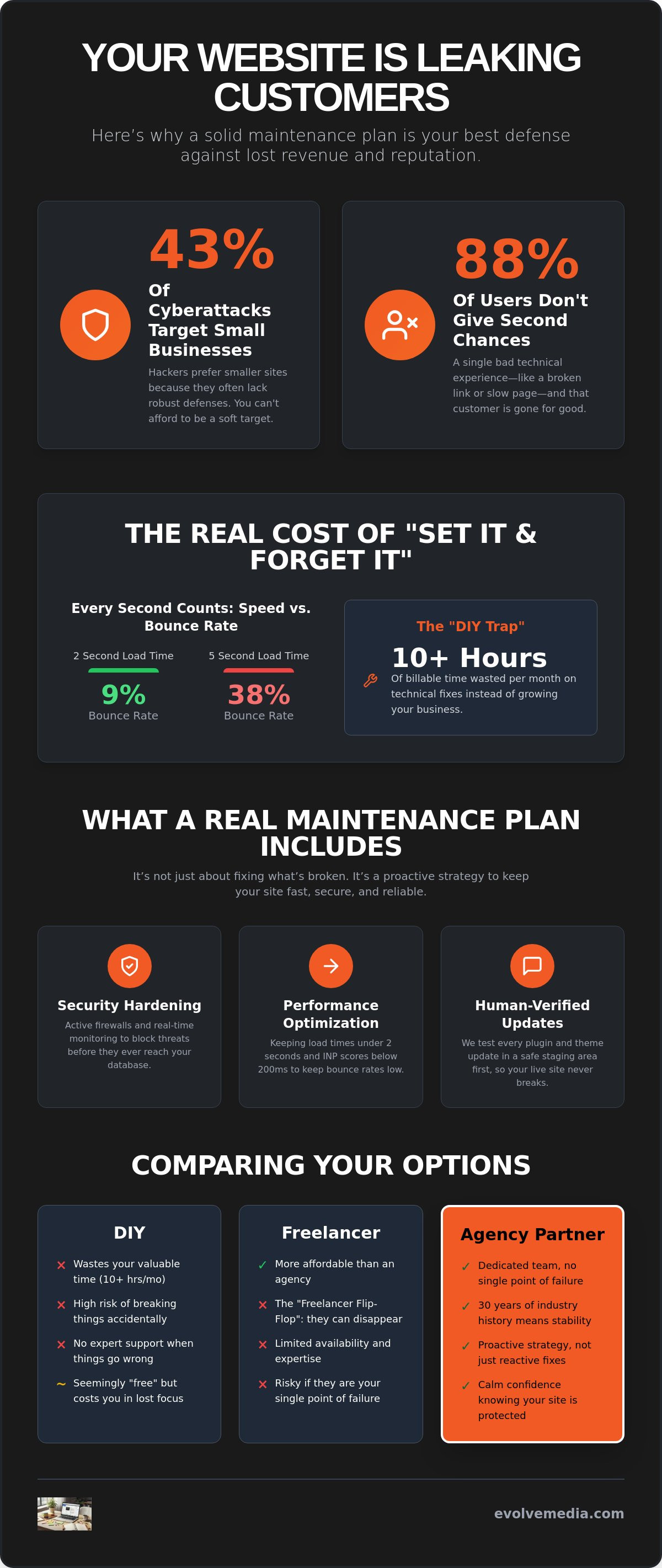
- Neglecting your site is often more expensive than keeping it healthy. Discover why 88% of users won’t give your business a second chance after a single technical glitch.
- Speed and security aren’t just perks; they’re essentials. Learn how to keep load times under two seconds to slash bounce rates and protect your data from the 43% of cyberattacks aimed at small firms.
- Stop wasting 10 hours of billable time every month on the “DIY trap.” Finding a reliable website maintenance plan for small business lets you focus on your actual work while experts handle the technical heavy lifting.
- Avoid the “Freelancer Flip-Flop” where your support disappears when things get messy. See how a partner with 30 years of industry history provides a level of calm confidence that one-man shops can’t match.
- Align your maintenance with your bigger goals. We’ll explain how to sync your tech updates with your ecommerce development strategy to ensure your site stays fast as you scale.
Why Your Small Business Website Needs a Maintenance Plan (and Not Just a Prayer)
Imagine walking past a storefront with a cracked window, flickering lights, and a thick layer of dust on the display. You probably wouldn’t go inside. Your website works exactly the same way. If your links are broken or your images don’t load, you’re effectively hanging a “closed” sign on your digital front door. Research shows that 88% of online consumers won’t return to a site after a poor technical experience. That isn’t just a missed click; it’s a permanent loss of a customer.
We’ve been navigating the digital space since 1996, and we’ve seen how the “set it and forget it” mentality leads to disaster. A professional website maintenance plan for small business shifts the strategy from reactive fixing to proactive protection. This involves understanding the various types of software maintenance, like preventive and perfective care, which keep your code clean and your server happy. Choosing a proactive website maintenance plan for small business means you’re investing in stability rather than just paying for a digital insurance policy.
The Real Cost of Setting and Forgetting
Plugins are useful tools, but they aren’t a shield against a core server crash. When a conflict occurs between an outdated theme and a new security patch, your site can go dark in seconds. Every minute your website remains offline is a minute where your revenue stream is completely frozen.
Beyond the immediate cash loss, search engines are unforgiving. Websites that load in 2 seconds have a 9% bounce rate, but that jumps to 38% if you hit the 5-second mark. If Google tries to crawl your site and finds a 500 error or a sluggish response, your hard-earned rankings can drop faster than a lead balloon. Regular upkeep ensures your site stays fast and visible.
Security Beyond the Green Padlock
Many owners think an SSL certificate is a suit of armor. In reality, that green padlock only encrypts data in transit. It doesn’t stop a bot from brute-forcing your login or injecting malware into your database. Since 43% of cyberattacks target small businesses, you can’t afford to be a soft target. Hackers actually prefer smaller sites because they often lack robust defenses. Building a digital moat around your customer data requires constant monitoring and real-time updates to ensure your business stays a fortress rather than a target.
The Core Pillars of a Professional Maintenance Package
A solid website maintenance plan for small business doesn’t just keep the lights on. It actively polishes your digital presence so you don’t lose that 88% of customers who flee after a bad technical experience. While some vendors treat maintenance as a simple checklist, we view it as a high-performance tune-up for your most valuable employee: your website. Following FTC cybersecurity guidelines provides a necessary foundation, but a professional package goes much deeper.
- Security Hardening: We deploy active firewalls and real-time monitoring to catch threats before they reach your database.
- Performance Optimization: Our goal is keeping your load times under the 2-second mark to keep bounce rates low.
- Database Cleanup: We strip away the digital “junk” like old post revisions and expired transients that sluggishly bloat your site.
- Content and Link Audits: Nothing kills a sale faster than a 404 error on a “Buy Now” button; we find and fix those dead ends.
- Custom Logic Support: If you have custom ecommerce workflows or online applications, we ensure the code stays stable as web standards evolve.
Updates: Automated vs. Human-Verified
Automated updates are a gamble. Clicking that “auto-update” button on a major plugin can instantly break your layout or crash your checkout page. We’ve been doing this since 1996, so we know that “new” isn’t always “compatible.” Our team uses staging environments for every change. This “white-glove” approach means we test every update in a safe sandbox before it ever touches your live traffic. If you’re tired of crossing your fingers during every update, reach out to our team to see how we handle the heavy lifting.
Backups: Your Digital Insurance Policy
Server backups are a start, but they aren’t enough. If your hosting environment fails, your backup fails with it. We prioritize off-site backups stored in separate, secure locations. Frequency is also vital. For a standard site, daily might work, but ecommerce stores often need hourly snapshots to protect transaction data. We don’t just store these files; we run “Recovery Tests” to ensure that if a crisis hits, your data actually restores correctly in minutes, not days.
Comparing Your Options: DIY vs. Freelancers vs. Agencies
Choosing how to manage your site is a major fork in the road for your company. You can try to do it yourself, hire a solo freelancer, or partner with a full-service agency. Each path has a different price tag, but the hidden costs often matter more than the monthly fee. A website maintenance plan for small business should be a bridge to your 2026 revenue goals, not a weight that holds you back.
The True Cost of Doing It Yourself
The DIY trap is a common pitfall. You might think you’re saving money, but you’re actually burning through 10 hours of billable time every month troubleshooting CSS or chasing down broken links. That’s time you could spend closing deals or improving your products. Before you worry about deep maintenance, ensure you have the essential pages every small business website needs properly structured. Trying to maintain a site without a solid foundation is like painting a house with a crumbling base. Plus, your Small Business SEO Services will inevitably suffer when technical debt piles up from unoptimized updates.
- The Anxiety Factor: Every time you click “update,” you’re risking a site crash without a safety net.
- The Time Drain: Troubleshooting a single plugin conflict can eat up an entire afternoon.
- The Skill Gap: Most owners aren’t trained to spot the subtle security gaps that hackers love.
Choosing an Agency for Strategic Growth
Freelancers are often talented, but they’re only human. If they get sick or take a vacation, your support disappears. An agency provides collective expertise and 24/7 reliability. We’ve been in this space since 1996, providing a brain trust of developers, designers, and marketers who know your business logic. This moves the relationship from a simple “vendor” to a strategic partner who cares about your long-term success. Managed hosting through an agency also provides a stable foundation for high-performance apps that a standard shared server just can’t match.
Ready to stop playing tech support and get back to running your business? Talk to us about a maintenance plan that actually protects your bottom line.
Finding the Perfect Partner for Your Website’s Future
Choosing a partner is the most critical decision in this process. You aren’t just buying a list of technical updates. You’re hiring a team to protect your digital reputation while you focus on scaling your operations. A website maintenance plan for small business should feel like a relief, not another item on your to-do list. We’ve been doing this since 1996. That means we’ve survived every major tech bubble and shift in the last three decades. This kind of institutional knowledge provides a level of calm confidence you won’t find in a startup that launched last Tuesday.
Your maintenance shouldn’t live in a vacuum. It needs to align with your ecommerce development strategy. If you’re planning a big seasonal sale or launching a new product line, your maintenance team needs to know. They can then stress-test your checkout flow and ensure your server resources are ready for the surge. We focus on clear, human-readable reporting that shows you the actual value of your plan. You don’t need a list of technical jargon that makes your eyes glaze over; you need to know your site is fast, secure, and making money.
Questions to Ask Before Signing the Dotted Line
Don’t get dazzled by a low price tag without digging into the details. Ask these specific questions to see if a provider is truly ready to handle your business:
- Do you use a staging site for updates? If they update your live site directly, they’re playing Russian roulette with your revenue.
- What happens if my site goes down at 2 AM on a Saturday? You need to know exactly who to call and how fast they’ll respond.
- How do you handle custom code and third-party integrations? Standard “one-size-fits-all” plans often break custom features. Ensure they have the expertise to manage your specific logic.
The Evolve Media Difference: Partnership over Projects
We operate with a “curious partner” philosophy. This means we care about your “why” just as much as the “how.” We want to know your business goals so we can suggest technical improvements that actually help you grow. We bridge the gap between 1996 reliability and 2026 innovation, giving you a stable foundation to build your future. Getting started is simple and direct. There is no corporate fluff or endless meetings here. We’re just a reliable team ready to protect your bottom line. Reach out to us today to start the conversation.
Building Your Digital Legacy with Confidence
Your website is much more than a collection of files; it’s the 24/7 engine of your brand. We’ve been partnering with businesses since 1996, navigating every major tech shift with a focus on long-term stability rather than quick fixes. It’s clear that a professional website maintenance plan for small business is a strategic asset that protects your bottom line and your sanity.
From our deep expertise in custom online applications to our comprehensive managed hosting solutions, we provide the technical authority you need to stay competitive in 2026. You’ve worked hard to build your business. You shouldn’t have to spend your weekends troubleshooting plugin conflicts or worrying about security gaps. We’re here to handle the heavy lifting so you can focus on your next big milestone.
Let’s talk about protecting your digital investment. We’re excited to hear about your goals and show you how a reliable partner makes all the difference. Your future growth starts with a site that just works.
Frequently Asked Questions
What is included in a standard website maintenance plan?
A standard plan covers the technical essentials that keep your site functional and safe from external threats. This usually includes monthly updates to your core CMS and plugins, regular security monitoring to catch malware, and off-site backups that live in a separate, secure location. We also focus on performance checks to ensure your speed doesn’t slip as you add new content or features.
How much does a website maintenance plan for small business cost?
The cost of a website maintenance plan for small business varies based on whether you choose an automated “set-and-forget” service or a full-service agency partnership. Factors like the complexity of your ecommerce logic, the number of custom integrations, and the frequency of your backups all influence the final rate. While automated options are cheaper, they often lack the human oversight needed to prevent site-breaking update conflicts.
Do I really need a maintenance plan if my site is small?
Yes, because even the smallest sites are targets for automated bots looking for easy entry points. Small business owners often face much higher costs for emergency repairs after a hack than they would for a year of preventive care. It’s about protecting your digital reputation before a “site down” notification happens and ruins your morning.
What is the difference between web hosting and website maintenance?
Web hosting provides the server space where your site lives, while maintenance is the active care of the software itself. Think of hosting as the plot of land you rent and maintenance as the gardener and security team that keeps the property pristine. You need both to ensure your business stays accessible, fast, and professional.
How often should website maintenance be performed?
Most essential tasks like security scans and backups should happen daily, while software updates are typically managed on a monthly cycle. We recommend a deeper structural review or accessibility audit every quarter. This steady rhythm ensures your site stays compliant with 2026 performance standards, such as maintaining an Interaction to Next Paint (INP) score under 200 milliseconds.
Can I cancel my website maintenance plan at any time?
Most professional agencies offer month-to-month agreements because they want to earn your business through results rather than a restrictive contract. While you can usually cancel at any time, we suggest viewing your website maintenance plan for small business as a long-term partnership. Stable growth requires a reliable foundation that doesn’t disappear when your billing cycle ends.