
Why does your monthly invoice look like a collection of random numbers and tech jargon that requires a degree in computer science to decode? It’s a common frustration for store owners who just want to know what they’re paying for. If you’ve ever felt the sting of a hidden fee for a simple plugin update, you know that understanding your ecommerce website maintenance cost is about more than just numbers; it’s about trust.
We’ve been building and maintaining digital platforms since 1996, and we’ve seen how easily maintenance can become a black box of opaque charges. You likely want to stop holding your breath during high-traffic sales, hoping the site doesn’t buckle under the pressure. This guide provides an honest breakdown of what it really takes to keep your store fast and ready to capture a slice of the $7.4 trillion global ecommerce market projected for 2026.
We’ll explore the real-world expenses of managed hosting, security compliance, and why custom code beats bloated third-party tools every time. You’ll walk away with a clear budget for the year and the technical peace of mind to focus on your actual business goals.
This focus on business goals is essential; insights from Big Drop Inc on the evolving role of digital platforms highlight how websites must serve as proactive engines for growth.
Key Takeaways
- Think of maintenance as digital health insurance that protects your server performance and security patches before a high-traffic crash occurs.
- Define your 2026 ecommerce website maintenance cost by weighing the hidden risks of DIY fixes against the long-term value of a professional team.
- Move beyond basic “rent” by choosing managed hosting, which serves as the high-speed foundation for a store that actually converts visitors into buyers.
- Set a realistic budget by earmarking 10 to 20 percent of your initial site investment for annual updates and database optimization.
- Prioritize custom code over bloated plugins to keep your site lean, secure, and free from the opaque fees often found in agency invoices.
What Does Ecommerce Website Maintenance Actually Cover?
Maintenance is the digital health insurance for your online store. You don’t buy insurance because you expect a crash today; you buy it so a single server hiccup doesn’t bankrupt your business tomorrow. By 2026, the standard for a healthy site has shifted significantly. It’s no longer enough to just “stay online.” You have to stay fast, stay secure, and stay compatible with an ever-changing web of browser updates and third-party API shifts.
When calculating your ecommerce website maintenance cost, you’re really paying for proactive defense. This includes security patches, server performance monitoring, and database optimization. If you’re still just clicking “update” on a dashboard and hoping for the best, you’re playing a dangerous game with your revenue. One bad plugin conflict can take down your cart, and by the time you notice, you’ve lost thousands in sales.
Security and Technical Stability
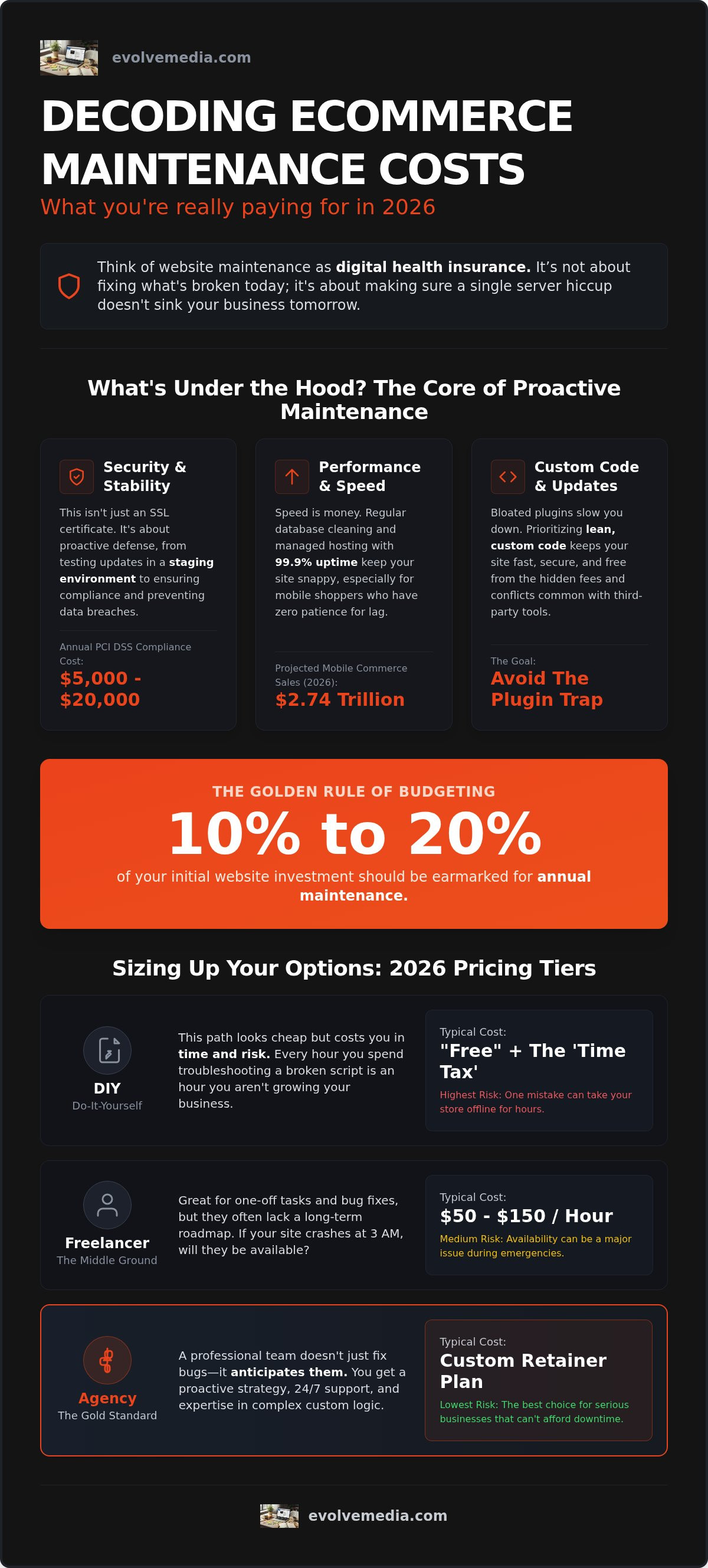
Imagine a security patch that fixes a vulnerability but accidentally breaks your checkout flow. Customers see a spinning wheel, get frustrated, and leave. This is why professional maintenance involves testing updates in a “staging” environment first. Modern E-commerce security goes far beyond a basic SSL certificate. You’re looking at quarterly vulnerability scans and ensuring your backups actually work when you need them. For a small organization, staying PCI DSS compliant can cost between $5,000 and $20,000 annually. Having a partner who understands these requirements prevents expensive fines and keeps your customer data locked down.
Performance and Speed Optimization
Speed is money. In a world where mobile commerce is expected to account for $2.74 trillion in sales by the end of 2026, a slow site is a dead site. Regular database “cleaning” removes the digital clutter that slows down your search function and product filters. This keeps the experience snappy for the 2.86 billion online shoppers worldwide who have zero patience for lag. Managed hosting plays a massive role here, providing the 99.9% uptime and server resources needed to handle traffic spikes without a sweat. It’s about ensuring your ecommerce website maintenance cost translates directly into a faster, more profitable store that outpaces your competition.
2026 Pricing Tiers: From DIY to Professional Agency
Choosing how to manage your store is a trade-off between your time and your bank account. In 2026, the ecommerce website maintenance cost you pay is directly tied to the level of risk you’re willing to stomach. DIY maintenance looks cheap on paper, but you’re essentially paying with your own billable hours. If you spend five hours troubleshooting a broken checkout script, that’s five hours you aren’t growing your business. It’s a “time tax” that many founders realize is too expensive once they hit a certain scale.
Freelancers are a popular middle ground. They usually charge between $50 and $150 per hour for website maintenance. They’re great for “one and done” tasks, like fixing a CSS bug or adding a new banner. However, they often lack a long-term roadmap. If your site crashes at 3 AM on a holiday weekend, a solo freelancer might not be checking their email. For businesses that can’t afford a single minute of downtime, a professional agency is the gold standard. A custom ecommerce development plan doesn’t just fix bugs; it anticipates them before they hit your bottom line.
The Hidden Cost of “Cheap” Maintenance
Those $50 a month “unlimited” plans are enticing. But when a real crisis hits, you’ll find out why they’re so cheap. These services often rely on a “plugin trap” where they stack free tools to solve problems. This bloat slows your site to a crawl. Forbes notes that infrastructure and security are among the most overlooked e-commerce business costs, yet they’re the first thing to fail under pressure. Tweak your strategy by moving from reactive firefighting to proactive health checks. This keeps your site lean and fast.
Custom Logic and Business Automation
Modern maintenance involves more than just core updates. It’s about keeping your CRM, inventory syncs, and custom online applications running in perfect harmony. Maintaining custom logic requires a deeper understanding of how your specific business operates. Our team, founded in 1996, focuses on this long-term stability. We don’t just patch templates; we manage the complex logic that keeps your orders flowing. If you’re tired of opaque invoices, let’s talk about a maintenance plan that actually makes sense for your scale.
Hosting and Security: The Non-Negotiables
Think of hosting as the foundation of your entire digital building. If the foundation is shaky, it doesn’t matter how beautiful your storefront looks. Many owners view hosting as a simple utility bill, like rent for a small corner of the internet. In reality, your choice of server environment is the single biggest factor in your site’s speed and reliability. When you calculate your ecommerce website maintenance cost, you have to decide if you want a bargain-bin solution or a high-performance engine.
Shared hosting is often a recipe for disaster for transactional stores. You’re sharing server resources with hundreds of other websites. If one of those sites gets a massive traffic spike or becomes a target for a bot attack, your store slows to a crawl or crashes entirely. Managed hosting provides a “walled garden” that isolates your resources and prioritizes uptime. This isn’t just about convenience; it’s about revenue. Google’s algorithms prioritize sites that load quickly, meaning your hosting choice directly impacts your SEO rankings in 2026.
Managed Hosting for High-Growth Stores
High-growth stores need infrastructure that can breathe. If you run a flash sale or get featured on a major social channel, you need automatic scaling. This technology allows your server to pull in extra resources instantly so the site doesn’t buckle under the pressure. We focus on 24/7 server monitoring because a crash at midnight shouldn’t wait until business hours to be fixed. It’s about buying back your time and removing the stress of wondering if the site is still up.
Security Audits and Compliance
Security isn’t a one-time setup; it’s a constant cycle of audits. You need to implement essential security measures like web application firewalls and regular vulnerability scans to stay ahead of increasingly clever bot attacks. Staying PCI compliant is also non-negotiable to avoid the massive fines that card brands can levy. To keep a pulse on how these technical factors affect your visibility, you might need an SEO marketing agency to monitor your site’s health and search performance. If you want a hosting environment that actually supports your growth, reach out to our team today.
How to Budget for Your 2026 Ecommerce Success
Stop looking at your monthly maintenance invoice as a bill you have to pay. Instead, start seeing it as an investment in your store’s ability to actually make money. If your site is down or slow, your ecommerce website maintenance cost is effectively zero, but your lost revenue is infinite. A healthy, proactive budget ensures that your digital storefront is always ready for the 2.86 billion online shoppers active this year—a standard upheld by high-growth brands like Evabiotic to maintain customer trust.
A smart strategy is to allocate 10 to 20 percent of your initial build cost for annual maintenance. This covers the essential updates, security patches, and the technical debt that naturally accumulates as your business grows. You want a partner who offers transparency, not hidden fees or vague line items that look like they were generated by a robot. A long-term partnership with a team that understands your specific business logic is always more valuable than a one-off transactional vendor who doesn’t know your goals.
Vetting Your Maintenance Partner
Don’t settle for a vendor who just checks boxes. Ask for a track record. How long has the agency been in business? We’ve been focused on custom web development and managed hosting since 1996, so we’ve seen every trend come and go. You need a team that understands your specific business logic and goals. Check for a focus on tangible results rather than just “keeping the lights on.” If they aren’t talking about your conversion rates, they aren’t the right partner.
Your Next Steps
Audit your current site today. Is it working as hard as you are to close sales? If you’re seeing slow load times or frequent errors, it’s time to phase in your upgrades. You don’t have to overhaul everything in a single week. Start with the critical security and performance fixes first. If you want a straight-talking quote on your ecommerce website maintenance cost and a partner who cares about your bottom line, contact our team to get started.
Build a Store That Scales With You
Your online store should be a reliable engine for growth, not a source of constant technical anxiety. By shifting your perspective and treating your ecommerce website maintenance cost as a strategic investment rather than a painful expense, you protect your revenue from the traffic spikes and security threats of 2026. We’ve established that managed hosting and custom code are your best defenses against the digital bloat that kills conversion rates. These aren’t just technical choices; they are the pillars of a profitable business.
We’ve been helping businesses navigate these technical waters as reliable digital partners since 1996. As custom application experts, we focus on performance and long-term stability without the corporate fluff that usually fills up an agency invoice. You deserve a partner who values your business logic as much as you do and stays curious about your specific goals. Let’s stop the reactive firefighting and start building for the future.
Ready for a store that never slows down? Let’s talk about your maintenance roadmap.
Take the first step toward technical peace of mind today. Your store is ready to work as hard as you do.
Frequently Asked Questions
Is $500 a month too much for ecommerce maintenance in 2026?
No, $500 is actually right in the sweet spot for professional, mid-market support. While smaller stores might pay less, high-volume sites need the proactive monitoring that this price point provides. It covers the technical expertise required to prevent a massive loss during a holiday sale. If your monthly revenue is growing, this investment is what keeps your ecommerce website maintenance cost from becoming a liability.
Can I handle my own ecommerce updates to save money?
You can certainly click “update” yourself, but you’re paying with your own time and taking a massive risk. In 2026, a single plugin conflict can break your entire checkout flow in seconds. Professional teams test these updates in a staging environment first to ensure nothing breaks. Unless you have the technical background to fix a database error at 2 AM, the DIY route often ends up costing more in emergency repairs.
Does website maintenance include SEO and content updates?
Usually, these are distinct services. Maintenance focuses on the “under the hood” health like security patches and server speed; SEO and content are about what people see on the page. However, technical SEO, like fixing broken links or improving load times, is often a core part of a good maintenance plan. It’s best to ask your partner if they include metadata tweaks or if that requires a separate marketing engagement.
What is the difference between web hosting and website maintenance?
Think of hosting as the land your digital building sits on and maintenance as the property management team that keeps the roof from leaking. Hosting is the physical or virtual server space where your files live. Maintenance is the active work of updating software, cleaning databases, and monitoring for security threats. You need both to stay profitable, but they serve very different roles in your business infrastructure.
How often should I perform a full security audit on my store?
You should aim for a deep security audit at least once every quarter. While automated tools scan for basic vulnerabilities daily, a manual check can find logic flaws that bots might miss. With global ecommerce sales projected to hit $7.4 trillion in 2026, stores are bigger targets than ever. Regular audits keep you ahead of evolving threats and ensure your PCI compliance remains rock solid.
Will my ecommerce site still work if I stop paying for maintenance?
Yes, your site will stay online, but it will slowly start to decay. Security vulnerabilities will go unpatched, and outdated plugins will eventually clash with new browser versions. It’s like never changing the oil in your car; it runs fine today, but you’re inviting a catastrophic engine failure down the road. Consistent maintenance prevents this slow slide into technical obsolescence and keeps your store fast for your shoppers.