
Your website isn’t just a digital business card; it’s a full-time employee that should be earning its keep. If you find yourself making excuses for your layout or apologizing to clients for a clunky mobile experience, you’re already seeing the signs you need a website redesign. We’ve seen it happen to the best businesses. You grow, your industry shifts, and suddenly your online presence feels like a suit that’s two sizes too small.
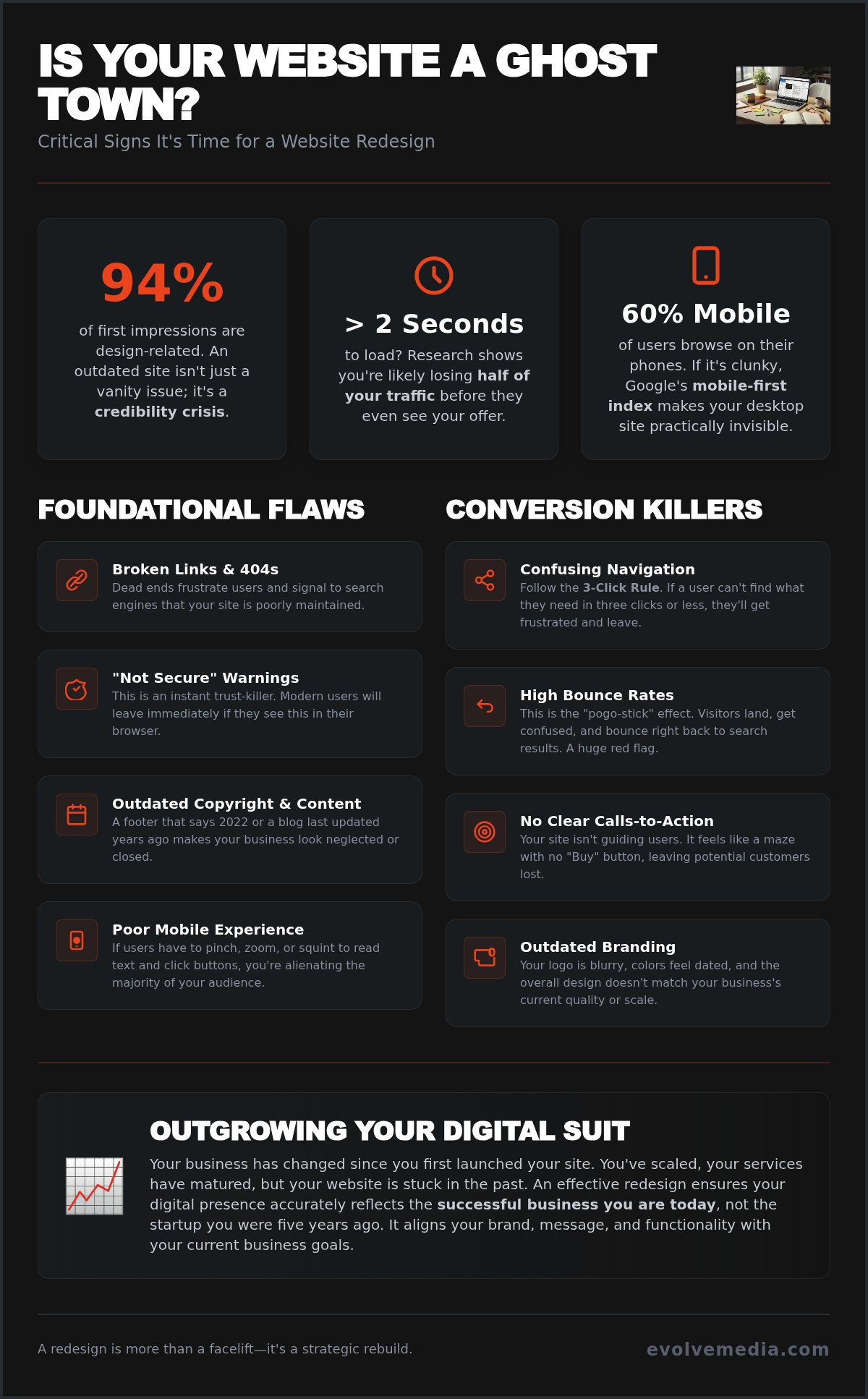
It’s easy to ignore subtle friction, but those small frustrations usually point to deeper strategy gaps that are costing you leads. With 94% of first impressions being design-related, an aging site isn’t just a vanity issue; it’s a credibility crisis. We’ll help you identify the critical performance and design flaws that are quietly draining your budget. We’re breaking down 12 specific red flags, from mobile usability headaches to the technical issues Google hates, so you can turn your site back into a lead-generating machine.
Key Takeaways
- Stop losing half your traffic to slow load times. If your site takes longer than two seconds to load, it’s time for a structural overhaul rather than a simple font swap.
- Spot the signs you need a website redesign by checking if your navigation feels like a maze that keeps customers away from your “Buy” button.
- Move beyond generic templates that you’ve outgrown. Your digital branding needs to match your business’s current maturity and scale.
- Use a data audit to see exactly where users are dropping off. This helps you build a roadmap based on real business goals like booking calls or automating tasks.
When Your Site Feels More Like a Relic Than a Resource
Think of your website as the engine of your business. If it’s sputtering every time a customer tries to load a page, it doesn’t matter how nice the paint job looks. A website redesign is a bottom-up rebuild of site architecture and UX. It is a total structural overhaul. Many people confuse this with a simple “refresh,” which is really just changing colors and fonts. If you find yourself constantly making excuses for why the site looks dated, those are clear signs you need a website redesign.
Security is another massive red flag. If a visitor sees a “Not Secure” warning in their browser, they’ll leave before they even see your offer. These warnings are instant trust killers for new visitors. They suggest your business isn’t keeping up with modern standards. We’ve been building custom sites since 1996, and we’ve seen how quickly a lack of maintenance can turn a professional site into a liability.
- Broken links that lead to 404 error pages.
- Outdated copyright dates in the footer (it shouldn’t say 2022).
- Flash elements or old plugins that no longer load in modern browsers.
- Blurry logos or low-resolution images that look terrible on high-def screens.
The Mobile-First Reality Check
Grab an iPhone and an Android and load your homepage right now. If it’s hard to click buttons or you have to squint to read the text, you’ve got a problem. Mobile-first is no longer a trend; it is the only way Google sees your business in 2026. Google now uses mobile-first indexing for 100% of new sites. This means your desktop site is practically invisible to search engines if the mobile version isn’t up to par. We often find that oversized images are the main culprit, slowing down the experience for the 60% of users who browse on their phones.
Speed and the 2-Second Rule
Speed is the heartbeat of user experience. If your site takes longer than 2 seconds to load, research shows you’re likely losing half your traffic. This leads to “pogo-sticking,” where users bounce back to search results immediately. Modern users won’t wait. Even a tiny 100ms delay can drop your conversion rates by 7%, according to Akamai data. Understanding the full Web development process helps you see that speed isn’t just about one setting; it’s about how the front-end and back-end work together. Don’t just guess how fast you are. Use tools like PageSpeed Insights to get a real score. If you’re unhappy with the results, it might be time to contact us for a performance check.
The Silent Lead Killer: Why Visitors Aren’t Converting
If your phone isn’t ringing and your inbox feels like a ghost town, your website layout is likely the culprit. It’s frustrating to spend money on ads or SEO only to watch visitors leave without taking action. High bounce rates on your key landing pages are loud signs you need a website redesign. They tell you there’s a massive mismatch between what your customers are looking for and what your current design is delivering.
Confusing navigation acts like a digital maze that keeps people away from the “Buy” button. According to this comprehensive website redesign guide from Forbes, setting clear goals for your content strategy is the only way to fix these conversion leaks. You need to know exactly what you want a visitor to do the moment they land on your page.
Navigation and the Three-Click Rule
Users should find what they need in three clicks or less. If they can’t, they leave. Complex menus with dozens of options cause choice paralysis. Your visitors get overwhelmed and simply shut down. You should simplify your header to focus on the top three actions you want people to take right now. Don’t hide your most valuable information behind five layers of sub-menus.
The Problem with “Ghost Town” Content
A blog that hasn’t been updated since 2022 tells customers you aren’t paying attention. It makes your business look closed or neglected to a first-time visitor. Outdated pricing or services lead to awkward sales calls and quickly destroy trust. You need to refresh your messaging to reflect who your business is today, not who it was five years ago.
We believe in growth that lasts. You can look at our about us page to see how we’ve evolved since 1996 to stay relevant in a fast-moving industry. If your messaging is stuck in the past, your conversion rates will be too. If you’re seeing these red flags, it might be time to start a conversation about how to turn your site back into a high-performance tool.
Outgrowing Your Digital Suit: Branding and Strategy Alignment
Your business has likely changed since you first launched your site. If you’re still using a “startup” style site but you’re now a mature player, you have a problem. One of the major signs you need a website redesign is when your digital presence doesn’t match your actual revenue or scale. It’s like wearing a suit that’s two sizes too small; it’s uncomfortable, and everyone notices.
If you’re embarrassed to send a link to a high-value prospect, it’s time for a change. You can’t afford to let competitors with modern sites win the trust battle before you even get a chance to speak. A site that looks dated suggests your services might be dated too. We’ve seen this happen to companies that have grown significantly but left their web presence in the past, losing potential leads to faster, sleeker rivals.
Aligning Design with Business Logic
A redesign is the perfect time to think about how your site can actually save you time. Custom online applications can automate tasks that your current site handles manually, like booking appointments or managing customer support tickets. Your website should work with your CRM and marketing tools, not against them. It’s also the best opportunity to integrate custom ecommerce development to streamline your sales funnel. Why settle for a generic template when your business logic is unique?
The Trust Factor and Visual Authority
First impressions are formed in just 50 milliseconds. That’s faster than the blink of an eye. In that tiny window, design is the primary driver of your credibility. Stock photos from 2010 and clunky fonts scream “outdated” to modern consumers. According to this ultimate guide to website redesign, consistency across your branding is non-negotiable. If your social media looks fresh but your site looks like a relic, you’re confusing your audience.
Reviewing the work of modern creative studios like jadore-design.preview.emergentagent.com can provide valuable inspiration for achieving the visual authority and brand consistency necessary to maintain credibility today.
- Visual Consistency: Your fonts and colors should be identical across all platforms.
- Modern Imagery: Swap out generic stock photos for high-quality, authentic shots of your team and work.
- Clear Messaging: Ensure your value proposition is the first thing people see without scrolling.
Your website should be a propellant for growth, not a weight holding you back. If your current site feels like a relic, get in touch with our team to discuss a strategy that actually fits your business today.
Building for 2026: The Strategic Redesign Roadmap
Once you’ve identified the signs you need a website redesign, you need a plan that goes beyond picking a new template. You can’t just throw a fresh coat of paint on a crumbling foundation. Start by auditing your current data to see exactly where users are dropping off. If your analytics show a 70% bounce rate on your primary services page, that’s a specific problem you need to solve with better UX. Next, define your 2026 business goals. Are you trying to sell products directly, book more discovery calls, or build authority in a crowded market? Your design should follow your function.
Launching the site is only the beginning. You need to test and refine based on real user behavior. Run a 3-day A/B test on your new headlines or call-to-action buttons to see what actually resonates with your audience. This data-driven approach ensures your site stays effective long after the initial launch excitement fades.
Choosing the Right Partner
Look for an agency with a long-standing history, not just a flashy portfolio of pretty pictures. You need a team that understands how to balance aesthetic appeal with a deep seo marketing agency strategy. Ask them specifically how they plan to maintain your current search rankings during a structural move. A good partner will challenge your ideas to ensure the final product actually works for your customers. We’ve been in this industry since 1996, and we know that a pretty site that doesn’t rank is just an expensive digital brochure.
Focusing on Long-Term Stability
Managed hosting is the insurance policy for your website’s performance and uptime. It’s not just about keeping the lights on; it’s about speed and security. Regular updates and security patches prevent your new site from becoming a relic by this time next year. A website redesign is an investment in your company’s future growth, and it requires a stable environment to thrive.
- Audit current data: Find the friction points in your current funnel.
- Define clear goals: Know exactly what success looks like before you start.
- Prioritize hosting: Don’t skimp on the infrastructure that keeps your site fast.
- Test and refine: Use real user feedback to make continuous improvements.
Don’t let your digital presence stall while your competitors move forward. If you’re ready to fix the gaps in your strategy, contact our team to discuss how we can modernize your digital presence and turn your site back into a high-performance asset.
Don’t Let an Outdated Site Stall Your Growth
Your website shouldn’t be a source of frustration or something you have to apologize for in sales meetings. If you’ve spotted the signs you need a website redesign, from sluggish load times to a layout that no longer matches your professional scale, it’s time to act. Ignoring these red flags doesn’t just hurt your brand’s pride; it actively drains your ROI by driving high-value leads straight into the arms of your competitors.
We’ve spent 30 years building custom solutions that go far beyond generic templates. Since 1996, our team has focused on solving complex business logic problems and creating high-conversion strategies that actually move the needle for our partners. We don’t just build sites that look good; we create strategic tools designed for long-term stability and measurable success.
Ready to turn your website into a growth engine? Let’s talk. We’re here to help you navigate the technical shifts of 2026 and build a platform that works as hard as you do. Let’s get started on your next chapter today.
Frequently Asked Questions
How often should a business redesign its website?
Most businesses need a full redesign every two to three years to stay competitive. Technology moves fast, and user expectations shift even faster. If your site was built in 2022, it’s likely missing modern accessibility standards or mobile optimizations. Waiting longer usually means you’re fighting an uphill battle against competitors who are updating their digital tools more frequently to stay relevant.
Will a website redesign hurt my SEO rankings?
A redesign won’t hurt your rankings if you have a solid migration plan in place. In fact, fixing slow load times and broken links are major signs you need a website redesign to actually boost your visibility. By preserving your URL structure and setting up proper 301 redirects, you protect your authority while gaining the technical benefits of a faster, more secure platform that Google prefers.
What is the difference between a website refresh and a redesign?
A refresh is like a fresh coat of paint and new curtains; it’s purely cosmetic. You might change your fonts, update some photos, or tweak the color palette to look more modern. A redesign is a total teardown and rebuild. It changes the underlying site architecture, the user experience, and the business logic to ensure your site actually hits your current performance goals.
How long does a typical professional website redesign take?
Timelines depend on the complexity of your business logic and the number of pages. A small site with about ten pages usually takes three to five weeks. Medium projects often span six to eight weeks. If you’re building a large ecommerce platform or a site with over 50 pages and custom features, expect a timeline of 10 to 16 weeks to ensure everything is tested.
How much does a website redesign cost in 2026?
Costs vary based on the scale of your project and the custom features you require to run your business. A professional redesign typically covers custom design, mobile responsiveness, and SEO fundamentals. Larger enterprise projects involve deeper integrations with CRMs and complex backend development. Investing in quality early prevents the high cost of lost conversions and security breaches down the road.
Can I redesign my website myself using a builder?
You can use a DIY builder, but it often leads to generic results that can’t handle complex business needs. These tools are fine for hobbyists, but they usually struggle with speed, custom logic, and long-term scalability. If you’re noticing signs you need a website redesign for a growing brand, you need the technical depth that comes from professional development, such as the services provided by Radhey Info Tech LLC, rather than a one-size-fits-all template.