
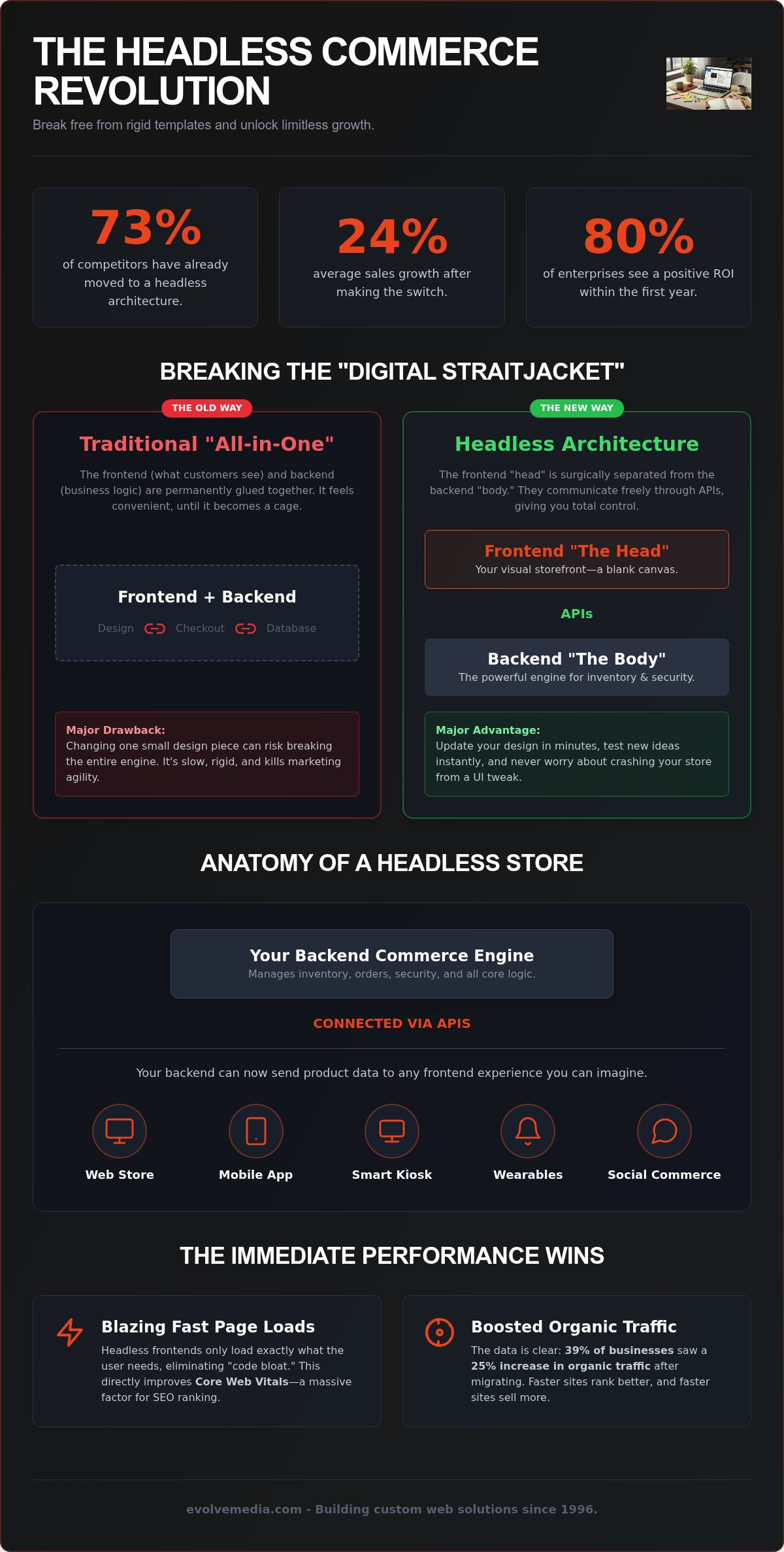
About 73% of your competitors have already moved to a headless architecture, and they’re seeing an average sales growth of 24% because of it. It’s a significant shift in how we think about digital storefronts. When you prioritize headless ecommerce development, you’re not just updating your tech; you’re joining the 80% of enterprises that see a positive ROI within their first year of switching.
We know the frustration of fighting a rigid platform that refuses to let you customize your checkout or fix a sluggish mobile experience. You want to move fast, but your current setup feels like it’s anchored in the past. Having been in this industry since 1996, we’ve seen that the most successful brands are those that refuse to be boxed in by templates. It’s time to stop letting your backend dictate how your brand looks and feels.
This article will show you how decoupling your store’s frontend can ignite your marketing agility and future-proof your digital growth. You’ll discover how to gain total creative freedom over your UI and achieve the faster page loads that modern shoppers demand. We are going to explore the exact steps to turn your store into a high-performance engine that finally converts at its full potential.
Key Takeaways
- Break free from the digital straitjacket of monolithic platforms to regain total control over your UI and checkout flow.
- Discover how headless ecommerce development can boost your organic traffic by hitting the strict Core Web Vitals targets that search engines demand.
- Use our readiness checklist to see if your current growth justifies the move, based on your budget, timeline, and technical needs.
- See how we use our experience from the early days of the web to handle the complex backend logic, so you can focus on brand strategy.
Why traditional ecommerce platforms feel like a digital straitjacket
Most online stores begin their journey on “all-in-one” platforms because they’re convenient. You get a theme, a checkout, and a database in one pre-packaged box. It works well until it doesn’t. As your brand grows, that convenience starts to feel like a cage. This is what developers call the “monolithic” problem. Your frontend (what customers see) and your backend (your business logic) are permanently glued together. If you try to change a tiny piece of the design, you risk breaking the entire engine.
This is precisely why headless ecommerce development has become the go-to strategy for brands that want to scale without limits. By adopting a Headless commerce architecture, you’re effectively performing a surgery that separates the “head” (your user interface) from the “body” (your data and commerce logic). It stops being an “all-or-nothing” system and starts being a flexible ecosystem that moves at your speed.
The limit of the ‘all-in-one’ approach
Themes and templates eventually become a ceiling for high-growth brands. When you want to run a specific A/B test on your product page or add a unique interactive feature, rigid platforms often block you. You end up stacking third-party apps to get things done. These apps bloat your code and kill your site speed. We’ve been building custom online applications since 1996; we know that every extra second a page takes to load directly eats your profit margins. A template shouldn’t dictate your conversion rate.
What actually changes when you go headless?
When you commit to headless ecommerce development, your backend transforms into a silent, powerful engine. It handles inventory and security in the background while your frontend becomes a blank canvas. You can build a custom experience for any screen, from a mobile phone to a smart kiosk, without touching your core commerce logic. APIs act as the bridge that lets them talk to each other. This means you can update your design in minutes, test new marketing ideas instantly, and never worry about your store crashing because of a simple UI tweak.
The anatomy of a headless store (without the headache)
Think of your store as a collection of specialized tools rather than one giant, clunky machine. In headless ecommerce development, everything connects via APIs. These are just digital handshakes that let your product data travel anywhere you want it to go. Want to sell on a smart mirror in a physical fitting room? Or maybe a custom kiosk at a pop-up event? APIs make that possible without forcing you to rebuild your entire catalog from scratch.
Speed is the most immediate win for your bottom line. Traditional stores often struggle with “code bloat” because they try to load every single backend feature at once. Headless changes that. Because the frontend is separate, it only loads exactly what the user needs to see. Data shows that 39% of ecommerce businesses saw a 25% increase in organic traffic after migrating, simply because their Core Web Vitals improved. Faster sites rank better, and faster sites sell more.
The tech stack: picking your ‘head’
When we handle headless ecommerce development, we aren’t stuck with a platform’s default editor anymore. We often use frameworks like React, Vue, or Next.js to build a clean, custom-built user interface that feels as fast as a native app. This is where Progressive Web Apps (PWAs) shine. They turn your store into a mobile powerhouse that can even work offline. It is all about removing the friction between a customer’s desire and their purchase.
Headless vs. Traditional: A quick side-by-side
Traditional platforms are great for day one, but they’re “out-of-the-box” for a reason; you’re eventually stuck inside that box. Headless lets you pick “best-of-breed” tools for every job. If you want a specific AI search tool or a unique loyalty program, you just plug it in. While the initial build requires more strategic thought, the long-term flexibility is unmatched. You can swap out your marketing tools or your hosting provider without tearing down the whole site. If you’re curious about how these pieces would fit your specific business goals, you can chat with our development team to map out a plan.
Deciding if your brand is ready for the headless leap
Moving to a headless setup isn’t a quick weekend project. It is a strategic shift that requires a clear look at your current roadblocks. If your marketing team is constantly hearing “no” from the tech department because the platform won’t allow a specific layout or feature, you’ve likely hit the ceiling of what your monolithic store can do. About 98% of businesses not yet using this architecture plan to evaluate it within the next 12 months, but that doesn’t mean you should rush in without a plan.
Success in headless ecommerce development depends on your specific goals. If you are a content-heavy brand that relies on high-quality video, interactive storytelling, or a massive blog, a Headless CMS will be your best friend. It allows you to manage your brand’s story in one place and push it out to your store, your mobile app, and even your social channels simultaneously. You stop managing a platform and start curating an experience.
Is your current site holding back your marketing?
The “Can we build this?” test is the simplest way to check your readiness. When you want to launch a 3-day A/B test on a new checkout flow or add a unique product configurator, how much friction do you hit? Often, ecommerce development shouldn’t just be about the “buy” button. It should be about building custom online applications that solve real customer problems. If your current theme makes every change feel like pulling teeth, it is time to move on.
Preparing your team for the shift
You don’t need a massive in-house engineering team to make this work, but you do need the right partner. Since 1996, we’ve helped brands navigate these technical transitions by focusing on the logic that actually drives sales. We handle the heavy lifting of managed hosting and backend stability so your team can focus on what they do best: growing the brand. It is about building a long-term partnership where the technology supports your vision rather than limiting it. If you’re ready to see how this fits your specific roadmap, you can reach out to our team for a strategy session.
For brands that aren’t ready for a full overhaul, a hybrid approach is often the best middle ground. You can keep your existing backend for order management while building a headless frontend to fix those sluggish page speeds. This lets you see the 42% average increase in conversion rates that many brands report after migrating, without the risk of a total “rip and replace” project.
How we turn complex headless architecture into your secret weapon
Headless architecture might sound like the latest tech trend, but for us, it is the natural evolution of a journey we started in 1996. We’ve watched the web change for three decades, and we know that while tools evolve, the need for reliability stays the same. When you partner with us for headless ecommerce development, you aren’t just hiring developers. You are gaining a strategic partner who has been building custom online applications since the early days of the internet.
Our process starts with curiosity rather than a sales pitch. We want to understand your specific business goals before we ever talk about code. Are you aiming for the 24% average sales growth that brands see after switching to headless? Or is your priority joining the 80% of enterprises that report a positive ROI within their first 12 months? We focus on the logic that makes those numbers happen, balancing technical authority with a collaborative warmth that keeps you in the loop at every stage.
Building for the long haul
A high-performance store needs a foundation that won’t crumble under the weight of your growth. We focus on building scalable ecommerce platforms that allow you to swap out marketing tools or add new sales channels without a total rebuild. This requires a professional web designer who knows how to integrate your branding into the very architecture of the site. It isn’t just about a pretty frontend; it is about ensuring your brand identity is baked into the code so your user experience stays consistent on every screen.
- Strategic Discovery: We map out your data flow and customer journey before writing a single line of code.
- Custom Development: We build the APIs and frontends that give you total creative freedom.
- Managed Hosting: We provide the stable environment your store needs to handle traffic spikes during major sales.
Your next steps toward total digital freedom
Don’t just build another store that you’ll outgrow in two years. Build a propellant for your brand’s long-term success. We believe that technology should serve your vision, not limit it. The first step is a conversation about your roadmap and the specific bottlenecks holding you back today. You can contact Evolve Media for a strategic audit of your current platform. Let’s find out if headless ecommerce development is the right move to unlock your next level of growth and finally give your marketing team the agility they deserve.
Stop Fighting Your Platform and Start Growing Your Brand
The web moves fast, but your store shouldn’t feel like it’s dragging an anchor. We’ve explored how separating your frontend from your backend can fix those sluggish load times and give you the total creative control you’ve been missing. Headless ecommerce development is the path toward a store that finally works for your marketing team instead of against them.
Since we started back in 1996, we’ve focused on being more than just a vendor. We’re a long-term strategic partner for brands across the country. Our deep enterprise experience and comprehensive managed hosting ensure that your store stays stable while you focus on scaling. You don’t need to worry about technical hurdles when you have a team that’s been navigating these shifts for three decades.
Ready to build a store without limits? Let’s chat about your project.
Your brand deserves a digital experience that keeps pace with your ambition. Let’s get to work on your next phase of growth.
Frequently Asked Questions
Is headless ecommerce more expensive than traditional platforms?
The initial build usually requires a larger investment because you are building a custom frontend from scratch instead of using a pre-made theme. However, you should look at the long-term ROI. Industry reports from July 2026 show that 80% of enterprises see a positive return within their first year. You are trading a lower upfront price for a store that actually converts at a higher rate and doesn’t need a total rebuild every two years.
Do I need a huge developer team to manage a headless store?
You don’t need a massive in-house team if you have a strategic partner to handle the heavy lifting. We take care of the complex backend logic and managed hosting, which lets your team focus on marketing and brand growth. Many of our clients find they actually spend less time fighting their platform and more time running their business once the “straitjacket” of a monolithic system is gone.
How does headless commerce improve my site’s SEO?
Headless commerce boosts your rankings by drastically improving your Core Web Vitals, specifically your page load speed. Research shows that 39% of ecommerce businesses saw a 25% increase in organic traffic after migrating to a headless setup. Because the frontend only loads the exact code needed for that specific page, search engines reward the lightning-fast experience with much better visibility.
Can I keep my current backend and just go headless on the frontend?
Yes, you can absolutely keep a backend like Shopify or BigCommerce while moving to a custom frontend. This hybrid approach is very popular because it lets you keep your familiar order management dashboard while gaining total creative freedom over the UI. It is a smart way to get the benefits of headless ecommerce development without the risk of a total “rip and replace” project for your entire operations team.
What happens to my existing apps and integrations if I switch?
Most modern tools connect via APIs, so your essential integrations will usually move right along with you. In fact, you will likely find that you can ditch many clunky “plug-and-play” apps that were previously slowing down your site. By using direct API connections, your headless ecommerce development stays lean and fast. We help you audit your current stack to ensure everything from your ERP to your loyalty program talks to the new frontend perfectly.
How long does a typical headless ecommerce development project take?
A professional headless build typically takes between three and six months depending on the complexity of your custom features. We avoid the “launch in 5 days” promises because those often lead to unstable sites and frustrated customers. Having been in the industry since 1996, we know that a thorough discovery phase and rigorous testing are what ensure your store stays stable during your biggest sales events.