
Have you ever noticed how a technical glitch always seems to happen at 2:00 AM on your biggest sales day of the year? It’s usually right then that you realize your website maintenance cost isn’t just a boring line item. It’s actually the price of sleeping through the night without a panic attack. Most business owners treat their site like a toaster, expecting it to work forever without a tune-up, until a PHP update breaks the checkout page or an SSL certificate expires without warning.
It’s exhausting to feel like you’re being nickel-and-dimed for technical jargon you don’t fully understand. You want a site that stays fast as you scale, not a pile of surprise bills for emergency patches. We’ve been managing digital growth since 1996, so we’ve seen every tech cycle and “mandatory” update the internet has thrown at us since the days of dial-up.
We’re going to strip away the fluff and give you a straight-up breakdown of what you should actually pay in 2026 to keep your site fast, secure, and profitable. We’ll look at the real numbers behind hosting, security, and developer support so you can stop guessing and start growing.
Key Takeaways
- Identify the “Fixed Three” expenses, including domain, hosting, and SSL, so you never get blindsided by renewal fees again.
- We’ll break down the true website maintenance cost for different business scales, from lean portfolios to high-traffic ecommerce hubs.
- Avoid the “DIY Trap” where a small technical tweak turns into a midnight server crisis that costs triple the price of a pro fix.
- Learn how to audit your current tech stack to slash unnecessary fees and bundle your hosting with managed security for total peace of mind.
- Discover why a proactive strategy beats reactive patching, ensuring your site stays fast and profitable as your business grows.
What Actually Goes Into Website Maintenance?
Website maintenance is the proactive prevention of digital decay. It is not just about making sure your URL still points to a homepage; it is about ensuring your 2026 digital infrastructure doesn’t crumble under the weight of outdated code or security vulnerabilities. Many business owners underestimate their total website maintenance cost because they only look at the visible bills, ignoring the behind-the-scenes labor that keeps a site fast. Effective website monitoring acts as your early warning system, catching performance dips or server errors before they turn into lost revenue.
The Fixed Essentials: Domains and Hosting
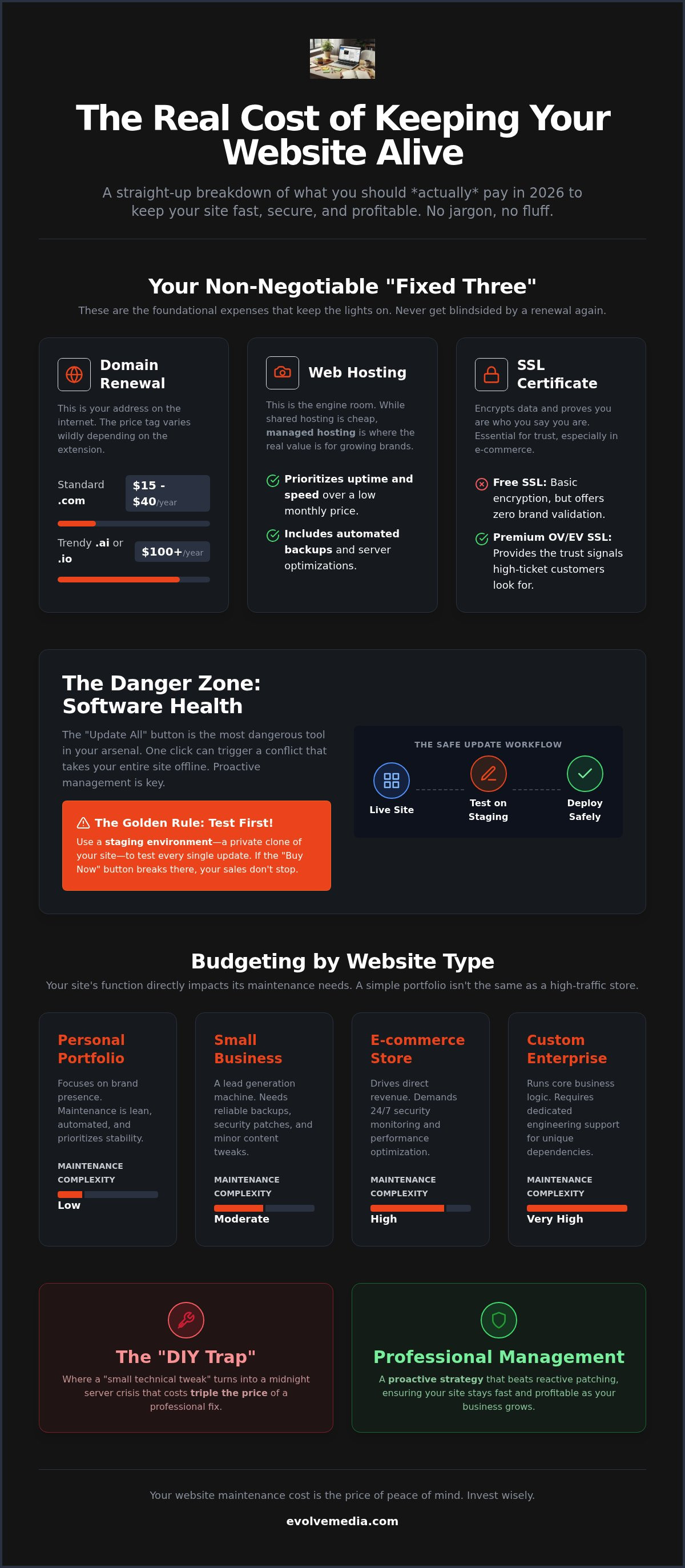
Every site has non-negotiable overhead that keeps your brand’s lights on. Domain renewals are the most basic expense, but the price tag varies wildly depending on your TLD. A standard .com might renew at roughly $22.99 per year, while a trendy .ai extension can easily set you back $100 or more annually. Then there is the hosting debate. While shared hosting is cheap, managed hosting is where the real value lives for growing brands. It includes automated backups and server-level optimizations that save you from massive technical headaches. For ecommerce, don’t just settle for a free SSL certificate. While they encrypt data, Organization Validation (OV) certificates provide the trust signals high-ticket customers look for before they feel safe entering credit card details.
Software Health: CMS and Plugin Management
This is where maintenance gets tricky. The “Update All” button in a WordPress or Shopify dashboard is actually the most dangerous tool in your arsenal. One click can trigger a conflict between a new PHP version and an old plugin, taking your entire site offline in seconds. Custom online applications require an even more delicate touch, as they often have unique dependencies that off-the-shelf patches cannot handle. We always recommend using a staging environment. This is a private clone of your site where you test every update first. If the “Buy Now” button breaks there, nobody sees it but the developers. If it breaks on your live site, your sales stop instantly. Keeping these moving parts in sync is a core part of your website maintenance cost, but it is much cheaper than an emergency repair at 3:00 AM.
- Domain Renewals: Expect $15 to $40 for .com; higher for specialty TLDs.
- Managed Hosting: Prioritizes uptime and speed over a low monthly price.
- Staging Environments: Essential for testing updates before they hit your live traffic.
Budgeting for Growth: Maintenance Costs by Website Type
Your total website maintenance cost depends heavily on what your site actually does for your business. A simple portfolio that sits quietly in a corner of the internet requires a completely different level of investment than a high-traffic store processing thousands of transactions. To get a realistic sense of current industry benchmarks, the Forbes 2026 website cost guide offers a helpful starting point for general market ranges. However, the real price of upkeep is often hidden in the complexity of your site’s specific features and goals.
| Website Category | Primary Focus | Typical Support Level | Maintenance Complexity |
|---|---|---|---|
| Personal Portfolio | Brand Presence | Lean & Automated | Low |
| Small Business | Lead Generation | Managed Services | Moderate |
| Ecommerce Store | Direct Revenue | 24/7 Security Monitoring | High |
| Custom Enterprise | Business Logic | Dedicated Engineering | Very High |
Small Business and Professional Portfolios
For most professional service providers, the website is a lead generation machine that must stay secure and accessible at all times. Maintenance here focuses on reliable backups, security patches, and minor content tweaks that keep your messaging fresh. Investing in professional web design from the start often reduces these long-term costs. Clean code and a logical site structure mean fewer “ghost in the machine” bugs that require expensive developer hours to track down later. It’s about stability, ensuring that when a potential client finds you, the site loads fast and the contact form actually works.
Ecommerce and Custom Enterprise Applications
Once you move into the world of custom ecommerce development, your website maintenance cost shifts from “keeping the lights on” to protecting your revenue stream. These sites require constant database integrity checks and monitoring of third-party payment gateway connections. If an API update breaks your checkout flow, every minute of downtime is a direct hit to your bottom line. Custom enterprise applications also deal with complex business logic that standard plugins can’t handle, requiring a seasoned expert who understands how your specific systems talk to each other. This proactive monitoring ensures your custom logic scales smoothly as your traffic grows. If you’re unsure where your current site fits, reach out for a quick chat about your specific goals.
The DIY Trap vs. Professional Managed Services
It is tempting to think you can manage your site in just a few minutes a week. You see a notification, click “Update,” and assume everything is fine. But the true website maintenance cost isn’t just the price of a subscription; it is the value of the time you lose when something goes wrong. A single $50 per month saving on a professional plan can easily lead to a $5,000 emergency repair bill when an amateur fix crashes your checkout page during a holiday sale.
Cheap freelancers often disappear when the server starts smoking. They might be great for a quick design tweak, but they rarely have the institutional knowledge to handle a full-scale security breach. Reactive maintenance means you only pay when things break, which is the most expensive way to run a business. It’s the difference between a routine oil change and replacing an entire engine.
Why Cheap Maintenance Often Costs More
Ignoring your site creates technical debt that piles up like unpaid credit cards. Every skipped update makes the next one harder and more likely to break your site. You also run the risk of “zombie plugins.” These are tools that haven’t been updated by their creators in years, acting as open doors for malware. Even high-performing managed seo services require a healthy, fast foundation to actually get you found. If your site is bloated with old code, no amount of keyword optimization will save your rankings.
The Value of a Strategic Partner
We have been navigating these digital waters since 1996. This long-standing tenure means we don’t just react to problems; we see them coming before they hit your bottom line. A strategic partner provides human-led security monitoring that automated scripts simply cannot match. This level of care protects your brand authority. A slow or broken site is a silent killer for your reputation, telling potential clients that your business is behind the times. Proactive care ensures your site remains a propellant for growth rather than a liability.
Stop guessing about your site’s health and start building for the long term. Talk to us today about a maintenance plan that actually fits your business goals.
Building Your Maintenance Strategy for 2026
A smart strategy turns your website from a sinking cost into a climbing asset. Instead of waiting for a plugin to crash your checkout page, you should be looking at how your website maintenance cost can actually fund your next big feature. The shift from a “break-fix” mindset to a growth partnership is where the magic happens. We’ve been guiding businesses through these transitions since 1996, helping them move away from frantic midnight repairs toward a predictable 12-month roadmap.
The “Bundle” strategy is your best friend here. By combining your hosting, security, and routine updates into one managed plan, you eliminate the friction of juggling multiple vendors. It also ensures that the person fixing a bug is the same person who knows your server inside and out. This holistic approach doesn’t just save money; it saves your sanity.
Auditing Your Digital Assets
Start by auditing what you actually have. Check your load speeds today; if your site takes more than three seconds to load, your current hosting is likely holding you back. Review your plugin list and delete anything you don’t use. Each unnecessary plugin is a security risk and a drag on performance. Use your routine monthly check-ins to tweak your headline or run a quick test on your CTA. These small, consistent improvements keep your site profitable while your technical team handles the heavy lifting in the background.
Choosing the Right Partner
Choosing the right partner means looking for transparency rather than just a low price tag. In 2026, clear reporting is a non-negotiable requirement for any maintenance contract. You should always ask an agency these three questions before signing:
- How do you handle emergency patches outside of normal business hours?
- Do you test updates in a staging environment before touching my live site?
- What specific metrics do you track to ensure my site stays fast as it scales?
You deserve a partner who is as curious about your business goals as they are about your PHP version. If you are ready to stop worrying about your tech and want to focus on your actual growth, let’s build a strategy that works for the long haul. We’ve seen the internet change a lot over the last few decades, but one thing remains constant: a well-maintained site is a profitable one.
Stop Fixing Your Site and Start Growing Your Business
Managing your website maintenance cost shouldn’t feel like a high-stakes game of whack-a-mole. We’ve covered how the “Fixed Three” of domains, hosting, and SSL certificates form your foundation, while proactive software health prevents the kind of technical debt that kills profit. You now have the roadmap to move away from reactive “break-fix” panic and toward a predictable strategy for 2026.
Since 1996, we’ve acted as a trusted digital partner for brands that want to scale without the technical headaches. Our managed hosting is built specifically for high-performance ecommerce, ensuring your site stays fast even during your busiest sales hours. We focus on custom-built solutions that minimize technical debt from day one, giving you total peace of mind regarding your site security.
Let Evolve Media handle the tech so you can handle the growth. You’ve built something incredible, and it deserves a digital home that is as reliable and ambitious as you are. Your future self will thank you for choosing stability today.
Frequently Asked Questions
How much should I pay for website maintenance per month in 2026?
Industry benchmarks for 2026 suggest that a typical website maintenance cost ranges from $50 to $500 per month depending on your site’s complexity. A lean portfolio site might stay on the lower end of that spectrum, while a high-traffic store with custom integrations requires more intensive care. The goal is to find a budget that covers security, speed, and reliability without paying for features you don’t actually use.
Is it cheaper to maintain a website myself?
Maintaining a site yourself looks cheaper on paper, but it usually ends up costing you more in lost time and emergency repairs. Unless you are a developer, spending four hours trying to fix a CSS bug is four hours you aren’t spending on growing your sales. Professional managed services prevent those “I broke the internet” moments that happen when you click the wrong update button at midnight.
What happens if I stop paying for website maintenance?
If you stop maintenance, your site will slowly degrade until it eventually breaks or gets hacked. Security patches are released constantly to fight new threats, so an unmaintained site is an open invitation for malware. Beyond security, your site will slow down as database junk piles up, eventually hurting your search rankings and frustrating your customers.
Does website maintenance include SEO updates?
Standard maintenance usually focuses on the technical plumbing rather than content creation or keyword research. While it doesn’t always include active SEO updates, it provides the fast, secure foundation that search engines demand. Without regular website maintenance cost investment in technical health, even the best SEO strategy will fail because of slow load times or broken links.
How often should a professional audit my website?
You should have a professional perform a deep-dive audit at least once every six to twelve months. While monthly check-ins handle routine updates, a full audit looks for deeper issues like outdated PHP versions or emerging security threats. This proactive approach keeps your technical debt low and ensures your site is ready for the next tech cycle.
Can I change my maintenance plan as my business grows?
You absolutely can and should adjust your plan as your business scales. A startup needs lean support, but a growing brand might require more frequent backups and specialized ecommerce development as transaction volume increases. We’ve seen many clients start small and expand their support as they move from simple lead generation to complex online applications.